




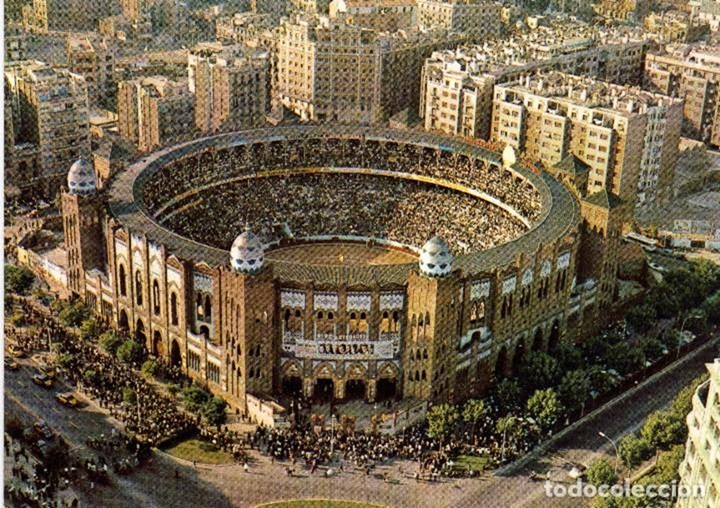
Above: "Plaza de Toros Monumental (Barcelona)", also known as "La Monumental." Kolorham postcard no. 83, circa 1960.
Source: totocoleccion.net.
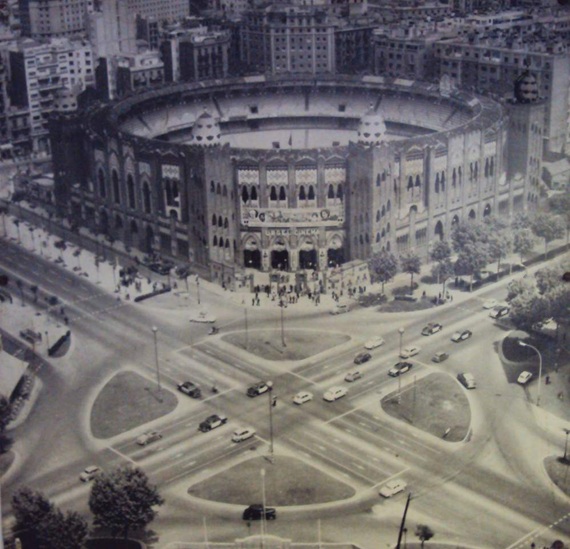
Above: "Old photo in the bullfighting museum," circa 1960. Another photo of La Monumental, showing the intersection where Rachel was greeted by dignitaries.
Source: "La Monumental – Bullring and Bullfighting Museum," via Barcelona Lowdown.
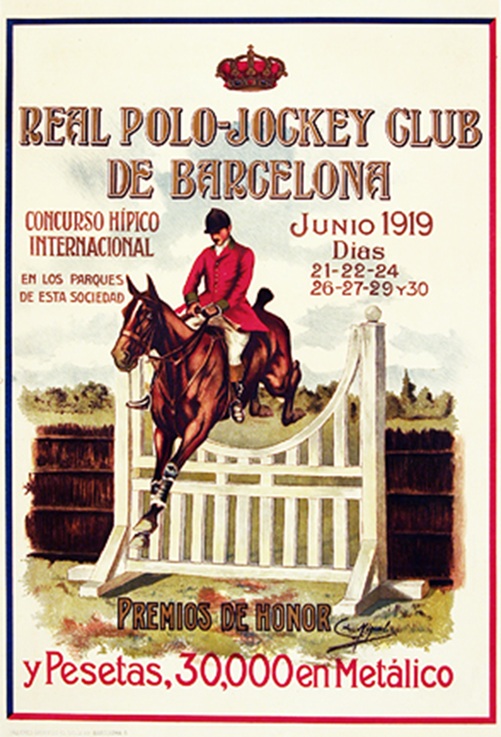
Above: Poster for the Royal Polo-Jockey Club of Barcelona, 1919, by C. de Miguel.
Source: Omnibus Gallery, Aspen Colorado.
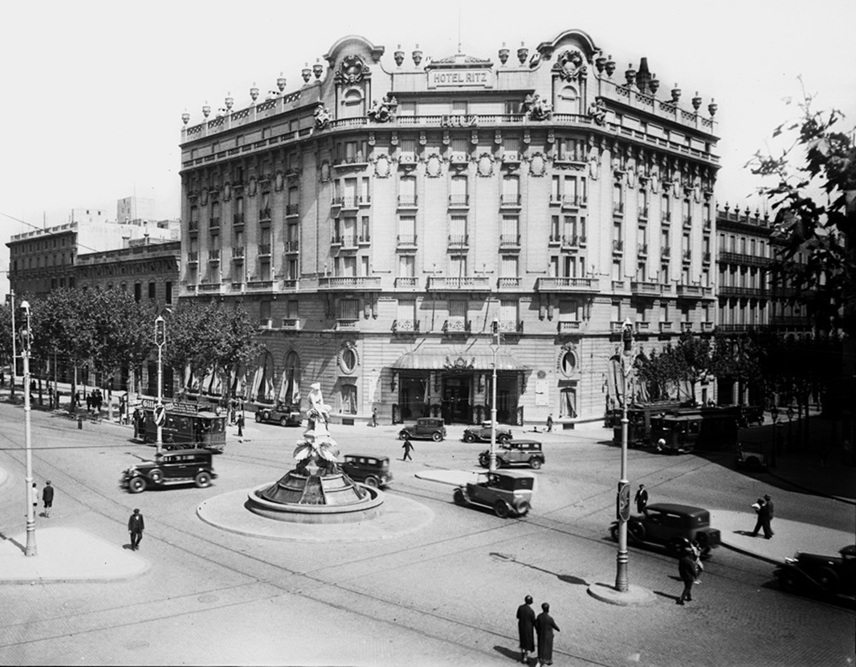
Above: The Ritz Hotel circa 1925 (detail) where Rachel stayed in Barcelona. Still in business as El Palace Barcelona.
Source: "Our heritage: Our past, present and future" via El Palace Barcelona.
11. Barcelona, 1929 (continued)
At ten o'clock on Tuesday morning, September 24, an El Dia Grafica reporter named Francisco Madrid intercepted Rachel on the coastal highway near Arenys de Mar, 44 kilometers from Barcelona. Madrid had hitched a ride with an impatient friend named Merletti who didn't want to waste much time on Rachel.
"Señorita Rachelle D'Orange smiles as she sees Merletti's car and the reporter arrive. She gives the impression that she was expecting the visit, but not so soon.
"We climb onto the hood of Merletti's car to begin our conversation, since he cannot linger on the road. Villasar is waiting for him for lunch, and he needs to arrive in Barcelona at a quarter past four sharp." "We," meaning Francisco, sits on the car hood interviewing Rachel as she rides along while Merletti drives slowly beside her and Va-au-Bout.
Unfortunately, Francisco confined himself to the same banal questions that Rachel had answered countless times before, but he did at least capture a glimpse into the difficulty of handling Va-au-Bout in traffic:
"'He's quite obedient. Especially when we're alone. Cars still scare him. The honking bothers him. And drivers are so inconsiderate that when they approach, instead of slowing down, they speed up! I have to hold him back every moment.'
"The horse, as if he had heard us, pulls away from the reins: 'Hey, you pig, come on!' We continue on our way with the young lady....
"'I congratulate you on your courage.'
"'Thank you. But you should also congratulate my horse.'
"The horse feels the urge to run again. The fender brushes against Señorita D'Orange's knee.
"'You hurt me, you brute!' exclaims Señorita D'Orange. And she continues on her way." A sidebar on Francisco's report describes Rachel's entry into Barcelona:
"At five o'clock sharp yesterday afternoon, Miss D'Orange arrived in Barcelona.
"Waiting for her at the site known as the 'Mataró tollbooth' were the government delegate, Mr. Aspiazu, representing the civil governor of the province; Commander Pelayo, representing the Army and Navy Circle, who presented the gracious rider with an artistic 'corbeille' of flowers, adorned with ribbons in the colors of the Spanish and French flags.
"Also in attendance were representatives from all branches of the cavalry; Security Commander Mr. González, representing the head of the Corps; Commander Bufalá of the Santiago Regiment; Second Lieutenants Calzada and Laguía; Commander Mr. Rivera, representing the Marquis of Foronda; and Mr. Enrique Sostres, representing the Royal Polo-Jockey Club." These dignitaries, or some of them, joined Rachel in a procession that moved on to another Barcelona landmark where she found still another assembly of welcoming officials. According to El Debate:
"At the intersection of Cortes Street and Marina Street, where the monumental square is located, she was greeted by representatives of the authorities and a procession of thirty Spanish horsemen, organized by the Royal Polo Jockey Club.
The "monumental square" is the site of "La Monumental," a huge circular amphitheatre designed as a bullfighting ring with a capacity of over 19,500 people (left). Since the last bullfight there in 2011, it is now a venue for concerts, sporting events and even circuses.
"As soon as the intrepid horsewoman came into view, she was greeted with a very warm ovation. Two horse-drawn carriages from the Sociedad Barcelona-Tours (Barcelona Tours Company) were also waiting for her.
"The representative of the mayor of Barcelona presented Miss Dorange with a beautiful bouquet of flowers. Mademoiselle Raquel, with her very feminine figure and graceful face, thanked everyone present for the kindness they had shown her by coming to welcome her. The procession then proceeded to the Royal Polo and Jockey Club, where Mademoiselle Raquel was offered a luncheon and warm speeches were delivered to welcome her.
"Among others, the Vice-Consul of France spoke. She was presented with numerous bouquets of flowers from the Barcelona garrison, the Barcelona Tours company, the Army and Navy Cultural Center, and other organizations.
"Mademoiselle Raquel said that, after the welcome she received in Berlin, the one in Barcelona was the one that had moved her the most. Shortly afterward, she went to the Ritz Hotel, where she is staying, and there she changed her clothes, putting on a simple and elegant street outfit." Once again Rachel appears as the innocent abroad, floating peacefully over a landscape that was on the verge of explosion.
The Spain that Rachel entered was ruled by a dictator, Miguel Primo de Rivera, who had overthrown the parliamentary government in a military coup in 1923. Though Spain appeared stable and prosperous, a volcano of dissension was growing beneath the surface.
Despite having to survive three attempts to overthrow his regime by force in 1926, Primo de Rivera initially enjoyed a degree of popular support due to improved economic conditions that were aided by public works projects, by a construction boom in Barcelona which drew workers from other parts of Spain, and by preparations for the long-delayed World's Fair.
As well, a savage colonial war with the Berber peoples living in the Rif region of northern Morocco, which had raged for five years, was bought to an end by a massive Spanish military invasion in 1926.
However the U.S. stock market crash of October, 1929 had worldwide repercussions that Spain did not escape. Primo de Rivera's regime depended on the backing of the two most reactionary forces in Spain, the army and wealthy landowners. As the economy began to suffer Primo de Rivera fell out of favour with his backers, causing him to resign in 1930.
The dissension between right and left wing elements boiled over in a bloody civil war from 1936 to 1939, followed by the 36-year-long dictatorship of Francisco Franco.