




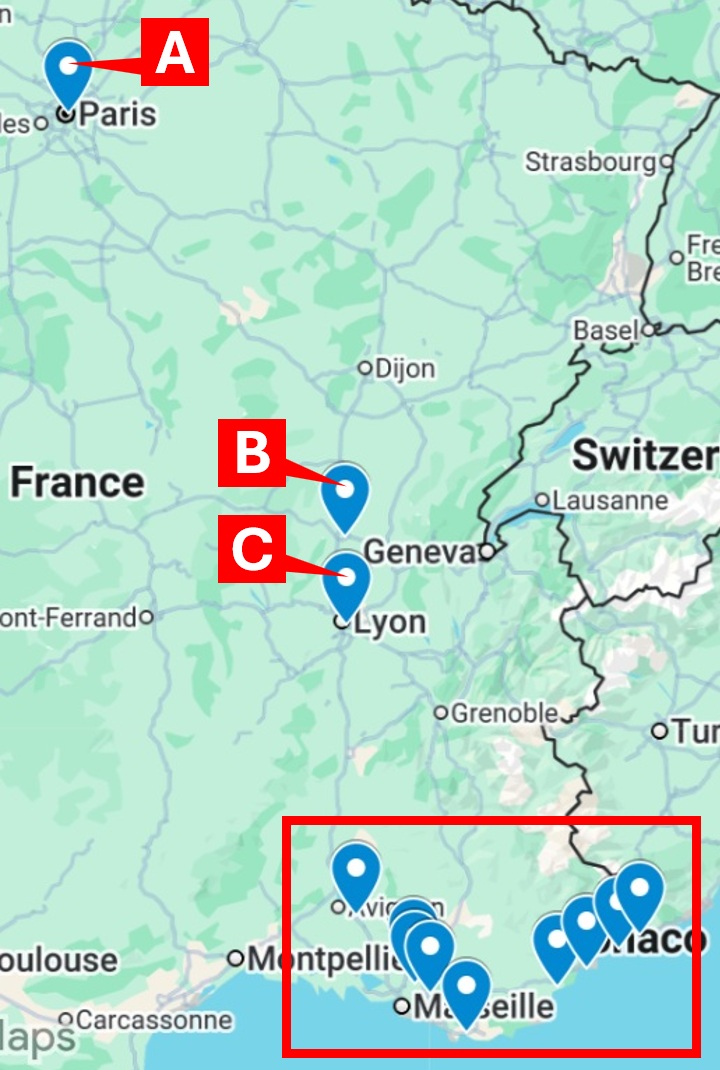
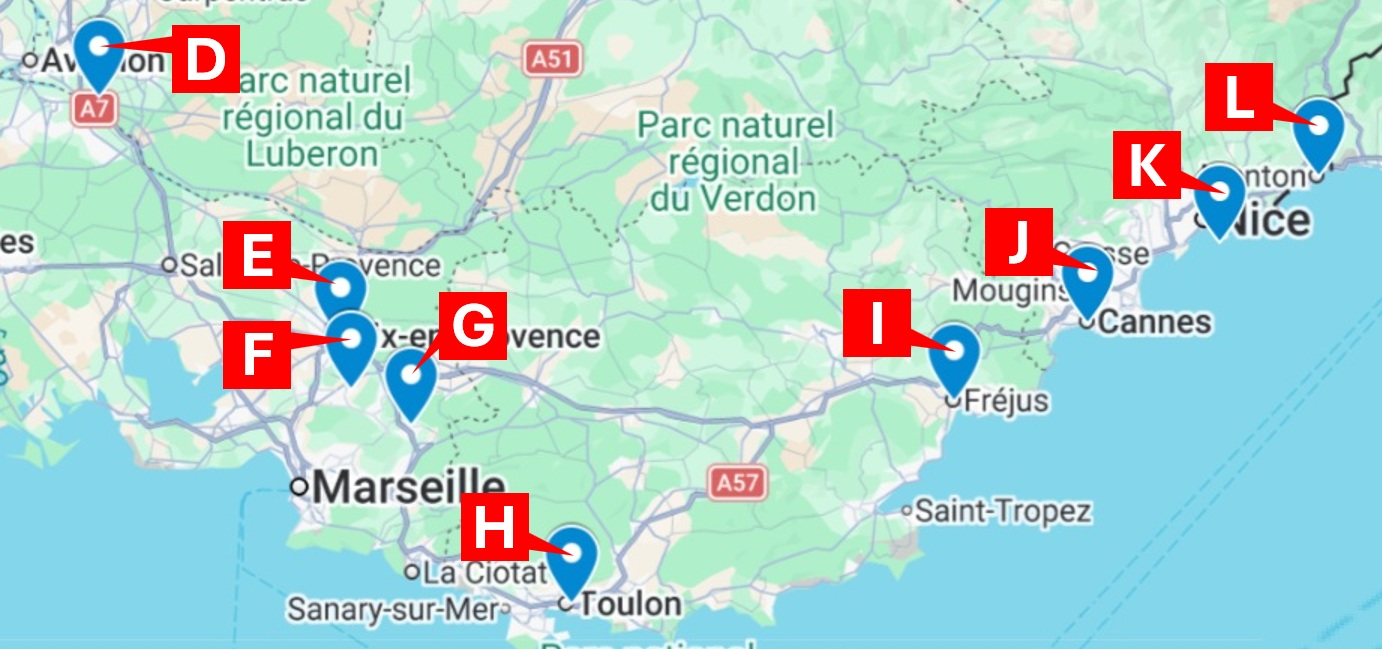
Above: Rachel's Paris-Rome trip. Letters refer to text. The red box is enlarged at right.

Above: Rachel setting off from Place de la Concorde, destination Rome.
Source: Le Petit Journal, "Un raid Paris-Rome Équestre" ("A Paris-Rome horseback ride"), August 6, 1935, p. 1. National Library of France (via Gallica).

Above: Same photo (detail).
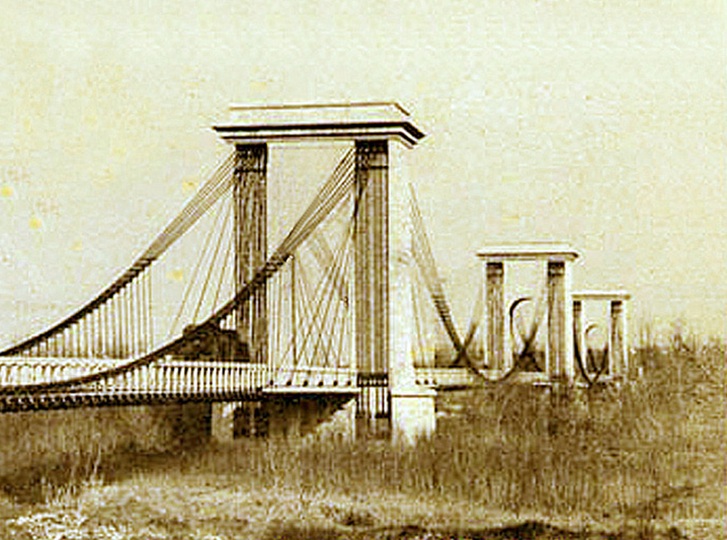
Above: The Bonpas suspension bridge, where Rachel was ticketed (postcard, circa 1900). The bridge was constructed in 1894, destroyed in 1944 by retreating German troops and replaced in 1954.
Source: "Pont de Bonpas" (Wikipedia). See also "Bonpas Suspension Bridge" (Bridgemeister).
15. Paris-Rome, 1935
In June 1934 Rachel served on a panel of Judges at a beauty contest to choose a two of the most beautiful children in Paris for the title of Mr. Paris and a Miss Parisette. The contest was a charity event to raise money for La Tutelaire, a children's protective association, one of several charities that Rachel took part in. The beauty contest winners were a three-year-old boy and a six-year-old girl.
We hear nothing more of Rachel for over a year, until August of 1935 when she left Paris on another long-distance ride, this time to Rome.
(A) Rachel set off from the Place de la Concorde on Tuesday, August 6, 1935 cheered on by several friends. Her horse, a mare, was named La Hupette in memory of Le Huppé.
As usual she paid special attention to how she dressed. A reporter for L'Est Républicain wrote, "I have before me this courageous woman. She is wearing riding breeches, a Lacoste shirt, and boots like a jockey."
The Lacoste shirt shows that Rachel was on the cutting edge of fashion. Tennis champion René Lacoste invented a soft, loose-fitting, short sleeved tennis (or polo) shirt in the 1920s but only began marketing it in 1933. The shirt, which bore a small crocodile (his personal emblem), was quickly adopted by women and Lacoste soon brought out a line of women's sportswear.
(B) Gaps between news reports, delays in publication and the occasional absence of datelines make it hard to follow Rachel's progress precisely. An example is the August 22 Excelsior report of Rachel passing through Mâcon, 398 kilometers south of Paris on a Sunday evening and attending horse races there.
"During Sunday's meeting, the Mâcon crowd was pleasantly surprised to have the opportunity to show their support for Mlle Dorange, the charming horsewoman who is currently undertaking another Paris-Rome endurance ride and who happened to be passing through Mâcon during the races.
"Accompanied by the president and a few committee members to the founders' box, she was able to watch several races before continuing on her way that very evening toward Lyon. And the crowd at the weigh-in and on the lawn, where she had insisted on going, showed their admiration for our valiant compatriot's new and courageous endeavor with warm applause."
Since the report was published on Thursday, August 22 the previous Sunday was August 18. But on that Sunday Rachel was already in Aix-en-Provence, 381 kilometers to the south. So Sunday, August 11 must be the date that she was in Mâcon. Her average daily mileage from Paris over six days would have been 66 kilometers.
The dispatch from Mâcon is therefore our first of the sporadic bulletins charting Rachel's progress after leaving Paris. Nevertheless, the news items that exist testify that, as on her previous rides, she was recognized by local citizens along her route who greeted her as a celebrity.
(C) The Mâcon dispatch says that Rachel left in the direction of Lyon, which is 72 kilometers away. Since it was already evening she would have stopped for the night somewhere between Lyon and Mâcon.
(D) Our next news item finds Rachel about 74 kilometers northwest of Aix-en-Provence, probably on August 15 or 16:
"The gendarme is merciless. Mlle Rachel Dorange, an intrepid horsewoman, continues her journey and, she too, encounters the little annoyances of the road, including the penalty of a traffic ticket.
"Thus, upon arriving at the Bonpas Bridge, which crosses the Durance River not far from Avignon, the traveler encountered a traffic jam, and the gendarme on duty asked her to dismount and hold the horse by the bridle. Mlle Dorange, deeming this unnecessary, did not comply, which earned her a formal citation.
"So it's not just motorists who get ticketed...."
(E) Rachel reached Aix-en-Provence, 774 kilometers southeast of Paris, on Saturday, August 17, having averaged overall 65 kilometers a day. She was treated to lunch by the Club Hippique d'Aix and then reportedly left for Marseille at about 1 p.m. (although in fact she seems to have bypassed Marseille).
(F) Unfortunately La Hupette stumbled over the railway crossing in the hamlet of La Malle, about 15 kilometers south of Aix. Rachel was thrown from the saddle but landed unhurt. Nevertheless she decided to call it a day. She left La Hupette at Gardanne, about 14 kilometers from Aix, and returned to Aix for the night.
Initially Rachel intended to stay two nights in Aix, but the next afternoon, Sunday, August 18 she returned to Gardanne to pick up La Huppette. She left Gardanne about 4 p.m., hoping to reach La Bouilladisse, a further 16 kilometers south, by evening.
While in Aix Rachel acquired some additional baggage in the person of Georges Noel, president of the Club Hippique d'Aix, who decided to accompany her all the way to Rome. Was Rachel happy with his decision, or did she regard him as a mixed blessing like Colonel Păun (page 23)? We don't know.
But although he is only mentioned in one news item, Georges and Rachel were evidently still together when Rachel reached the Italian border because Italian customs officials demanded entry fees for two horses.
(G) Rachel presumably spent the night of Sunday-Monday, August 18-19 in La Bouilladisse. It took Rachel two days to cover the 59 kilometers from La Bouilladisse to Toulon. We do not know where she spent the night of Monday-Tuesday, August 18-19.
(H) (I) Rachel was in Toulon on the night of Tuesday-Wednesday, August 20-21. She left Wednesday morning headed for Fréjus, 91 kllometers away. She presumably spent the night of August 21-22 there.
(J) Rachel arrived in Cannes on the evening of Thursday, August 22 "coming from Saint-Raphael" which is only three kilometers from Fréjus. "The beauty and the beast are both in very fine form." (L'Éclair).
Rachel remarked on the difficulty of finding feed for the horses, complaining "that she couldn't find a single bale of hay to buy between Toulon and Saint-Raphael". (Le Figaro)
Rachel spent the night in Cannes but, uncharacteristically, she did not stay for a huge party planned for Sunday, August 25. "Preparations are underway in Cannes for the nighttime flower parade that will bring together, on Sunday, both all the celebrities currently vacationing on the French Riviera (I swear there are a few) and the entire population of this cheerful piece of coastal Provence." (Paris Soir)
(K) The next leg of her journey was only 33 kilometers, from Cannes to Nice. Rachel arrived in Nice about noon on Friday, August 23 and spent the night there. Rachel "plans to set out again tomorrow for the Italian border, bypassing Monaco, where, as we recall, a few years ago, in a fit of neurasthenia, she attempted suicide, an incident that caused quite a stir at the time. She will pass through Beausoleil." (Excelsior)
(L) Rachel left Nice at about 11 a.m. on Saturday morning for Menton on the French-Italian border, 30 kilometers away. She spent the night of Saturday-Sunday there, preparing to tackle Italian customs the next morning. But things did not go well:
"Rachel Dorange will not be going to Rome. After crossing France from Paris to the French Riviera, Mlle Rachel Dorange arrived this morning at 7:30 a.m. at the Menton-Garavan border crossing to continue her horseback trek to Rome. But it was not to be – at least not this year – that the Eternal City would receive a visit from the intrepid rider.
"Due to customs difficulties (she was asked to pay five thousand francs to bring her two horses into the country), Mlle Rachel Dorange, despite all her pleas, was not authorized to enter Italy. She is being prevented from going to Rome.
"Well, she will leave tomorrow for Paris, from where she will travel to Brussels. To that end, Mlle Rachel Dorange put 'La Hupette' on a train this afternoon at 5 p.m. bound for the capital."
Presumably Georges Noel, like Rachel, was either unable or unwilling to stump up the required entry fee for his horse. If Rachel's announced trip to Brussels came off, there seems to be no record of it.
According to Rachel, a postscript to her foiled trip to Rome was supplied by Benito Mussolini himself. As she told Minerva reporter Maria Jean three years after the fact:
"Back in Paris, she found a telegram from Il Duce ordering that every convenience be provided for her journey.
"She had given up too soon. A day later, she would undoubtedly have found all the customs officers at the border standing at attention."
It's a pity Mussolini didn't send his telegram to the customs officers instead of Rachel.