





Above: Rachel getting assistance with her backpack before she sets off.
Source: Excelsior, "Bloc-notes: La route est belle" ("Notepad: The road is beautiful") February 11, 1938, p. 2. National Library of France (via Gallica).

Above: One of the 22 stamps issued by the French government in support of unemployed intellectuals. Here Marianne (the French counterpart of Uncle Sam) gives a small purse of money to a destitute intellectual who is identified as such by a quill pen, a music stand and an artist's pallet and brushes.
Source: Phil Ouest: Les timbres de France (postage stamps of France).

Above: Rachel and Diane (detail from a photo montage).
Source: L'Impartial, "Mme Rachel Dorange...." March 12, 1938, p. 7. National Library of France (via Gallica).
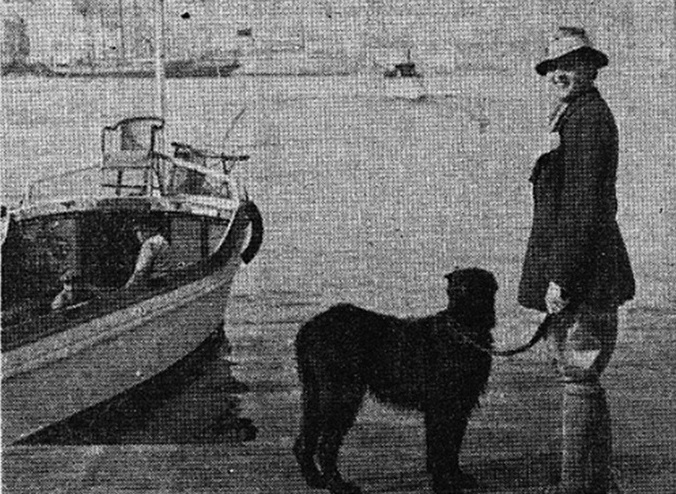
Above: Rachel cooling her feet in the Mediterranian at Marseille (detail).
Source: L'Intransigeant, "L'Écuyère sans monture se 'Promène'" ("The Horsewoman Without a Horse Goes for a Walk"), March 10, 1938, p. 1. National Library of France (via Gallica).
17. Paris-Nice, 1938
On February 10, 1938, Rachel set off from Paris on another long-distance trek, but on foot this time rather than on horseback. Her destination was Nice, 961 kilometers away on the Côte d'Azur, otherwise known as the French Riviera. Rachel's winter departure to the Mediterranian was to become a habit.
Along the way Rachel proposed to sell postcards on behalf unemployed intellectuals (artists, writers and musicians) but this was not a cause that she had dreamed up herself. The French national fondness for intellectuals has deep historic roots and French intellectuals even had their own lobby group, the Confédération des travailleurs intellectuels (Confederation of Intellectual Workers), established in 1920.
The Confederation was influential enouigh to persuade the French government to issue, between 1935 and 1940, a series of 22 postage stamps to be sold with a surcharge in support of unemployed intellectuals. Rachel was simply lending her weight to a charity that was already established.
Rachel's departure from Paris was described by Excelsior:
"'How many days will it take?' That was the question on the minds of the curious onlookers who gathered in droves yesterday morning at Place de la Concorde to witness the start of Mlle Rachel Dorange's journey....
"Wearing a skirt, boots, and a white suede belt, she began her planned walk from Paris to Nice. Leaving behind her faithful horse Le Happé she set off at exactly 10 o'clock, accompanied only by her Flemish sheepdog Diane." "As she strode briskly down Boulevard Saint-Germain toward Porte d'Italie, she took the time to make a brief statement to us.
"'I'm going to sell postcards along the way to benefit the mutual aid society for intellectual workers on Rue Henner.'" "'And how long do you expect it to take?'
"'The more cards I sell, the longer my journey will last.' Rachel Dorange gave us a friendly wave goodbye.
"'The road is beautiful!' she exclaimed." Over the month that Rachel was on the road she was only able to raise about 800 francs (US$160), though as L'Écho d'Oran commented, her postcard sales might not do much to help the unemployed intellectuals "but they will certainly be touched by the gesture."
Despite the "droves" of people who saw her off from Place de la Concorde, newspaper coverage was sparse. The first report places her in Auxerre on February 15, 177 kilometers southeast of Paris. In her six days on the road, therefore, she averaged about 30 kilometers a day. She left Auxerre on February 16 heading for Avallon, 60 kilometers further southeast, which would have taken her two days.
A flurry of publicity erupted from an incident that happened on the second day of her journey, about 48 kilometers from Paris, although this did not hit the newspapers until a month and a half later.
It must have been on February 11 that Rachel and Diane were caught in a sudden downpour near Saint-Fargeau-Ponthierry and stopped to wait it out at a milestone along the road. Here they attracted the attention of a pair of gendarmes who did not recognize Rachel and who knew nothing of her latest expedition.
When Rachel told them that she was walking to Nice the gendarmes assumed that she was joking or lying or insane and arrested her for vagrancy. She spent the night in the local police station or, according to one indignant editorial, was sent "to sleep on the damp straw in the Ponthierry jail."
The threatening daily headlines about Hitler and Mussolini and the spectre of imminent war may have made the gendarmes nervous about spies and saboteurs. In any case Rachel was released the next morning with apologies and went on her way, but not before instructing her lawyer, Théodore Valensi, to lodge a formal complaint for arbitrary arrest.
By the time Rachel was back home in Paris in May, her arrest was enough of a cause celebre for her to draw an audience at the venerable Club du Faubourg which provided a venue for lectures and debates on social and political issues. Rachel's presentation was entitled "Why I'm Suing the Gendarmes!"
Several newspapers published pictures of Rachel and Diane on their journey but the only additional reports about her progress announce her arrival in Marseille on Sunday, March 6:
"Having set out from the capital twenty-four days ago, the daring athlete arrived yesterday at 5:30 p.m. at Place d'Aix. Accompanied by her dog Diane, she will set off again today for Cassis. Mlle Dorange, who is in excellent shape, plans to arrive in Nice on Saturday [March 12], having thus completed her feat in thirty days." (Le Petit Marseillais)
Cassis is 33 kilometers from Marseille, so presumably Rachel spent the night there.
Assuming that Rachel actually arrived in Nice on March 12, it would be another two weeks before the story broke about her arrest for vagrancy in Saint-Fargeau-Ponthierry.
Recalling her Paris-Nice hike for Qui? Detective magazine in 1951, Rachel told of setting off from Paris in her riding boots and getting as far as Avallon before they hurt too much to continue in them. Then "she walked, limping more or less, 650 kilometers from Avallon to Marseille – wearing a pair of espadrilles bought for twelve francs, the toes of which she had cut off to let her own toes stick out."
Espadrilles were originally Basque peasant shoes made of esparto, a tough wiry grass also used to make rope and basketry. The shoes became popular after being adopted by celebrities like Pablo Picasso, Salvadore Dali and John F. Kennedy, though presumably not for long-distance walking.
What Rachel wore from Marseille to Nice is not recorded, but hopefully she found something more comfortable.
"Give a girl the right shoes and she can conquer the world."