





Above: Occupation zones of France during the Second World War - English version, September, 2008 (detail).
Source: Eric Gaba (Sting - fr:Sting) for original blank map; Rama for zones (via Wikimedia Commons).


Above: Rachel cleaning a cab window before leaving the stable.
Source: Paris Soir, "Image d'à présent: Une écuyère devient cocher de fiacre" ("Image of the present: An equestrian becomes a cab driver"), January 31, 1941, p. 1. National Library of France (via Gallica).
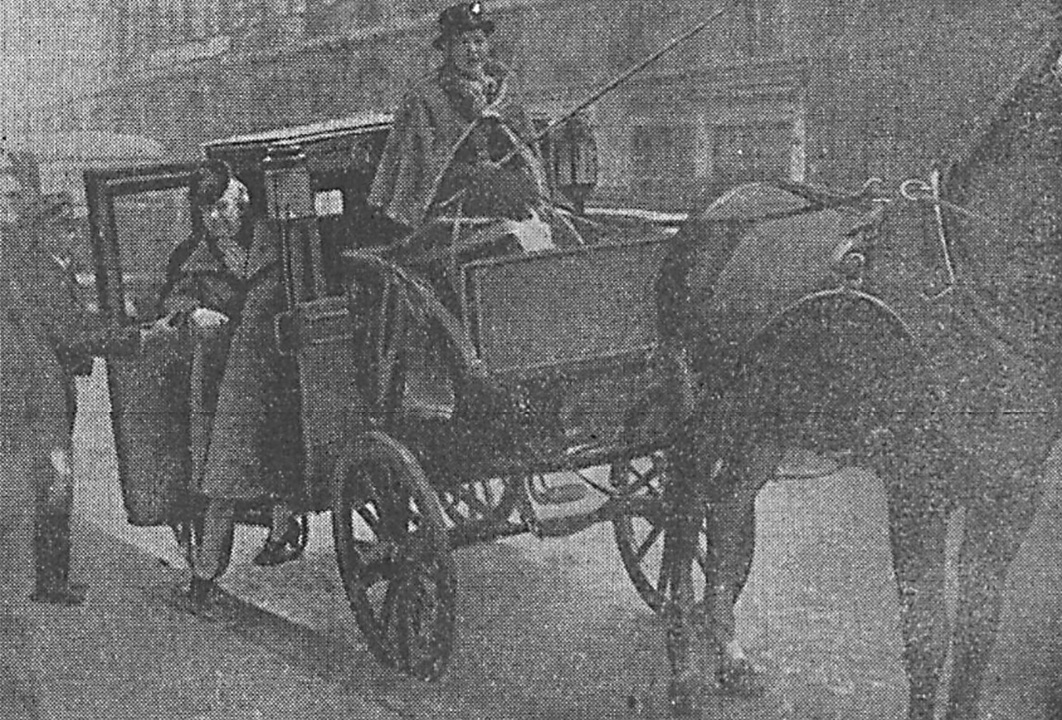
Above: "Here's the cab stopping in front of a big restaurant in Rue Royale."
The big restaurant would have been Maxim's (photo page 61), established at number 3 Rue Royale in 1893. By the 1950s it was reputed to be the most famous restaurant in the world. During the war, under German management, the restaurant was the favourite of the German high command when in Paris, including Hermann Goering among others (Wikipedia).
Source: Same source.
18. War Years, 1939-45
On September 3, 1939, responding to the German invasion of Poland on September 1, France and Britain declared war on Germany. Germany then invaded Belgium and the Netherlands but when the French and British armies advanced to meet them they were outflanked by German forces coming down from the north through the supposedly impenetrable Ardennes forests.
As the French and British retreated an estimated six to ten million civilians fled the German onslaught, clogging roads and adding to the general chaos. This mass movement of population came to be known as "The Exodus."
The British army, along with French and Belgian troops, was forced back to Dunkirk on the English Channel from which 330,000 soldiers were evacuated at the end of May. On June 14 German forces entered Paris unopposed and on June 22 an armistice was signed between Germany and a new French government established at Vichy.
Germany occupied roughly the northern half of France plus territory fronting on the English Channel and the Atlantic. The Vichy government, collaborating with the occupiers, controlled the south.
As she did in other occupied countries, Germany systematically stripped France of assets and industrial output. Germany confiscated between 55 and 86 percent of strategic metal production (iron, copper, nickel, aluminum, magnesium) and between 70 and 87 percent of wool, linen and cotton production. The same applied to all locomotive and most machine tool production.
In addition, France was required to reimburse Germany for the cost of occupying the country. These payments amounted to between 300 million and 500 million francs per day and totalled 479 billion francs between 1940 and 1944.
The impact of these measures on the French economy was exacerbated by the blockade imposed by the British and American navies which cut France off from its colonies and former trading partners.
On the ground the German military requisitioned anything needed for the war effort, particularly food and fuel. In Paris civilian motor vehicles virtually disappeared from city streets. Food rationing became so severe that it provided less than half of the calory intake required for a healthy diet. Malnutrition led to higher mortality from diseases associated with vitamin deficiency.
In these conditions, people who could afford it turned to the black market, partly as a matter of survival and partly as an act of protest against the Vichy and German authorities. Ironically, despite highly publicized official efforts to catch and punish black marketeers and their customers, the SS actively participated in the black market, conniving with Vichy bureaucrats and criminal gangs to purchase massive amounts of all kinds of goods with French money and ship them back to Germany.
Agricultural production, already damaged by the absence of 1.8 million prisoners of war, was further crippled as able-bodied men were rounded up to serve as forced labour in Germany or to build coastal and other defences against an Allied counterinvasion. At the same time, police began rounding up Jews and deporting them to slave labour and death camps. In one notorious incident 13,000 Jews were packed into a Paris sports arena and held there for days without food or water before being deported to Auschwitz.
By August, 1944, a total of 77,000 Jews living on French soil died in Auschwitz or other death camps. One-third of them were French citizens. The rest were Jews who had fled to France from other countries.
In these circumstances the French term "Système D" became a watchword and an obsession. The D stood for "se débrouiller," meaning to get by or make do. Or, more pungently, it stood for "se démerder" meaning to keep oneself out of s**t.
But Système D for ordinary French citizens struggling to find enough to eat for themselves or their families was very different from Système D for the wealthy and powerful who by luck or collaboration had managed to hang on to their wealth and power.
For people with money the occupation could amount to little more than an inconvenience. This is a February, 1941 newspaper report from Gringoire:
"On Avenue Matignon, in a white-and-gold salon where electric light blends with natural daylight, Lucien Lelong's models showcase the winter collection.
"Lining the walls of the room are wealthy clients whose fortunes have survived the exodus and the occupation. There is just one discordant note: these very elegant women are beginning to falter when it comes to their shoes, which are losing their shape because they are worn by feet accustomed to traveling by car.
"Yet in Paris, at the moment, when it comes to transportation, there is only the metro, half a dozen horse-drawn carriages (including the one driven by former horsewoman Rachel Dorange), and that is all. So, unaccustomed to walking, these elegant beauties wear out their shoes all the more quickly, making it necessary to replenish their stock." For Rachel, "Système D" meant providing this class of customer with an essential service.