




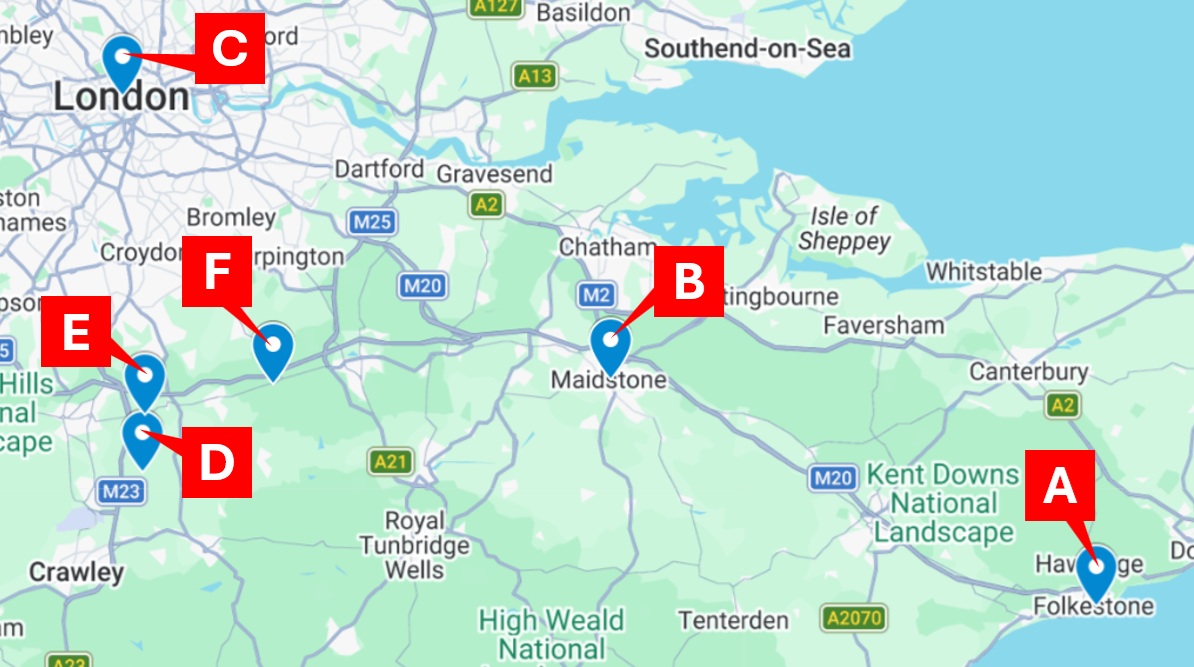
Above: Rachel in England. (A) Folkestone. (B) Maidstone. (C) London. (D) Outwood. (E) Bletchingley. (F) Westerham.

Above: Rachel and Coco four miles from Charing and 17 miles from Maidstone on their way from Folkestone to London.
Source: The Sketch
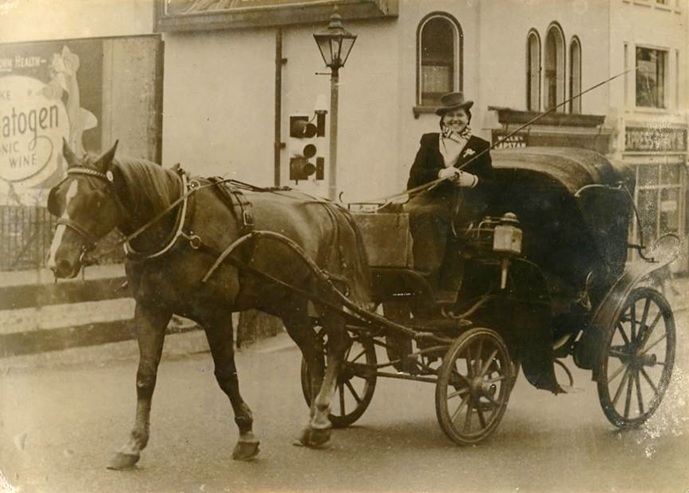
Above: Rachel and Coco (detail).
Source: Vintage Press Studio photo, ABE Books. Vendor: Bits of Our Past Ltd, Poynton, United Kingdom.
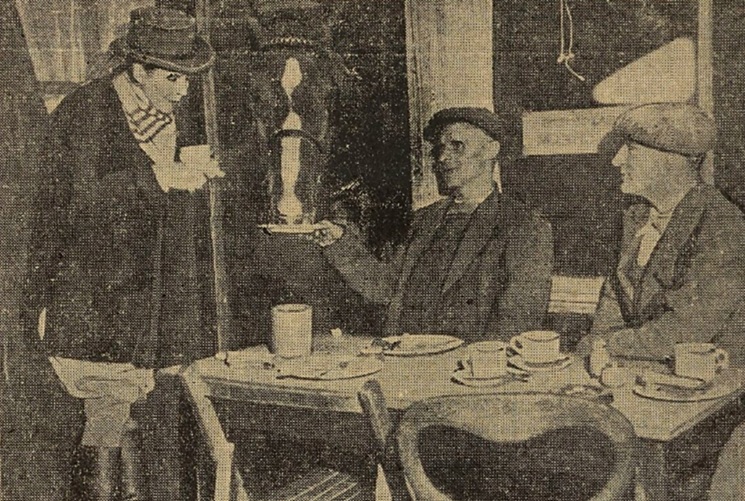
Above: "Paris Cab Horse and Lady Driver on English Junket." Coco joins the party through an open doorway.
Source: New York Herald Tribune (European Edition), November 2, 1948, p. 3. National Library of France (via Gallica). The location is identified as "near Maidstone" by the Daily Herald, November 1, 1948, p. 3. British Library (via British Newspaper Archive; subscription required for full text).
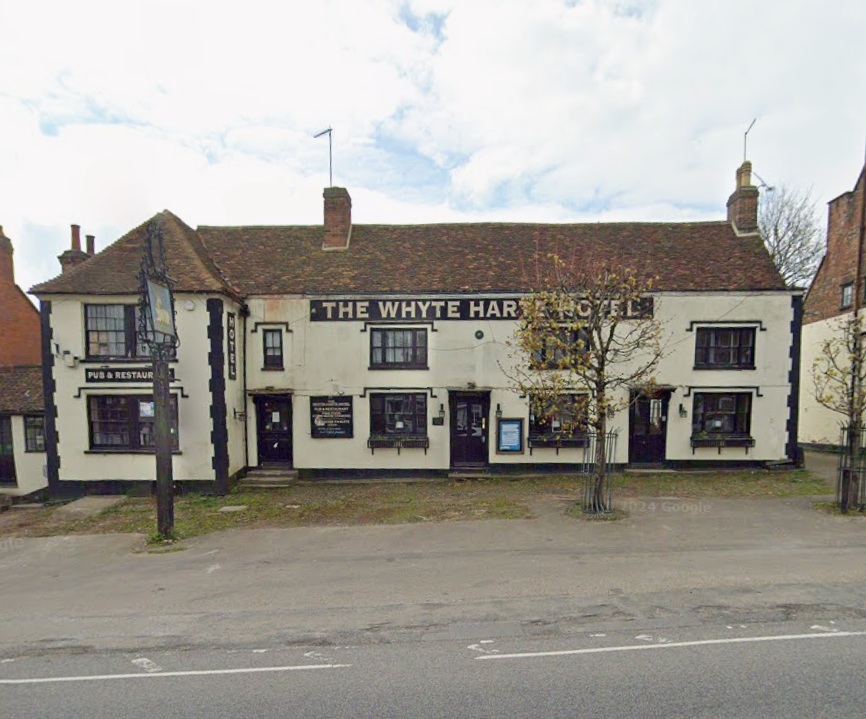
Above: The Whyte Harte Hotel, Bletchingley, England, April, 2023 (detail). Bletchingley is 73 kilometers south of London (by road).
Source: Google Maps
20. London, 1948
Postwar Paris soon recovered its role as a tourist magnet, especially for visitors from Britain. Rachel impressed some of her British clients so much that they invited her to cross the Channel and visit them. In October, 1948, Rachel decided to take some of them up on their offer.
Rachel left Paris on October 20 with no fanfare. In fact during the whole week that it took her to cover the 279 kilometers from Paris to Boulogne-sur-Mer she attracted no press attention at all. It was only after she embarked on a cross-channel steamship and landed in Folkestone on October 27 that reporters began to take notice:
"FOLKESTONE, England, Oct. 27, Mme. Rachelle d'Orange arrived here today to begin the last lap of a trip in a horse-drawn cab from her native Paris to London She stepped from a Cross-Channel boat, and efficiently supervised the unloading of the horse, Coco, and the cab.
"Many of the English who have hired her cab have said 'come and see us some time.'
"'And that is just what I am doing,' said Mme d'Orange. She has a book full of addresses in London, and Coco and the cab will take her there." But Rachel's plans received a temporary setback:
"Customs officials confiscated Coco and the carriage because Mlle Dorange had not paid the shipping duties on them at Boulogne and could not pay at Folkestone. So Mlle. Dorange changed into a fur coat and a very feminine hat with two large feathers and went to see French officials in London – by train.
"Last night it was agreed that Coco would be released later. Mlle Dorange told me last night: 'I came to London because I am giving up cab-driving and I am going to buy a restaurant. But I have been too humiliated. I shall leave England how and go to Brussels.'" Rachel had come prepared with French francs and French travellers' checks but the customs officials demanded payment of 15 pounds in English money, then the equivalent of $60 U.S.
If Rachel actually made the threat to return home, it was a momentary outburst. Events proved that she was determined to carry through her trip to London. She soothed her hurt feelings by writing a letter to Queen Elizabeth (the "Queen Mum," consort of George VI and mother of Elizabeth II and Princess Margaret):
"'Madam," she wrote, 'please excuse my boldness, but I must confess that I was very surprised by the discourteous behavior of certain Englishmen....'"
"And, no doubt to console the queen for the distress she had caused her, she concluded by saying: 'I am enclosing a few photos. There are some pretty ones of London....'" Rachel returned to Folkestone by train on October 28 and after settling Coco's bill she set out for London again on October 29, though with a somewhat shaky start:
"COCO IS ON THE WAY; Madame Drives to London. Mme Rachel Dorange, with her horse, Coco, harnessed to the old French cab, started her drive to London from Folkestone to-day. She paid part of the transport charges from Boulogne to Folkestone and left her fur coat behind as a security to cover the remainder and hotel expenses.
"When she started, Mme. Dorange drove to the right of the road into oncoming traffic, but then drove over to the left. She then tried to drive up a steep hill, but the road was so slippery that Coco almost fell three times, so she took another route." "The stout old cab, sound of spoke and thill, looked fit for many miles. It is fitted with oil lamps looking to the front, which Mme d'Orange believes are required by the British gendarmerie, and a red reflector looking to the rear. The one modern touch, not so very modern, is a horn with which Mme d'Orange will warn slow traffic. She works it by squeezing a rubber bulb." (New York Herald Tribune)
"'My horse is eight years old,' says Mme Dorange, 'my cab is about 80, and I am somewhere in between.'" (Dundee Courier)
Photos show Rachel driving both an open carriage (as here) and an enclosed cab. It was standard practice for horse cab companies to put different types of vehicles on the road (enclosed or open) depending on the season or weather conditions. Presumably Rachel rented or borrowed a second cab when the weather did not suit the one she owned.
The top photo at left shows Rachel and Coco on their way to London from Folkestone. The signpost reads four miles (six kilometers) to Charing and seventeen miles (27 kilometers) to Maidstone so at this point Rachel would have been about 30 kilometers from Folkestone. The distance from Folkestone to London is 117 kilometers, a two-day trip.
Rachel stopped for lunch at a cafe near Maidstone where Coco stuck his head through a doorway to accept what looks like a saucer of sugar (left). They arrived in London on the evening of October 30. The next day Rachel and Coco toured central London:
"Cabbies greet Madame. TAXI-DRIVERS shouted 'Bonjour, madame' as Madame Rachel Dorange drove round London yesterday in her four-wheel cab drawn by Coco, her horse. She drove over Westminster Bridge, through Trafalgar Square ('Charming' said Madame), Leicester-square and Piccadilly." (Daily Herald)
As she passed Hyde Park Rachel was convinced that she saw Queen Elizabeth smiling at her (Calgary Herald).
In her brief tour Rachel must have seen evidence of the damage suffered by London during the war. For nine months, from September 1940 to May 1941, in what came to be known as "The Blitz" the German air force tried to bomb Britain into submission with air raids that repeatedly targeted more than a dozen port cities and industrial centres. An estimated 20,000 tons of bombs fell on London alone.
The Blitz was followed in 1944-1945 by V-1 and V-2 rocket attacks. An estimated 963 V-1 and 164 V-2 rockets fell on London. In all between 40,000 and 43,000 British civilians were killed in the bomb and rocket attacks, almost half of them in London. Buckingham Palace, the House of Commons, the British Museum, the Tower of London and Westminster Abbey were all hit by bombs. Many historic landmarks were damaged or destroyed. The House of Commons was so badly damaged by fire that it was not repaired until 1950.
Rachel left London for Outwood, Surrey, about 40 kilometers south of London. The Surrey Mirror reported on her visit to nearby Bletchingley:
"After several days in London, she made for the Outwood home of some acquaintances of hers whom she had befriended during the Paris taxi strike of last summer. On Thursday evening last week [November 4], she and her friend paid a visit to that charming oid English hostelry, the Whyte Harte, at Blechingley (left), where the fiacre, standing outside, gave ]ust that final touch to the old world atmosphere.
"While in the area. Madame Dorange's Coco was kept at Mr. Sam Marsh's stables, Scamperdale, Edenbridge and Friday they were off again towards Folkestone, via Westerham, and so to the Continent. It is to be hoped Mme. Dorange took back with her a pleasant memory of an English autumn, as she certainly left with us a recollection of a form of transport of an age that is past and, perhaps sadly. is never to return." Westerham (Kent) is about 21 kilometers northeast of Outwood. Rachel arrived in Folkestone on the evening of November 7, after a two-day journey. The next day she left England for France.