




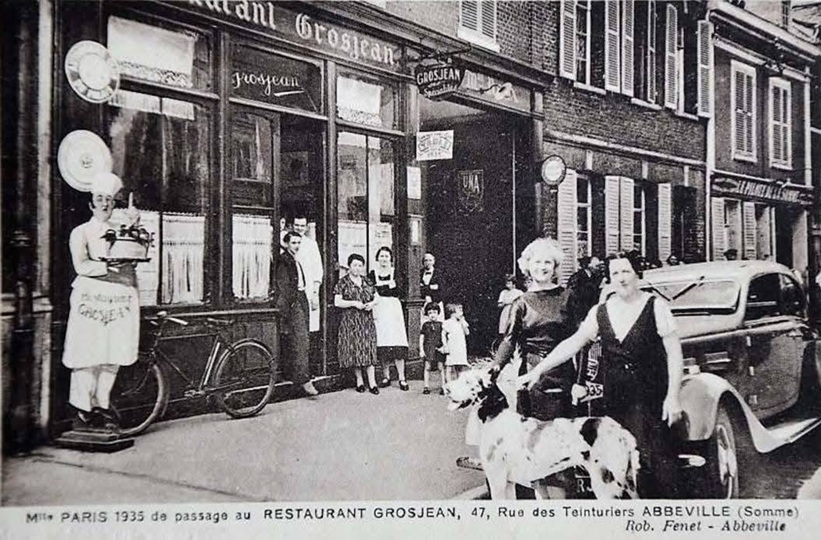
Above: "Mlle Paris 1935 visiting Restaurant Grosjean, 47 Rue des Tainturiers, Abbeville." Photo credit: Rob. Fenet, Abbeville.
Marie-Louise Paris (1889-1969) is the black-haired woman with the dog at right. Better known as Mlle Paris, she was a ground-breaking engineer who, in 1925, founded the first engineering school for women in France. See Wikipedia.
Source: Facebook. Posted by Stephane Toune Dupont, November 5, 2025.
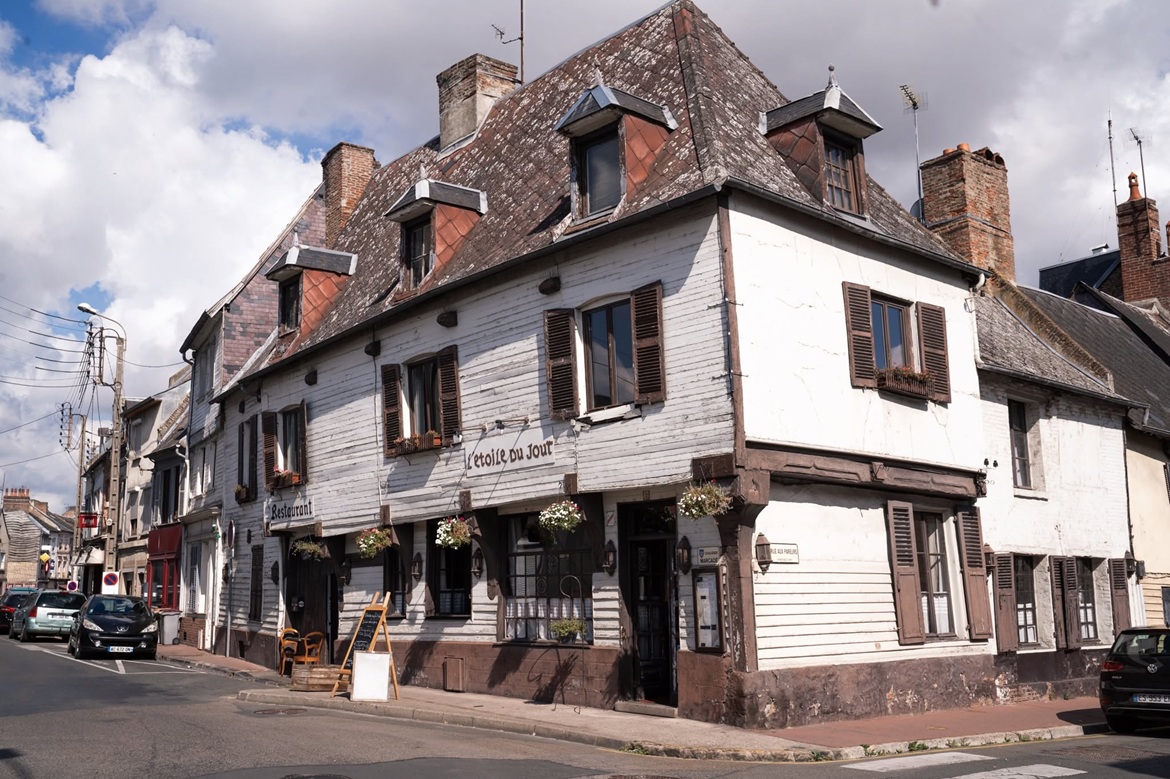
Above: L'Étoile du Jour Inn, Abbeville, where Coco was stabled and Rachel spent the night of November 10-11, 1948.
Both the Restaurant Grosjean and LÉtoile de Jour are still in business (2026).
Source: Facebook.
20. London, 1948 (continued)
On November 10, Rachel stopped in Abbeville, 82 kilometers south of Boulogne-sur-Mer. From Abbeville Libre:
"Across the Channel, the team and its driver enjoyed great success. On her way back, Rachel Dorange arrived in Abbeville on Wednesday, November 10. She stopped at the Grosjean restaurant on Rue des Teinturiers, while 'Coco' was being settled into the stable at the "Étoile du Jour" inn, owned by Mr. Braure, on Chaussée Marcadé.
"On Thursday, she reached Amiens, cheered on by a large crowd. Before returning to Paris, Rachel Dorange went to Dury to pay her respects at the grave of her brother, who was killed in action during World War I." Rachel's brother Jules Albert Dorange was two years older than Rachel. He enlisted in the French army in 1917 and was killed on May 16, 1918 at Dury. He was 21 years old.
The photo of Coco poking his head through the doorway of an English cafe (page 62) was widely reprinted and in one instance provoked some sour grapes. The writer of the "Women's Diary" column in La Liberté vented her suspicion that Rachel was not what she pretended to be:
"MANY Parisians, myself included, were pleasantly surprised to see the photograph of Mlle Rachel Dorange raising a glass with her horse 'Coco' and the regulars at an English pub.
"The caption to this photograph told us that the famous horse-drawn carriage driver had been invited to England by customers. Clients! But who has ever seen any in the carriage she has been driving through the most beautiful streets of Paris for over fifteen years?
"Empty, as always, the seats seem to suffice for themselves behind the pretty 'horse woman' who leads her horse 'Coco' at a walk or a gentle trot, but always in the finest style. Wearing a top hat on Monday, a bowler hat on Tuesday (unless it is the other way round), a felt hat the following day, she is seen at the end of the week wearing a small grey cape neatly draped over her low bun.
"Rachel Dorange once rode across the plains and mountains of Europe on her horse, on her way to Bucharest. But she has long since become a fixture of the Parisian landscape. She, her horse, and her carriage always empty.
"Seeing the three of them every day, I had got it into my head that our wise city councillors were providing the carriage with a stipend so that it might remain part of the scenery and offer the capital an extra attraction.
"But no. I was mistaken. Rachel Dorange does sometimes take on clients – clients who invite her to their homes in England. What an excellent profession!" Aside from the fact that cabs spend a lot of their travel time running empty – going to trips, coming from trips and cruising for fares – there is enough evidence of Rachel driving customers to show that she was a working cab driver.
Admittedly she was a celebrity cab driver who did not have to rely solely on cab fares for her income. This set her apart from the original Femmes Cocher and their male counterparts who had to work brutally long hours and take on all sorts and conditions of customers.