




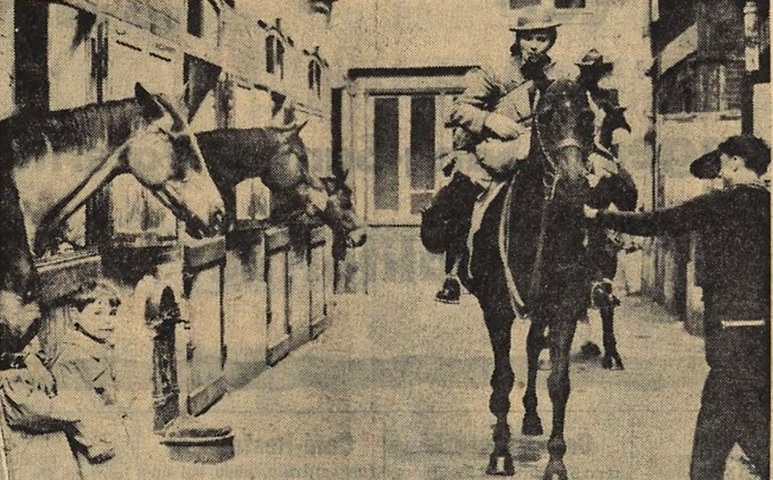
Above: Rachel setting off on her ride to Geneva. This stable may be at Neuilly-sur-Seine. A profile of actress Geneviève Brunet includes a photo of her posing with the fiacre that "belongs to the famous femme cocher Rachel Dorange who keeps it at this riding school in Neuilly." (Ciné-Révélation, January 1, 1955, p. 4. National Library of France (via Gallica).
Source:. La Tribune de Genève March 22, 1956, p. 7. Swiss National Library (via e-newspaperarchives.ch).
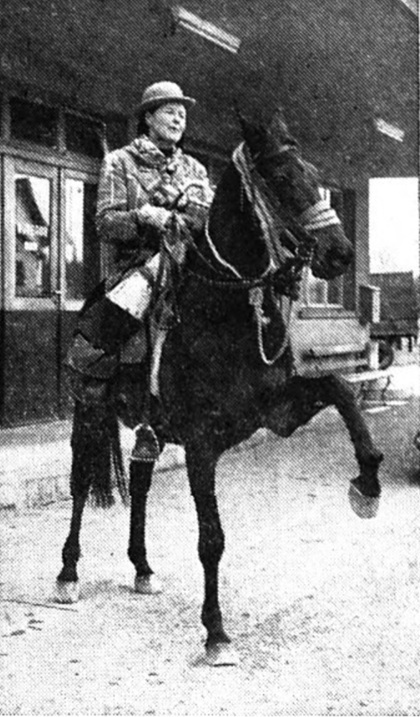
Above: Rachel at the Swiss border performing the Spanish Step to prove Pascal's fitness. Rachel feared that her train accident injury would prevent her from training horses to do the step.
Source:. La Sentinelle, April 5, 1956, p. 4. Swiss National Library (via e-newspaperarchives.ch).
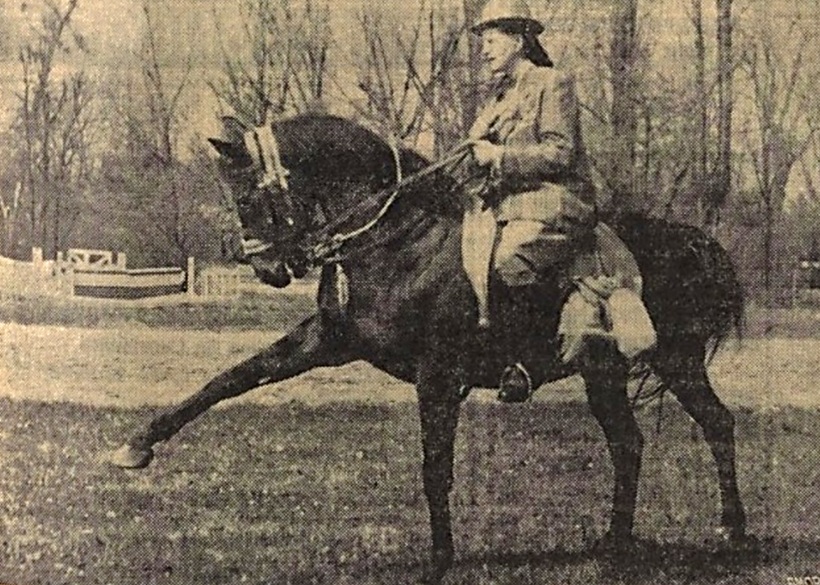
Above: Rachel and Pascal performing the Spanish Step. Photo credit: Actualité Hippique, Geneva.
Source:. La Tribune de Genève, April 5, 1956, p. 9 Swiss National Library (via e-newspaperarchives.ch).
21. Scrapbook: 1949-1956 (continued)
Scrapbook: 1955 On June 10, 1955 a dinner and dance (evening dress required) was held at the Pavillon Dauphine to celebrate "elegance, art, and equestrian sports" on the occasion of that year's International Equestrian Competition.
The Pavillon Dauphine was built for the 1878 Paris World's Fair as the Chinese pavilion. It was subsequently dismantled and moved to the edge of the Bois de Boulogne where it became, and remains, a premier venue for large gatherings and events.
The Pavillon included a riding arena where the evening's exclusive guest list were entertained by exhibitions of horsemanship and performances by well-known singers and musicians.
Rachel was one of five equestrian performers on the bill. Although the dinner was called "Le Diner des Amazones" there is no word as to whether she got to join in the dancing.
The following article appeared in October, 1955 and illustrates Rachel's continuing international appeal (especially in Canada, where it was published in at least eight different newspapers):
"PARIS (Reuters) Rachel Dorange, the "Woman Coachman," belongs to the Champs Elysees as much as the chestnut trees and the sidewalk cafes.
"This woman with her fiery red hair and bright smile is more than a tradition. She is literally a moving monument. Summer and winter, her fiacre, a small hackney coach, carries sightseers along the boulevards of Paris.
"Although comparatively young in years, Mademoiselle Dorange's coach recalls a past era when leisure was not a luxury and an afternoon drive was a major divertissement.
"Two other women have capitalized on Rachel Dorange's popularity and followed her lead, but Rachel was the first woman to drive a horse carriage in Paris.
"Rachel's carriage is to be found most days at lunchtime around the Rond Point de Champs Elysees. If this spot is sometimes vacant, it merely implies that Rachel has gone off on a trip.
"Three years ago, Rachel made a trip to London with her horse and carriage, and was delighted when the Queen smiled at her in Hyde Park."
Scrapbook: 1956
Following her train accident in 1951 Rachel feared that her equestrian career was over, but though she was still suffering frm her injuries she undertook a new horseback ride from Paris to Geneva in March, 1956. She and her new horse, Pascal, left Paris on March 21 or 22 and covered the the 538 kilometers in ten days at a very respectable average of 54 kilometers a day.
The lingering aftereffects of the accident forced Rachel to make some adjustments. She could no longer ride at a gallop so she held Pascal to a walk or slow trot, and she had to use a padded saddle.
By the time she reached Dijon, 316 kilometers from Paris, Pascal had begun to limp. Against veterinary advice Rachel had a nail removed from one of his shoes and that cured the problem.
At the Swiss border, "'thanks to the kindness of the Swiss customs officers,' she was able to find a farm where a makeshift stable allowed her to spend the night with her horse. This time, she didn't even take out the pajamas stuffed with four ties and two blouses from one of her saddle bags. Rachel Dorange... slept on a box of oats, wrapped in her old camel hair cape."
The next day she rode the last few kilometers into Geneva where she was interviewed by Tribune de Genève reporter François-Achille Roch.
"I found her at the riding school in Geneva, working with Pascal with all her gear, sitting far back since her accident, having forgotten her spurs at the border, stored in the oat box, because she doesn't like to see her things lying around, swearing, cursing because little Pascal no longer understood quickly enough without the help of the spurs, ready to laugh when he showed enthusiasm...."
Roch found the interview taxing. Rachel was happy to tell him all about herself and her life, but she had a tendency to leap from episode to episode in no particular order.
"When she talks about herself, it feels like opening a detective novel on page 147: she doesn't seem to realize that we haven't necessarily read the first 146 pages."