





Above: Movie poster for "Le Chanteur de Mexico" starring Luis Mariano as Victor and André Bourvil as Bilou.
Watch the whole movie on DailyMotion.
For a plot synopsis, cast list (including Rachel), posters and photos, see Le Cinema Français.
Source: "Le Chanteur de Mexico," Studiocanal.
22. Le Chanteur de Mexico, 1956
Rachel's continuing celebrity earned her a charming little cameo role in a 1956 feature film, a musical comedy entitled "Le Chanteur de Mexico" ("The Singer of Mexico").
The plot: Victor Etchebar, a popular local singer In the Basque town of Lesaka, is spotted by a Paris impresario who wants to hire him for a theatrical tour of Mexico but they are unable to meet in person.
Victor and his friend Bilou arrive unannounced in Paris to look for the impresario who is meanwhile trying to contact them in Spain. Crossed wires, mistaken identity, lovelorn jealousy and a pair of kidnappings are all happily resolved after a lot of singing.
Rachel's moment comes early in the film as Vincent and Bilou hire her for a trip across Paris.
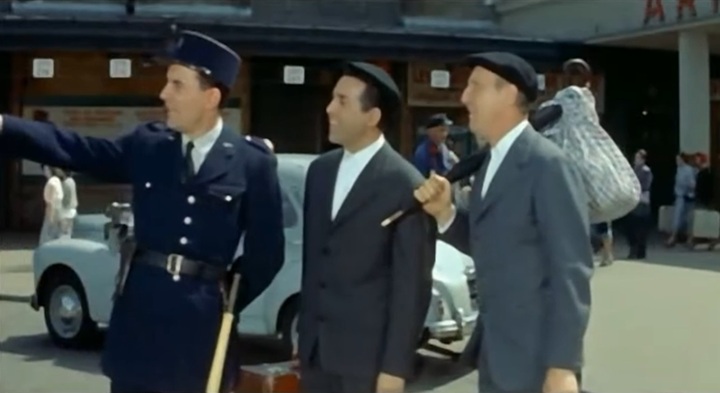
(After arriving by train, Vincent and Bilou ask a gendarme for directions.)
Vincent: Excuse me, officer. How do we get to Boulevard de Batignolles, please?
Gendarme: Do you want to go there by the metro?
Bilou: Yes, by the metro. I'd like that.
Vincent: Where do we go to take it?
Gendarme: It's down that way. And you transfer when you get to Stalingrad.
Bilou: Stalingrad.
Gendarme: Yes, you pass by Anvers and get off at Rome.
(Stalingrad, Anvers and Rome are Paris metro stations but Bilou thinks the gendarme is referring to the actual cities.)
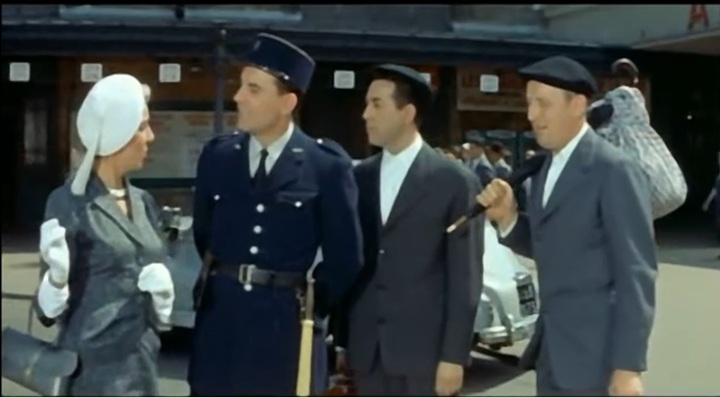
Woman: Officer, can I leave my car for five minutes?
Gendarme: Where, madam?
Woman: Over here.
(The gendarme goes off with the woman, leaving Vincent and Bilou to ponder their options.)
Bilou: Stalingrad, Anvers, Rome, it'll take two weeks to get there. We're better to go on foot.
Vincent: No, we'll get lost. Wait, we can take a fiacre. Maybe it's old fashioned but we're less likely to get lost.
Bilou: What do you mean by that?
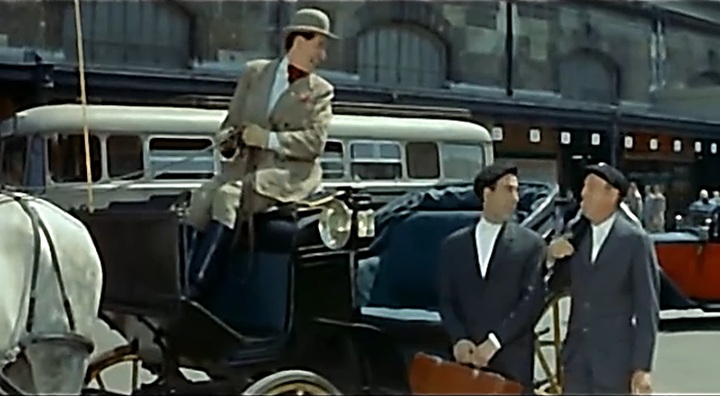
Vincent: Excuse me sir….
(Rachel turns and they all laugh when Vincent realizes she is a woman.)
Vincent: I mean to say, madam, we want to go to Boulevard de Batignolles.
Rachel: Very good. Get in.
Vincent: Onward! Let's go!
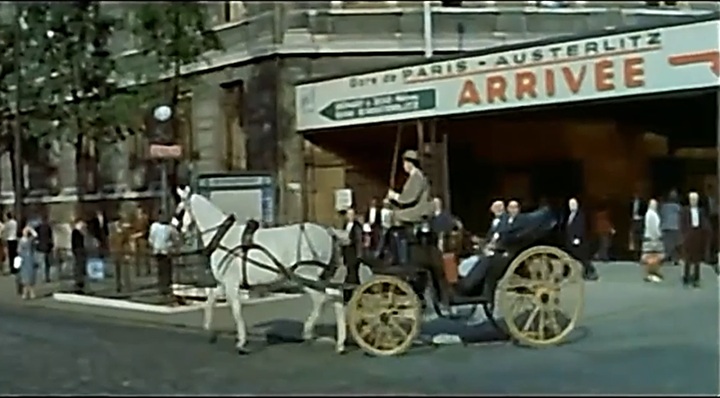
(Leaving the Austerlitz train station.)
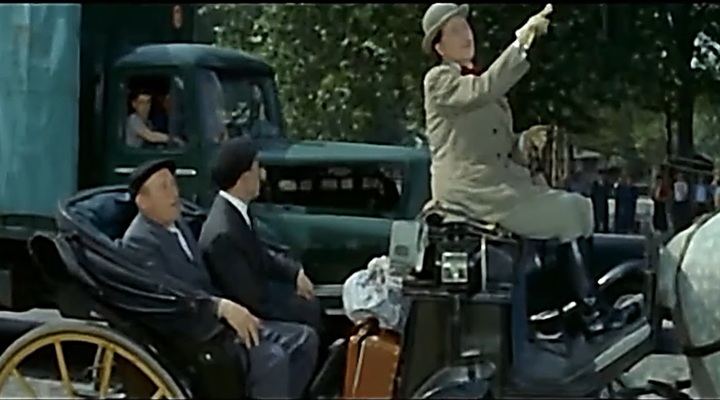
Bilou: Why are we stopping?
Rachel: Don't you see the light?
("Feu" in French means both "light" and "fire")Bilou: There's a fire? Where?
Rachel: Right there, in front of us, the red light. There, now it's green. All right?
Vincent: Did you understand?
Bilou: Yes.
Vincent: What did you understand?
Bilou: It's better to pretend to understand than to appear not to understand by asking someone to explain what you don't understand.
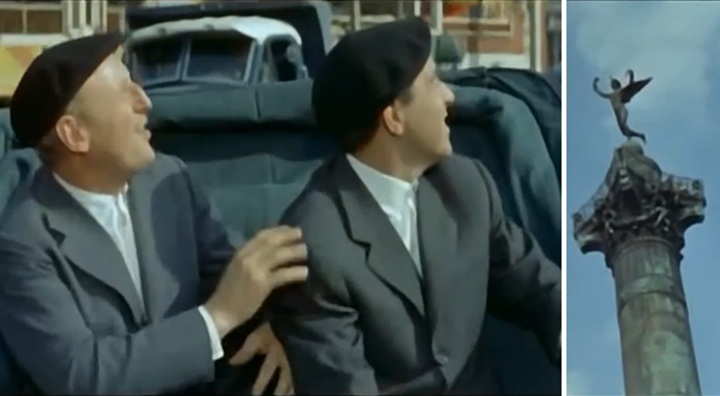
Bilou: Look at that guy up there standing on one foot!
(The July Column commemorates Bastille Day, July 14, 1789.)
Rachel: It's the spirit of the Bastille.
("Genie" in French can mean "spirit" or "genius." It can also mean "engineering.")Bilou: You know, we could use some engineering ourselves.
Vincent: You said the Bastille?
Rachel: Yes, we're in La Place de la Bastille.
Bilou: Where is the Bastille?
Rachel: It no longer exists.
Bilou: You see? We got here too late.
Vincent: And the Champs-Élysées, the Arc de Triomphe, and La Place Pigalle?
Bilou: They're all still here, I hope.
Vincent: Do we pass by them?
Rachel: They're a bit out of our way, but if that's your pleasure….
Bilou: Yes, yes!
Rachel: I can't think of anything better myself.
Bilou: Ah, she certainly is accommodating. Onward! Let's go!
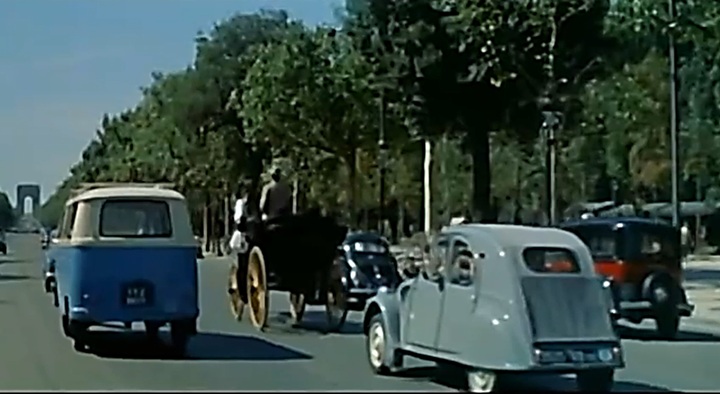
(Rachel's role includes some nice shots of Paris street traffic in 1956)
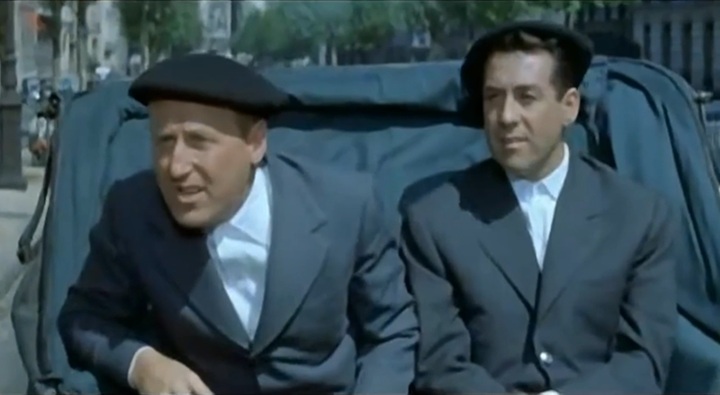
Bilou: But what's this box with the numbers on it?
Vincent: Oh, maybe it's the number of the fiacre.
Bilou: This is bizarre. It looks like the numbers are moving. Vincent!
Vincent: What's the matter? Are you feeling sick?
Bilou: Do you know what's written on this box?
Vincent: No.
Bilou: It's the price of the fare we have to pay. It's increasing all the time!
Vincent: 850 francs! Stop! Stop!
Bilou: Yes, stop! Stop!

Rachel: That comes to 850 francs. Without the tip.
Vincent: Without the tip? You've got that right. She certainly is accommodating. We've still got a long way to go.
Rachel: That depends. By car or on foot?
Vincent: On foot.
Rachel: About half an hour. But you can always take the metro. Thank you!
Vincent: No, I don't feel like taking a trip around the world. I'll certainly remember our arrival in Paris.