|
|
The notes In the columns at right are listed in order by chapter and page. The Note links on individual Femmes Cocher pages bring you to the relevant note, and the Page number links in the notes take you back to the relevant page. Each link below takes you to the first page of the corresponding chapter. 1. Introduction
|
1. Introduction / Page 3 Could this be Mlle Dollet? "Yesterday morning at the Prefecture of Police Mlle Désirée Dolet successfully passed the theory examination with a view to obtaining permission to drive an automobile taxi. Monday she will undergo the practical examination, at the walking speed of a horse." Le Petit Parisien March 24, 1907, p. 2 (RetroNews). 1. Introduction / Page 5 For the decline in the numbers of women cab drivers, see "Fewer woman cabbies," New York Times, January 12, 1908, part 3, p. 2, col. 6. 1. Introduction / Page 10 This closeup of the Fourchambault cab shows a hand wheel (yellow circle) similar to the one on Madame Véron's meter (Madame Véron, page 1).  The cab and driver look genuine, but are they local? According to Agnès Sandras (Postscript, page 18) Inès Decourcelle and Marie Moser drove cabs in the summer carnival parade in Calais, nearly 300 km north of Paris. Could this be another Paris femme cocher taking part in a publicity stunt? Two other photos taken from approximately the same vantage point suggest that the cab took part in the "cavalcade" (parade) that presumably kicked off the fair, and may even have led it with digitaries as passengers. The top photo shows the cab in the foreground. (A) marks a gateway that appears in the other two photos. (B) is a carriage whose passengers are standing up to watch the parade. In the middle photo the foreground now shows a float in the shape of a boat sponsored by Société de Pȇche du Gardon Rouge (Gardon Rouge Fish Company. The gardon rouge is a European freshwater fish called the rudd in English). (C) is a building that also appears in the third photo. The bottom photo shows a float carrying the Queen of Queens on a throne (perhaps a local beauty contest winner). Top and middle photos: delcampe.net. Bottom photo: Wikipedia Commons. 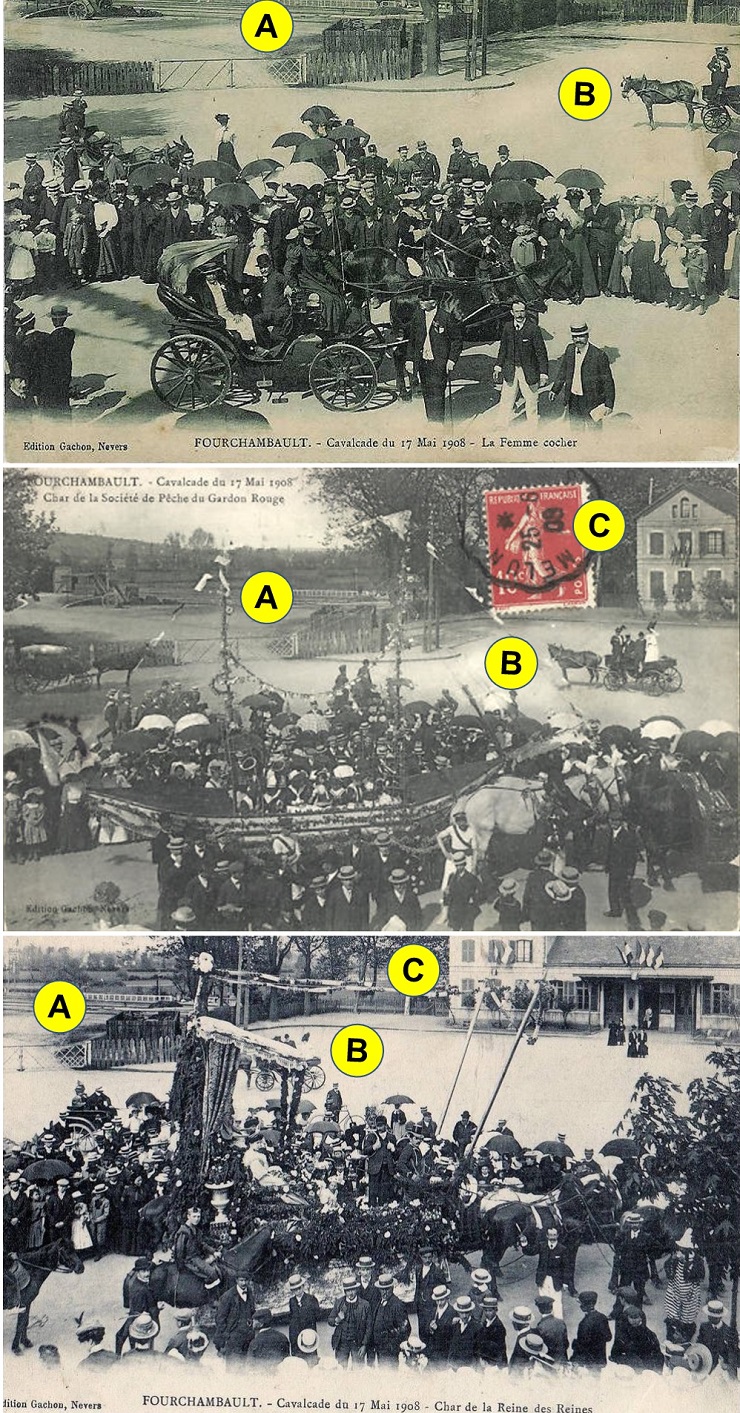 2. Madame Charnier / Page 4 For solid rubber tires and harness bells in London, see G. N Georgano, A History of the London Taxicab (New York: Drake Publishers, 1973), p. 34. 2. Madame Charnier / Page 8 Information about meters and other details about the Paris cab trade comes largely from Nicholas Papayanis, Horse-Drawn Cabs and Omnibuses in Paris (Baton Rouge: Louisiana State University, 1996). 4. Madame Lutgen / Page 4 For more about foot warmers, see Toasty Toes...Learning to Use an Antique Carriage Foot Warmer!, posting by Blacklocust on the Spunkysbuggy blogspot, February 2, 2016. For one in use, see Winnipeg Cab History. See also index, "Heated cabs." 4. Madame Lutgen / Page 5 For her employment as a nurse, see "Countess a nurse," New York Times, December 26, 1913, p. 1. 5. Madame Moser / Page 4 For tipping in the 1880s see L.J. Ransone, Good Form in England, by an American Resident in the United Kingdom. (N.Y.: Appleton, 1888), p. 278. Accessible via Google Books. 10. Cab Horses / Page 4 For Madame Lutgen's charges of cruelty to horses, see "A Paris Horror," New York Times, October 13, 1907, p. C4. 10. Cab Horses / Page 8 For the cab driver quotation see Anna Sewell, Black Beauty, any edition, chapter 34. 13. Femmes Chauffeur / Page 1 For Bertha Benz's long distance motor trip, see Cyril Posthumus, The Story of Veteran & Vintage Cars (London: Hamlyn, 1977), p. 11. Ten years later, in 1898, there were several women driving cars around Paris. The most notable of these was Marie-Clémentine de Rochechouart-Mortemart, duchesse d'Uzès (1847-1933), who combined the avocations of militant feminist, sculptor and monarchist. The duchess quickly accumulated several speeding tickets, not difficult to do at a time when anything faster than a walking pace was deemed dangerously excessive. There were enough women drivers in 1898 for the Paris newspapers to take notice and christen them "chauffeuses," a term that offended the Duchess. It literally meant "stoker" and dated back to the time when chauffeurs drove locomotives and shovelled coal into fireboxes. The Duchess appealed to the press asking them to use the English term "motor woman" instead. ("Automobiles in Paris," Anaconda (Montana) Standard, July 31, 1898, p. 12 (Newspapers.com OCR text). It was the Duchess d'Uzès who "endorsed" Marie Lutgen's decision to become a cab driver (Madame Lutgen, page 5; Postscript, page 22.). 13. Femmes Chauffeur / Page 2 Although one might assume that women taxi drivers evolved from women horse cab drivers, the evidence shows that the two occupations emerged almost simultaneously. By her own account, Inès Decourcelle passed her taxi driving exam on February 27, 1907, two days after Eugénie Charnier and Clémentine Duffaut had their first horse-cab shift. ("Du Fiacre au Taxi-Automobile," La Vie au Grand Air, May 16, 1908, p. 10 (RetroNews). Mme Decourcelle was inspired to drive a taxi after reading about a woman who was already driving one, and other women soon followed their example.
13. Femmes Chauffeur / Page 13 For the anonymous woman reported driving a taxi in 1909, see "Woman drives Paris taxicab," New York Times, September 19, 1909, part 3, p. 2, col. 6. This article seems to be based on Le Figaro September 17, 1909, p. 1 (Gallica). 13. Femmes Chauffeur / Page 14 In London horse cabs were only required to travel at four miles an hour which was about all that the average cab horse could manage when pulling a loaded four-wheeler. In Winnipeg, where horse cabs were pulled by two horses, owners protested when the 1910 city council proposed a minimum speed of seven miles an hour. See Norman Beattie, "The Cab Trade in Winnipeg, 1870-1910", Urban History Review, vol. 27 no. 1 (October, 1998) pp. 36-52. See note 4, pp. 49-50 for the protest against the proposed minimum speed of seven mph. In London some motor cab drivers used the minimum speed limit to their advantage. The 1907 Baedeker guide to London warned visitors that they should tip taxi drivers generously if they wanted to travel faster than four miles an hour. See John Fisher, The World of the Forsytes (London: Secker & Warburg, 1976) p. 142. 13. Femmes Chauffeur / Page 20 See Alexander Woollcott, "The Paris taxi driver considered as an artist," Enchanted Aisles (New York: G.P. Putnam's Sons, 1924), pp. 88-101. (Continued next column) |
13. Femmes Chauffeur / Page 22
The picture of Rita Yape Sounkouron on page 22 Is cropped; the original photo, such as reproduced in the Manitoba Morning Free Press and the Los Angeles Times, below, shows the entire taxicab. The picture below is from La Croix, July 21, 1909.  Articles re Rita Yape Sounkouron:
13. Femmes Chauffeur / Page 24 Arcticles re Elizabeth von Papp (from Chronicling America):
13. Femmes Chauffeur / Page 26 For Sheila O'Neill, see G.N. Georgano, A History of the London Taxicab (N.Y.: Drake, 1973), pp. 69-70. She created a sensation in British newspapers of the time. See British Newspaper Archive (login required). 13. Femmes Chauffeur / Page 28 For Evelyn Buckman, see:
13. Femmes Chauffeur / Page 29 For Natalie White, see:
13. Femmes Chauffeur / Page 31 Juliette Rennes (see Postscript) has drawn attention to the short memory of news media: their preoccupation with "pioneers" and "firsts" and their tendency to forget yesterday's news. With regard to the first women cab drivers and chauffeurs, the issue of primacy -- who came first -- is secondary to the real accomplishment of these women. They all ventured into unknown and largely hostile territory and showed that women could succeed in all sorts of roles hitherto reserved for men. When knocking down a barrier the first hammer hammer blow may get the most attention, but without the second, third, fourth or four hundredth it is meaningless. 14. A Cocher Miscellany / Page 6 For wood block paving in Paris, see André Guillerme and Sabine Barles, "Histoire, statuts et administration de la voirie urbaine," Conservatoire National des arts et métiers, no date, p. 14: "Imported from St. Petersburg via England, its use increased greatly during the 19th century, notably 'in places where it was necessary to escape the dizzying noise of vehicles.' London even made tentative experiments with rubber paving." (via Internet Archive) 15. Postscript / Page 1
15. Postscript / Page 7 For Alfred Dufaut as a Compagnie Urbaine driver, see "Les Femmes-Cochers," (La Patrie, November 13, 1906 (Bibliothèque Nationale de France). For other references see Rest & Relaxation page 9 and Postscript page 19 and page 20. 15. Postscript / Page 13 Agnès Sandras, "Automédone, Cocherette ou Cochonnette, un Accès de Fièvre Satirique et Machiste Devant les Premières Femmes Cochers?" Hypotheses, Biobliothèque Nationale de France. For Collignon, see British Newspaper Archive (login required) for these items:

|