


Click on the picture to see a larger version.
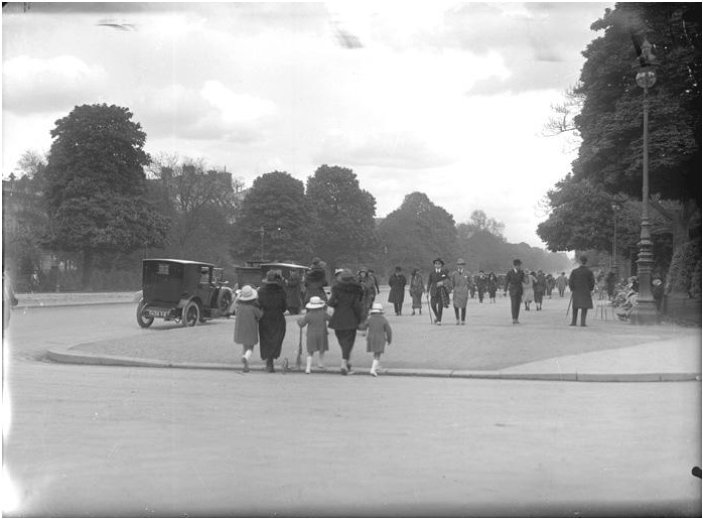
Strollers on avenue Foch. Called avenue du Bois de Boulogne until 1929 when it was renamed in honour of war hero Ferdinand Foch, avenue Foch runs from the Arc de Triomphe to the edge of Bois de Boulogne park and is lined with chestnut trees all the way. It has always been a highly desirable residential street, comparable to New York's Park Avenue. Photo by S�eberger (fr�res).
Source:
Minist�re de la Culture (France), M�diath�que de l'architecture et du patrimoine (archives photographiques) diffusion RMN (photo no. 1FS01543):
Click here to view source.

Gaito Gazdanov's Paris / 11
The lawyer's wife
I never had any such trouble with my lower class customers: laborers, small business people, saleswomen. They regarded me as one of themselves and in cases of dispute, argued their case as equal to equal.
Meanwhile, certain customers in evening dress from the chic neighbourhoods of Paris were capable of unhinging the calmest of men.
For instance, this woman, who was returning to avenue Foch: we had barely gone a few hundred metres when she rapped her umbrella against the glass separating her seat from mine:
"We�re not going to a funeral, I hope. Please go faster."
Ordinarily in such cases I would slam on the brakes and reply:
"If you�re not satisfied, get out and find another taxi."
But that day I was in a particularly bad mood. I punched the accelerator and took off at top speed. We passed cars, tore through traffic and nearly hit a bus.
She shouted that this was suicide, that I was crazy, but I ignored her cries. Finally we arrived at avenue Foch and I slowed down.
"You�re crazy! You were trying to kill me! I�m going to report you!"
"You should take better care of yourself, madam. I think your nerves are shot. If you like, I can recommend a clinic."
"What is this farce?" Her indignation knew no bounds. "Perhaps you don�t know who I am?"
"To tell the truth, I don�t."
"I�m the wife of�." She named a well-known lawyer.
"What�s that supposed to mean?"
"What, you�ve never heard of my husband?"
"It seems he�s a lawyer."
"In any case, he�s not a taxi driver."
"Of the two trades, madam, taxi driving seems to me to be the most honest."
"Ah, so you�re a revolutionary!" she cried.
In spite of the bad turn our conversation had taken she didn�t leave, didn�t settle the fare; the meter kept on ticking.
"I detest that breed."
"Probably because you know nothing about revolutionaries, or about economic or social problems. Mind you, I�m far from reproaching you for that. But at least have the tact not to talk about things you don�t understand."
"Nobody in my whole life has taken such a tone with me. What insolence!"
"That�s not surprising, madam. The people you know all seek to keep either your friendship or your benevolence. That doesn�t matter to me. I�ll be leaving in a few minutes and I hope never to see you again. Why wouldn�t I � given the circumstances � tell you what I think?"
"So to you I�m nothing but an ignoramus and a goose?"
"I won�t insist on the latter qualification, but I won�t hide the fact that I find the first one entirely adequate."
"Very well. All that�s left for me to do is pay you. I�ll even give you a tip."
"You can keep your money, madam, I�ll make you a present of it."
"No, you really deserve it, if only for your charming conversation."
"I�m glad it pleased you."
She then asked the final question:
"Tell me, please, are you a foreigner?"
"No, madam, I was born in rue de Belleville, number 42; my father has a butcher shop there, perhaps you know it?" [197-199]