


Click on the picture to see a larger version.
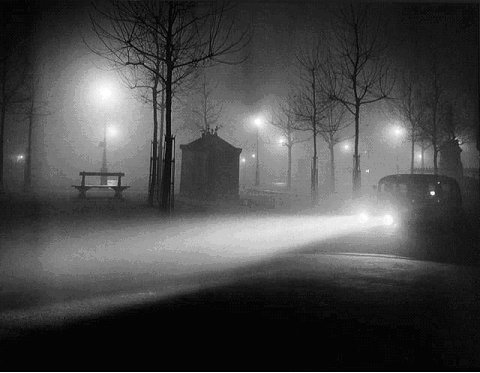
Brassai: Fog, avenue de l'Observatoire, 1934.
Source:
Tijil.org/gallery:
Click here to view source.

Gaito Gazdanov's Paris / 29
Night and day
The street lamps loomed out of the darkness and then disappeared, one after another; you could see stars in the sky and headlights, now near, now distant, danced across my windshield as if in some kind of children’s optical toy and their reflections zigzagged against a background of dark, transparent blue.
But the more time that went by the more I had to exert a tremendous effort to notice, even for the space of a second, the beauty of the dazzling combination of lights in the night, or the ideal perspective of the boulevards, or the dark green foliage which erupted in the harsh glare of my headlights only to vanish as abruptly on rounding the next turn in the Bois de Boulogne.
Paris faded before my eyes; I felt progressively blinder to it. The number of things that I was capable of perceiving diminished to the point where everything was overwhelmed in darkness.
Nevertheless this blindness dissipated on my days off when I wasn’t working and walked about on foot; then Paris seemed a different place; the same street corners, the same truncated angles of houses that I knew by heart, revealed themselves in a different light, imbued with an unaccustomed charm.
Even when I took a taxi as a customer and sat in the back seat the landscape seemed altered and in time I got used to the idea that in the last analysis one’s impression of Paris varies with insignificant changes, that this urban universe transforms itself with each imperceptible displacement – such as sitting a few centimetres higher and a metre and a half further back. [147-148]