


Click on the picture to see a larger version.
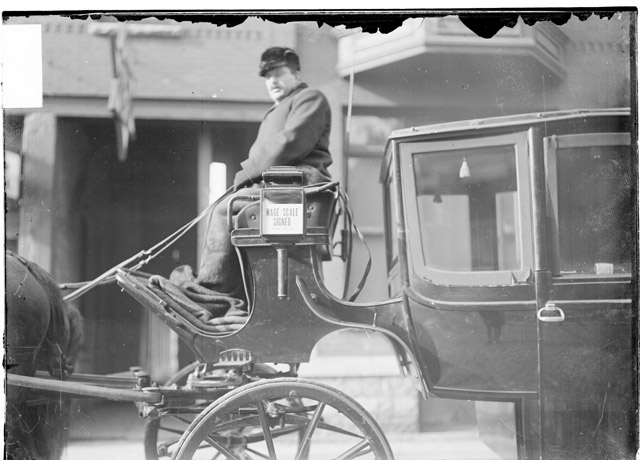
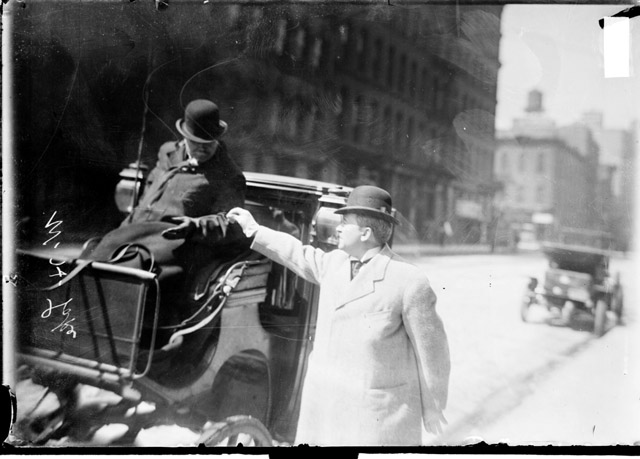
Above: Horse cab drivers presented a formidable target for robbers. Below: Also, horse cabs made so little money that they weren't worth the risk of robbing. Here William H. Lake, a Chicago grain dealer, pays his cab fare with a coin.
Source:
Top: Livery drivers' strike [1903], man driving a horse drawn carriage with a sign about the strike on the side of the carriage seat. (DN-0001719, Chicago Daily News negatives collection, Chicago History Museum. Bottom: W. H. Lake paying a cab driver sitting in his horse drawn carriage (DN-0008289, Chicago Daily News negatives collection, Chicago History Museum). (Search the photo ID numbers at the American Memory web site for more information.)
The Cab-Hold-Up Affair / 2
Horse Cab Robberies / 1
The cab hold-up affair was exceptional because attacks on horse cab drivers were quite rare. There were two main reasons for this.
One reason was that cab drivers were a difficult target, separated as they were from the passenger compartment, perched on an elevated seat and armed with a whip. It was not easy to take them by surprise and they were in a position to defend themselves.
The second reason was that horse cab drivers made very little money. In Winnipeg in 1910 their average take was estimated at 40 cents an hour for a twelve hour day, with a "good" team of horses able to earn up to six dollars a day (1).
This meant that cab robbery was simply not worth the risk. The commonest crime against cab drivers was fare bilking.
(1). "Says Cab Tariffs Are Reasonable," Manitoba Free Press, February 3, 1910, p. 13.