



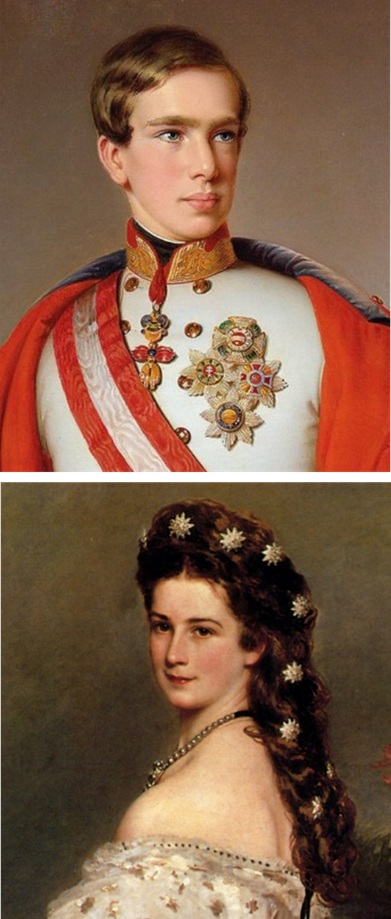
Top: Emperor Franz Josef in 1849: Portrait by Anton Einsle (detail).
Source: Meisterdrucke Art Prints, Paintings and Reproductions
Bottom: Empress Elisabeth of Austria in 1865: Portrait by Franz Xaver Winterhalter (detail).
2. Rudolf and Politics (continued)
The new emperor's instinct was to screw the lid down even tighter. He disavowed the pro-democratic concessions that Ferdinand had been forced to make, and when Hungary attempted to secede from the Austrian empire, Franz Josef's troops (with help from Russia) soon crushed the revolt. The military victory was followed up with repressive measures designed to discourage any future attempts at secession by Hungary or any other part of the empire.
For nearly 20 years Franz Josef's policy seemed to work, but by the 1860s the geopolitical landscape had radically changed. Prussia was now Austria's chief rival in Europe, a rivalry that culminated in the Austro-Prussian War of 1866. Austria was defeated in less than two months and although Prussia did not make any territorial claims, Prussia's alliance with the Kingdom of Italy resulted in Austria having to give up its Italian possession of Venetia.
Moreover, Prussia abolished the German Confederation, an association of 39 independent German-speaking states that Austria had presided over since 1815, and replaced it with a North German Confederation led by Prussia and excluding Austria.
Franz Josef was astute enough to see that a weakened Austria could not afford another Hungarian rebellion, so in 1867 he reluctantly agreed to what came to be called the Austro-Hungarian Compromise. Empress Elisabeth, who strongly supported the Compromise, is credited with convincing Franz Josef to agree to it.
Under the compromise Austria and Hungary were to be equal partners within the empire, each partner governed internally by its own parliament but with unified defence and diplomatic policies.
Franz Josef remained the ultimate authority both as Emperor of Austria and as King of Hungary. The Austrian Empire became the Austro-Hungarian Empire, or Austria-Hungary, or the Dual Monarchy.
Despite the Compromise Franz Josef remained suspicious of and hostile to any signs of liberalism and nationalism. Rudolf's flirtation with liberal and democratic ideals and his association with politically dubious friends exasperated Franz Josef and convinced him that he could not trust his own son.
Rudolf bombarded Franz Josef with political advice which the emperor ignored. Franz Josef also refused to give Rudolf any meaningful role in government.
Rudolf reacted by writing anonymous articles in a liberal newspaper published by one of his friends, though Franz Josef and his advisors would have had little doubt about who the author was.
The articles were critical of his father's policies, of his conservative advisors and of the wealthy and aristocratic elites who supported them. Needless to say, the articles did nothing to endear Rudolf to his father.