



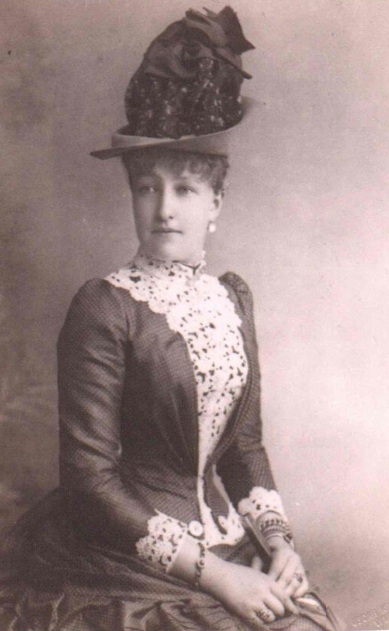
Above: Crown Princess Stephanie of Austria in 1886.
Source: Osterreichische Nationalbibliothek (Austrian National Library)
3. Rudolf and Women
Having been excluded from the centre of power, Rudolf had plenty of time to indulge his interests other than dabbling in politics. These included hunting, partying and womanizing.
In the words of an official in the German embassy in Vienna, "Female hearts positively dropped into the lap of the Crown Prince of the vast Austria, and perhaps even surrender to the young, elegant and charming Prince was considered to be a patriotic duty" (Judtmann 17).
One of Rudolf's many female admirers was his sister-in-law Princess Louise of Belgium (the older sister of Crown Princess Stephanie). She wrote in her memoirs that Rudolf was "more than handsome, he was seductive.... He was disturbing," and hinted that their relationship was more than just friendly.
Crown Princess Stephanie was well aware of Rudolf's extramarital affairs and after his death she confided to a friend that the young woman who died with him, Baroness Mary Vetsera, was only "one of many" (Judtmann 26).
Rudolf's forays into the night life of Vienna brought him into contact with all sorts of women who readily succumbed to his charm. One of his conquests was a chorus girl from the Carl Theatre to whom he gave a ring worth 1,200 florins, or about 600 U.S. dollars at the time (Baedeker).
Inevitably one of his sexual encounters, whether with an aristocrat or a commoner, resulted in his being infected with venereal disease. This occurred in February, 1886 and by March he had passed the infection on to Stephanie.
For the most part Rudolf's condition was successfully hushed up, but prescription records of the Court pharmacy have survived and reveal that starting in February, 1886, Rudolf received the standard (and ineffective) treatments administered in cases of gonorrhea.
Rudolf's doctors were sworn to secrecy and it was only later that Stephanie learned the cause of her own illness. She too kept Rudolf's secret, a galling burden since "I was reproached for being unable to bear another child. The Court knew only too well whose fault that was" (Judtmann 18).