


Click on the picture to see a larger version.
This picture shows the Butt Bridge cabmen's shelter which Leopold Bloom visited with Stephen Dedalus. However the bridge in the background is not Butt Bridge, which is out of the picture to the right. Fred Goldrich identifies this one as the Loopline railway bridge.
The crowd has gathered for one of the mass protests against British rule that preceded the War of Independence (1919-1921) and the Civil War (1922-1923).
George Noble Plunkett was an art historian and the director of the Science and Arts Museum of Ireland from 1907 to 1916. He had been created a Papal Count by Pope Leo XIII in 1877 while living in Italy. Plunkett's son Joseph was executed for his part in the Easter 1916 uprising and Plunkett himself was fired from his directorship, deported to England and imprisoned for his Republican political activities. He returned to Ireland illegally and was elected to Parliament for the Unionist party in by-elections in 1917 and 1918, refusing to take his seat in both instances.
Source: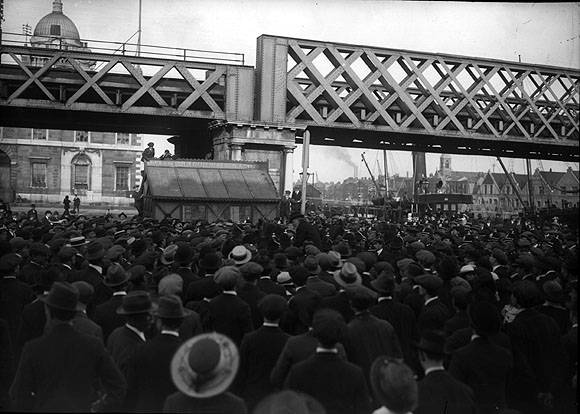
Protest meeting at Beresford Place, and the arrest of Count Plunkett, Butt bridge prominent in view, crowds. Photograph by Keogh Brothers Ltd 1917.
Reproduction rights owned by National Library of Ireland (Keogh Collection, call no. Ke 176).
Click here to view source.
Bloomsday for Cab Drivers / 25
The Cabmen's Shelter / 3
The cabmen's shelter idea spread to other countries, including Australia and Ireland. A lengthy scene in Ulysses takes place in the shelter on the cab stand at Butt Bridge to which Leopold Bloom brings a very drunk young man named Stephen Dedalus at one in the morning.
Dedalus (the counterpart of Odysseus's son Telemachus) has been pursuing his own odyssey through Dublin and he and Bloom have unwittingly crossed paths at different times during the day.
Their ultimate meeting takes place just after Dedalus has been beaten up by a couple of soldiers. Bloom takes pity on him and steers him toward the nearby shelter to sober him up with food and coffee.
Mr Bloom and Stephen entered the cabman's shelter, an unpretentious wooden structure, where, prior to then, he had rarely if ever been before, the former having previously whispered to the latter a few hints anent the keeper of it said to be the once famous Skin-the-Goat Fitzharris, the invincible, though he could not vouch for the actual facts which quite possibly there was not one vestige of truth in. A few moments later saw our two noctambules safely seated in a discreet corner only to be greeted by stares from the decidedly miscellaneous collection of waifs and strays and other nondescript specimens of the genus HOMO already there engaged in eating and drinking diversified by conversation for whom they seemingly formed an object of marked curiosity. [16 187 / 25765]