


|
|
This picture shows the Butt Bridge cabmen's shelter which Leopold Bloom visited with Stephen Dedalus. However the bridge in the background is not Butt Bridge, which is out of the picture to the right. Fred Goldrich identifies this one as the Loopline railway bridge.
The crowd has gathered for one of the mass protests against British rule that preceded the War of Independence (1919-1921) and the Civil War (1922-1923).
George Noble Plunkett was an art historian and the director of the Science and Arts Museum of Ireland from 1907 to 1916. He had been created a Papal Count by Pope Leo XIII in 1877 while living in Italy. Plunkett's son Joseph was executed for his part in the Easter 1916 uprising and Plunkett himself was fired from his directorship, deported to England and imprisoned for his Republican political activities. He returned to Ireland illegally and was elected to Parliament for the Unionist party in by-elections in 1917 and 1918, refusing to take his seat in both instances.
Source:
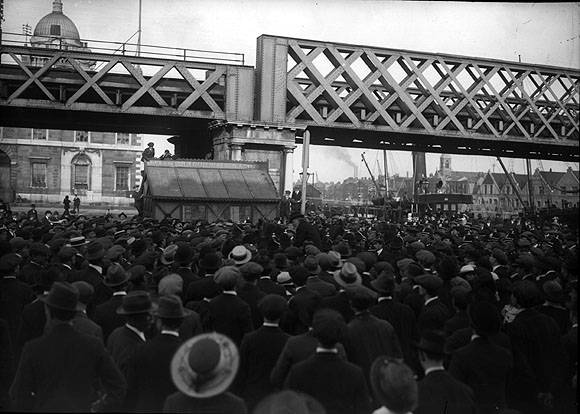
Protest meeting at Beresford Place, and the arrest of Count Plunkett, Butt bridge prominent in view, crowds. Photograph by Keogh Brothers Ltd 1917.
Reproduction rights owned by National Library of Ireland (Keogh Collection, call no. Ke 176).
Click here to view source.