




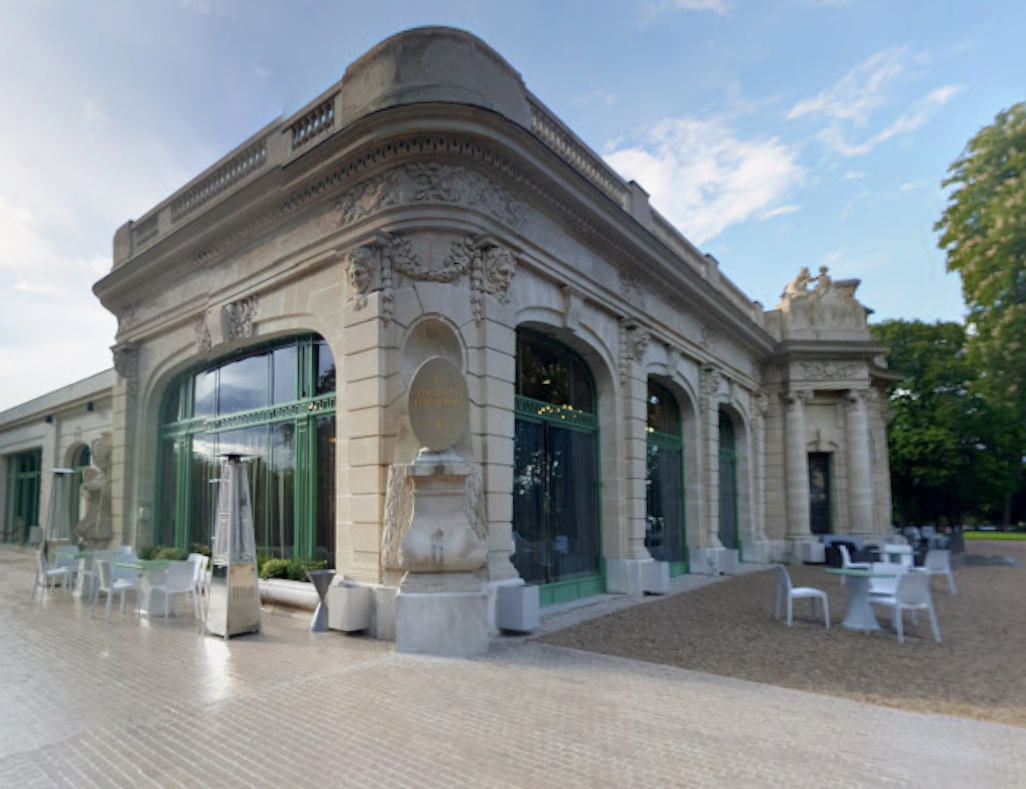
Above: Pavillon Dauphine, April 2017 (detail).
Source: Google Maps. Photo credit: Jean Vincent.
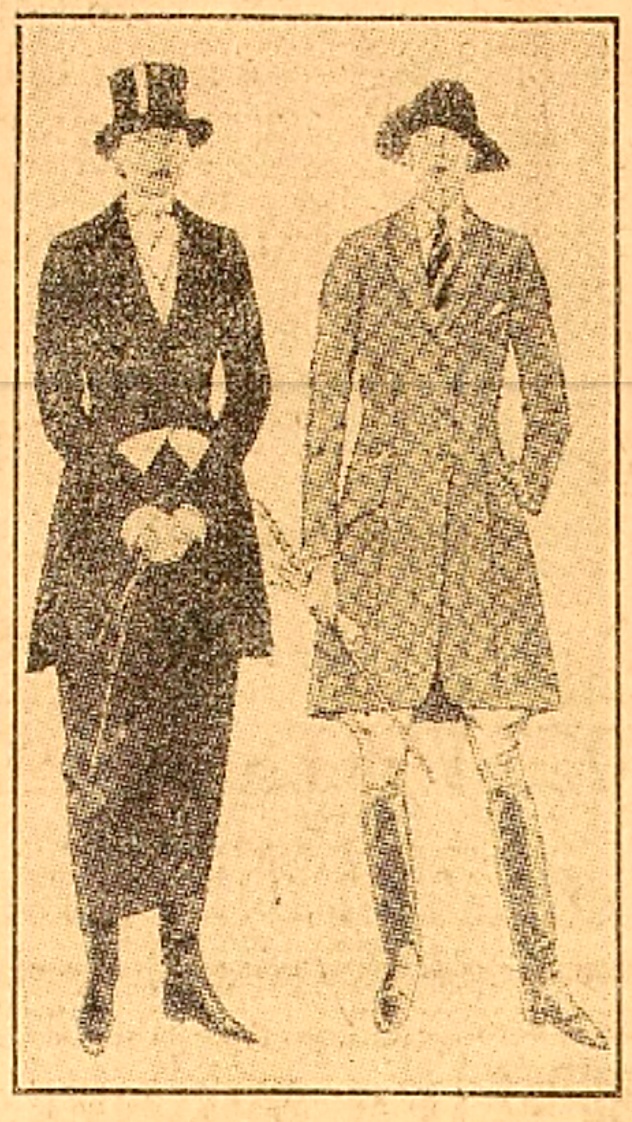
Above: Skirt vs trousers.
Source: La Liberté, June 27, 1925, p. 5 (via Gallica.
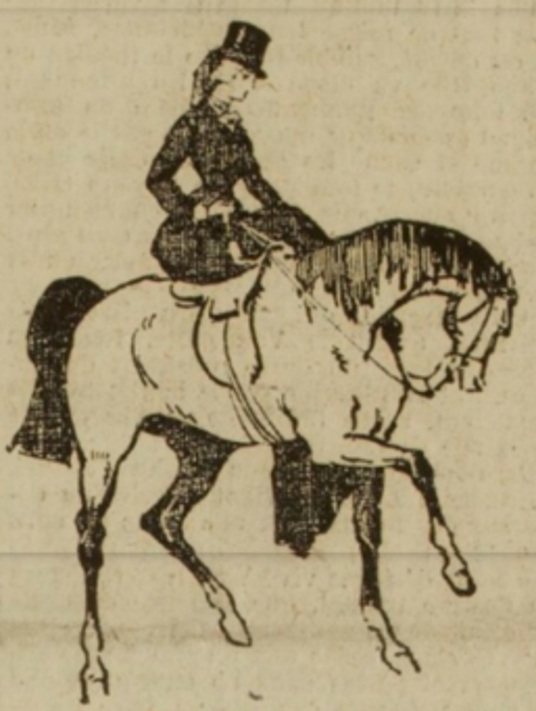
Above: "L'Amazone romanesque" after C. de Dreux, collection of André de Fouquières, showing a woman riding sidesaddle.
center>
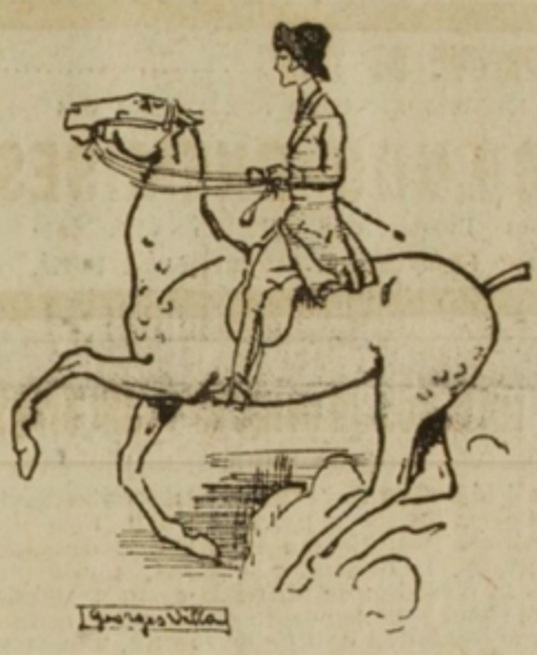
Below: "L'Amazone moderne" by Georges Villa, showing a woman riding astride.
Source: La Liberté, June 30, 1925, p. 1 (via Gallica).
6. La Plus Belle Amazone
In 1925 Rachel was building her reputation as a horsewoman not only on stage but at equestrian events. This led her to take part in the "Concours de la plus Belle Amazone" ("Most Beautiful Amazon Contest"), a publicity stunt engineered by Armand Massard, the editor of La Liberté.
Massard was a gold-medal Olympic fencer, a newspaperman and a huckster, though in 1925 the last two terms were more than a little synonymous. We will see Monsieur Massard again, along with his equally colorful sidekick Jean Hallaure, a little later (page 10).
Massard was likely inspired by a watershed moment that occurred in 1924 when the prestigious Paris Horse Show, for the first time, authorized an official show-jumping event for women. The event attracted a large number of accomplished riders. One of them, Mademoiselle Lacroix, riding three different horses, electrified the crowd by clearing 60 consecutive obstacles without a fault.
The 1924 Paris Horse Show stimulated public interest in women's equestrian events. This may have piqued Massard's journalistic and entrepreneurial instincts because he soon began looking for a way to capitalize on the phenomenon. His object was to create an amazon-related event that would sell newspapers while not costing La Liberté too much money
His answer was a beauty contest-cum-fashion show in which "The contestants will have no other formality to fulfill than to parade before the mixed jury, which will evaluate, based on overall appearance, the elegance of the rider as well as that of her mount." It would be an opportunity for the women to "showcase their elegance and poise, leaving other, more daring occasions for them to display their mastery."
It was to be a social rather than an athletic event. As finally formulated, the jury's criteria for judging the "elegance" of rider and horse were, in order of priority: 1) overall appearance (overall impression); 2) posture in the saddle; 3) the horse’s grooming and demeanor; 4) the competitor’s attire.
Since the women would not be engaged in a physical contest there was no need for a venue equipped with a race track or show-jumping obstacles. All that was needed was an open public space and Massard found one near the northeast corner of the Bois de Boulogne in front of the Pavillon Dauphine.
Massard knew that he could rely on his personal contacts in Parisian society to recruit some big names to aid him in his project. He could also count on the lack of opportunities for women athletes to show off or profit from their skills. This would make the event attractive to enough competent horsewomen to lend it athletic credibility. And, of course, the spectacle of young women parading on horseback would certainly draw a crowd of spectators and captivate newspaper readers.
Massard's concept was evidently sound and perhaps even brilliant, but as with other Massard projects the planning and execution were a bit slapdash. Eager to launch his contest Massard announced on June 25, 1925 that it would take place on the morning of June 30 between 11 a.m. and noon, only five days away.
Unfortunately Massard had evidently not completed all the necessary preparations. Details of the event trickled out over the next five days, suggesting that he was making them up as he went along.
The initial announcement claimed that judging would be carried out by "mixed jury" that included "figures of undeniable expertise" but no names were provided.
A later announcement promised prizes, but gave no particulars. It was not until June 30, the day of the contest, that the grand prize was revealed – "a complete riding outfit (for sidesaddle or English-style riding), provided by the famous tailor O’Rossen on Place Vendôme (valued at 2,500 francs)."
By June 26 Massard had rounded up enough volunteer jurors to publish a roster of names. The names attested to Massard's skill in recruiting prominent people to his cause. All were all well known to the Parisian public and most could claim experience in horsemanship. They included Ernest and Blanche (Allarty) Molier from the Cirque Molier; a veteran politician and former cavalry officer; a cavalry brigade commander; an Olympic polo player; acknowledged arbiter of taste and "ultimate man of the world" André de Fouquières (see page 61); and the stage (and later movie) actor Max Dearly.
On the same day Massard revealed his master stroke: he had managed to enlist Vogue magazine's Paris edition as a partner. This gave the contest immense credibility as a fashion show and alerted couturiers to the possibility of having their designs mentioned in a Vogue article or better, appearing in a Vogue photo spread.
The same enticement attracted customers of couturiers who enjoyed being seen in public wearing these designs. By June 28 Massard was able to report that "We already know of two leading fashion designers who specialize in this field who have received urgent orders in preparation for the Most Beautiful Amazon contest."
Massard also shrewdly exploited an ongoing controversy to spice up publicity for his event. By 1925 it was commonplace for women to ride horses "à califourchon" (astride) instead of sidesaddle, but the new style was still novel enough to provoke hostility among traditionalists. Although the Paris Horse Show admitted women competitors for the first time in 1924, it was not until 1930 that they were allowed to wear trousers and ride astride.
On June 27 therefore, Massard announced that contestants would be able to ride sidesaddle or astride as they chose. "Dress code is entirely optional, contrary to the rules stipulated for the Paris Horse Show, which allows only skirts, and we are eagerly awaiting the outcome on June 30 – will the traditional skirt or the emancipatory trousers win out?"