




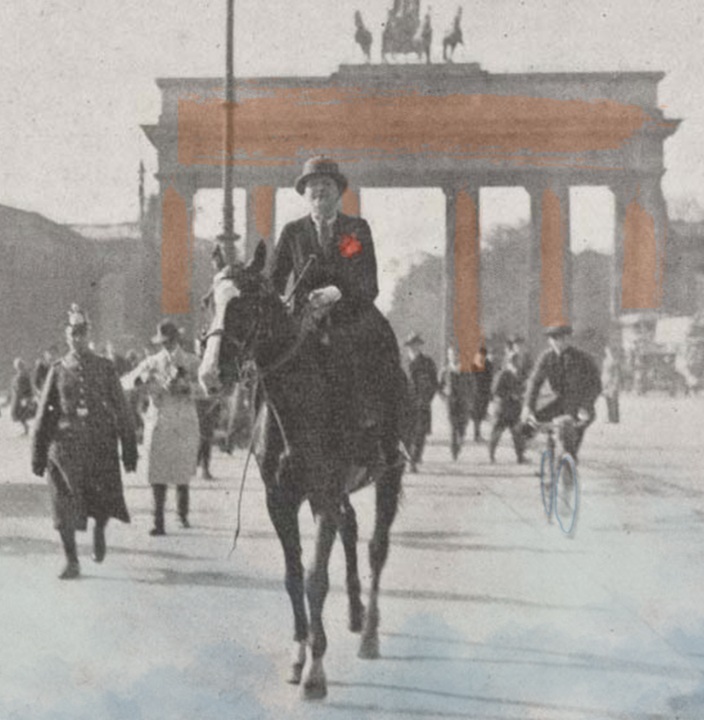
Above: Rachel's entry into Berlin with the Brandenburg Gate in the background (detail).
Source: "Exploration d'une Légende : Rachel Dorange, l'Amazone Intrépide," École des Roys, November 24, 2024.
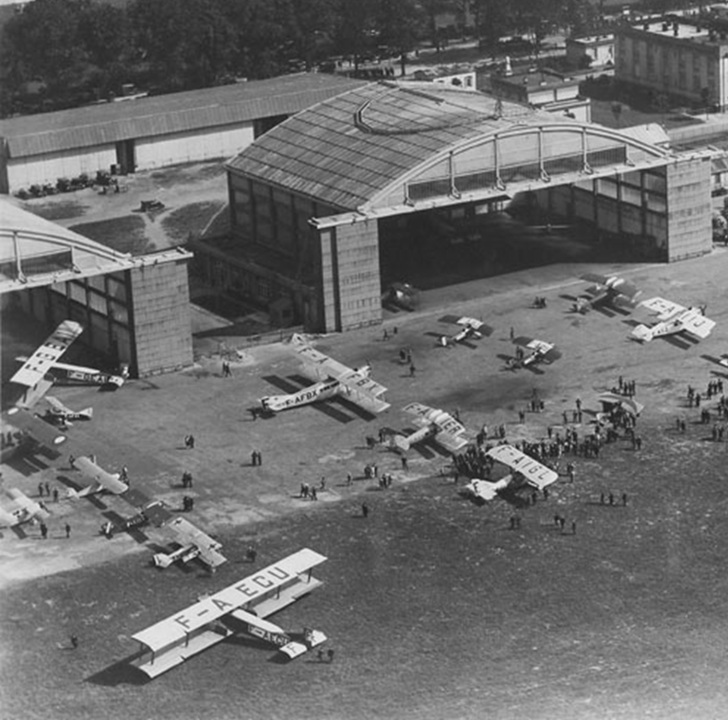
Above: Le Bourget aerodrome in 1927 (detail).
Source: Groupe ADP: The History of Paris-Le Bourget
7. Berlin, 1927 (continued)
Rachel made a triumphal entry through the Brandenburg Gate. Thanks to her preliminary visit to Berlin two weeks earlier, people knew who she was and anticipated her arrival with Le Huppé. She was greeted by a crowd shouting "Vive Fraulein Paris-Berlin!"
It had been an arduous journey. The trip to Berlin covered more than 1,000 kilometers and, with stopovers and delays, took 50 days.
"Believe me, very often I was at the limits of my endurance, haunted by the temptation to abandon the trip, to stop where I was. Streaming with rain in my raincoat which eventually was soaked through, I continued to the next stopover like a half-broken machine. Nevertheless, once I had my feet on the ground, I never missed carrying out the duties of a rider and groomed Le Huppé before thinking of properly taking care of myself. Was it painful? Ah, certainly."
Overall, though, her reception by people along the way was positive. She was greeted "With sympathy in France, with enthusiasm in Belgium where the farmers offered me coffee, with friendliness in Germany, above all in Berlin where I was taken to all the equestrian shows."
The only untoward incident happened in Holland where a bunch of children, who had obviously not seen a woman on horseback before, ran alongside jeering, showering her with pebbles and frightening Le Huppé with their clamor.
Rachel left for home on October 29 after ten days in Berlin. The 1,000 kilometer return journey to Paris took her only 23 days, but it was as taxing as the journey to Berlin had been. To make matters worse Le Huppé injured Rachel's foot by stepping on it and Rachel herself had a fall and hit her head.
The receptions varied from stopover to stopover, probably because the press coverage was spotty. Valenciennes, on the French side of the Belgian border, "watched her pass with disdain" but she was cheered at Saint-Quentin, 165 km northeast of Paris. At Aisne, where she stopped at nightfall on November 18, there was no fanfare. The only people to recognize her were the couple who ran the Hôtel de France et d'Angleterre (they treated her to supper) and two local reporters who were chagrined at the lack of attention she was receiving:
"Ah! if she had been an American, or even an Englishwoman, the newspapers would have made a big deal out of it, but since the heroine was just a little Parisian girl, they were content with a simple cliché to which the less clichéd added a few lines."
Things changed as she approched Paris. When she stopped briefly at Le Bourget aerodrome (where Lindbergh landed five months earlier), pilots and airport staff turned out to applaud her. She may have used this stop to switch saddles again because a photo of her arrival in the city shows her riding sidesaddle.
Rachel was now officially a celebrity and front page news. She was mobbed by reporters but they got little more than a few basic facts before she retreated home to rest and recuperate.
A reporter for Le Quotidien, Hugette Godin, stole a march on her male colleagues by interviewing one of Rachel's close friends rather than shouldering her way through the mob surrounding Rachel herself. Godin got to see the photographs and letters that Rachel sent back home during her trip, an archive that, hopefully, will surface someday.
Rachel was probably too tired to deal with the Paris reporters. She was certainly not trying to avoid them. When she learned that she was to have a full page devoted to her in the December 2, 1927 issue of Le Sport Universel Illustré she was so delighted that she spontaneously clapped her hands. The interviewer was amused by Rachel's innocent willingness to answer all questions, but he also discovered how quick she was to take offence. When he asked how long her "stages" were, suggesting 30 or 40 kilometers, she snapped back "Sir! You insult me!"
"Mademoiselle Dorange delivered her retort magnificently. Our best professional tragediennes could not have draped themselves in symbolic dignity any better."