




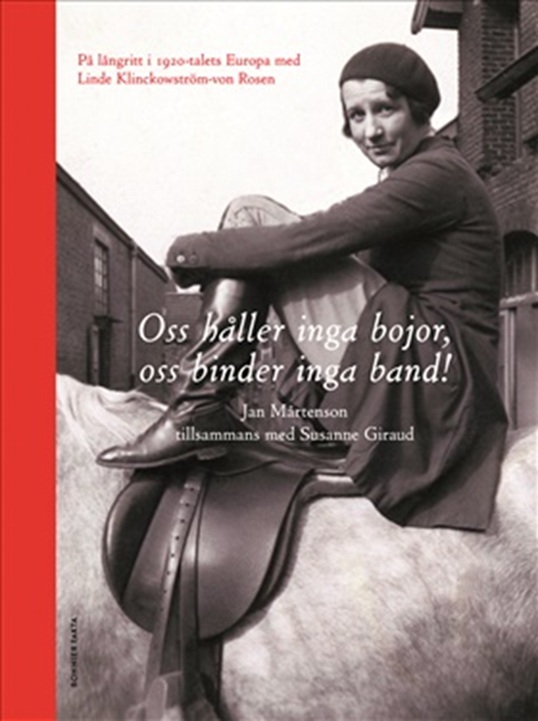
Above: Linde Klinckowström-von Rosen on the cover of her 2013 biography by Jan Mårtenson and Susanne G. Langenskiöld, Nothing holds us back, nothing ties us down.
Source: Wahlström & Widstrand, publishers.
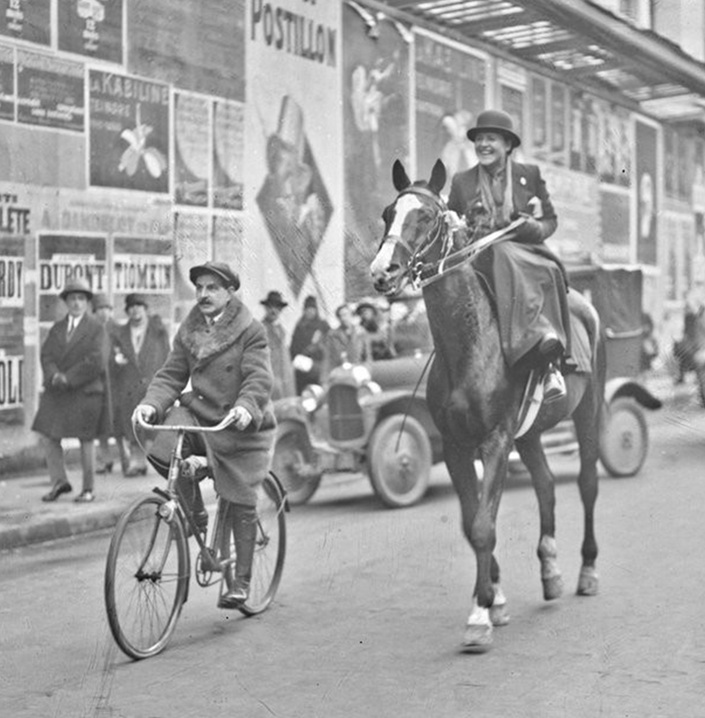
Above: Rachel on her return to Paris from Berlin, November 21, 1927 (detail). Nobody seems to have taken her picture when she set off from Paris nearly three months earlier. Although she rode astride on her return journey from Berlin, she made her entry into Paris riding sidesaddle and wearing a riding skirt instead of breeches.
Source: "21/11/27, Mlle [Rachel] Dorange sur [le cheval] Le Huppé," Agence Roi press photo in Bibliothèque nationale de France; via Gallica
7. Berlin, 1927
If Rachel needed inspiration for her first long ride from Paris to Berlin she may have gotten it from another amazon, a Swedish woman named Linde Klinckowström-von Rosen who rode 1,881 kilometers from Stockholm to Paris in December, 1926. Linde's purpose for the journey was simple: she wanted to visit her recently-married sister who was living in Paris. On the way she stopped off in Brussels to attend the wedding of Princess Astrid of Sweden and Prince Leopold of Belgium (Linde was a baroness).
Rachel would certainly have seen Linde's picture in Paris newspapers and read about her exploit. She would also have noted the intense public interest in long-distance records. Charles Lindbergh's electrifying trans-Atlantic flight had taken place in May, 1927, only three months before Rachel left Paris and while he and rival aviators claimed the most attention the news media were avid for any kind of record-breaking feat, from dance marathons to flagpole sitting.
Although the scars inflicted during 1914-1918 were still fresh and although border crossing requirements were as always complicated, Linde had managed to travel across Germany and through former battlegrounds to reach Paris. This in itself demonstrated the feasibility of a journey from Paris to Berlin.
Rachel left Paris on August 30, 1927, seen off by a few well-wishers. There was no fanfare or prior publicity: Rachel was well into her journey before the newspapers began to take notice of her. Apart from her everyday riding clothes she carried a small bag containing silk stockings, a dress and shoes for evening wear, toilet articles and "some linen". A second bag contained grooming aids for Le Huppé. She also carried a raincoat, a camera and a small revolver. The combined weight of rider and luggage was about 86 kilograms (190 pounds).
From Paris, Rachel's route took her northeast through a succession of towns and villages in France, Belgium and Holland, including Soissons, Liege, Brussels, Antwerp, Rotterdam and The Hague, which she reached on September 14. On average, for each of her fifteen days of travel she and Le Huppé covered 45 kilometers. However, the fifteen days included stopovers so the daily distance approximated Rachel's target of at least 50 kilometers.
"If I did not arrive at The Hague, including a serious detour, until 15 days after my departure from Paris, it's because I stopped, according to my inclination, a day or two in the cities that seemed to me interesting to visit. It was tourism that I wished to pursue, not a speed record." Rachel had planned at least 50 "stages" of 50 kilometers each so that her round trip would not take more than three months.
When Rachel reached The Hague, newspapers finally began to pay her some attention though only with laconic bulletins reporting her arrival and her intention to make Utrecht the next day. There were two weeks more of press silence until October 1, when Rachel arrived in Berlin, but without Le Huppé.
They had made it as far as Hanover on September 29 when Le Huppé was incapacitated by a muscle cramp. Rachel left him with a veterinarian and went on to Berlin alone, presumably by train. She had not yet completed her journey on horseback, but nevertheless "I was admirably received by M. de Margerie, the French colony and the German citizens." Pierre de Margerie was the French ambassador to Germany.
Rachel blamed Le Huppé's ailment on the fact that she had ridden sidesaddle. "I would have been better to have ridden the whole trip astride, walking beside my horse from time to time to give him a rest as is customary in long journeys. But when riding sidesaddle you are always leery of dismounting, not knowing how to remount if you are alone on the road."
Remounting required her to stand on a mounting block or a suitable substitute, such as a chair. "Try asking for a chair from a Dutch or German farmer if you don't know their language. You're stuck in the saddle from departure to arrival [at each stopover]. It's not funny, believe me."
Rachel did not understand German and depended on finding people who could speak French whenever she stopped. A teacher she met wrote a note in German to enable her to ask farmers for horse feed. When Rachel stopped near Osnabruck and handed the note to a farmer, he assumed that she was a beggar and not only gave her feed but handed her two five-pfennig coins as well. Rachel laughed in surprise but was touched by his kindness. She kept the coins as a souvenir and paid him with a five-mark silver coin.
It took two weeks for Le Huppé to recover. Rachel bought a "man's saddle" and they resumed their journey with Rachel riding astride "for the first time in my life." They stopped at Brunswick on October 14, Magdeburg on October 16 and Potsdam on October 18. A few kilometers from Berlin she changed saddles again and rode sidesaddle into Berlin on October 19.