




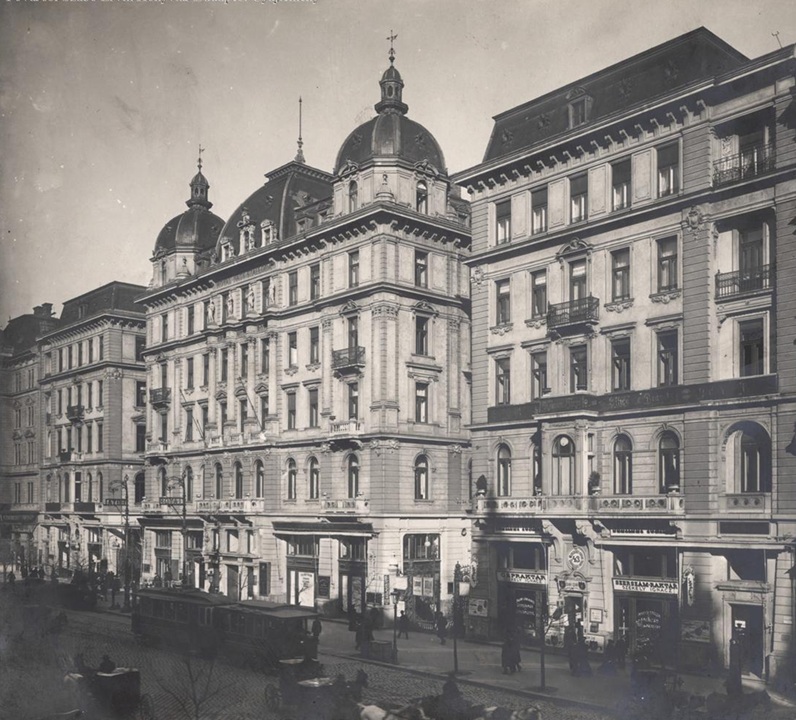
Above: The Royal Hotel, Budapest about 1900 (detail). Built in 1896, it was heavily damaged during the Hungarian revolution of 1956 and was only reopened in 1961 after extensive renovation.
Source: Csaba Domonkos, "The luxury hotel was designed for tourists from the West — the Royal reopened 60 years ago," Pest Buda, August 25, 1921. >
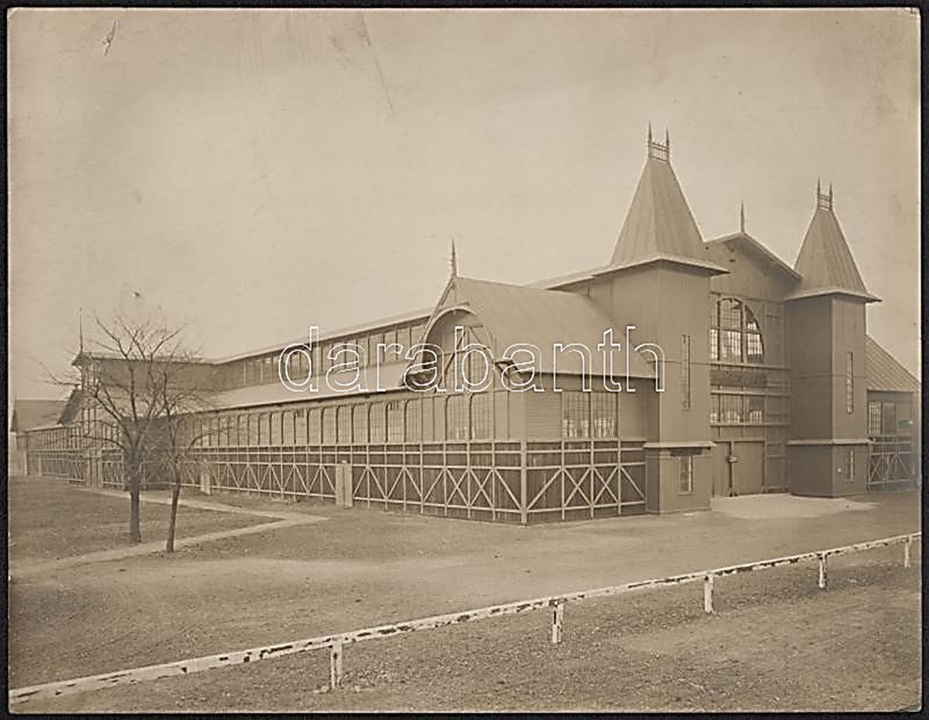
Above: Budapest, VIII. Tattersall, Nemzeti Lovarda (Budapest, VIII. Tattersall, National Riding School), about 1900. This is where Le Huppé stayed while Rachel was in Budapest. The building was replaced in 1932. Photo credit: Erdélyi Mór (1866-1934).
Source: Darabanth Aukciósház (Darabanth Auction House).
9. Bucharest, 1928 (continued)
Vienna to Budapest (Map 5-6)
The reporter for Magyar Hirlap strayed from the familiar script to ask a few intrusive questions. He elicited a revealing response, though perhaps not the one he hoped for.
"I am curious about what Miss D'Orange does for a living.... Miss D'Orange taps the table with impressive force.
"'This is my secret. I have money and I live off of it.'
"I ask about her parents. Miss D'Orange smiles.
"'If I told you who my parents were and what they did, people would know everything. So my identity is a bit vague, and let's be honest, it's much more interesting.'
"I ask if she is traveling under a pseudonym. Miss D'Orange doesn't answer.
"Now I boldly ask her about her age. Miss D'Orange is now seriously angry. She reaches for her trench coat and a huge Belgian revolver butt peeks out of a pocket. Her sun-kissed face becomes a shade darker.... Miss D'Orange cuts the matter short by quickly talking about her further plans."
While outlining where she intended to go after Budapest, Rachel's mood suddenly changed again as she revealed her sensitivity to some gossip that was being reported in the media.
"'They said I was cheating. That I was walking. That I would travel by car or a comfortable train. I really have nothing else to say to this. The petty people and the mockers are coming after me.'"
Rachel may have been upset by an article that appeared the day before in the daily newspaper Ujság. The article, scathingly dismissive, was a rare example of Rachel getting bad press:
"No matter how captivating Miss D'Orange's photographs in French newspapers may be, her venture has no sporting significance, just as her long-distance riding is not long-distance riding. There is no set time or daily performance; she does what she likes and stops where and for as long as she wants.... the so-called endurance riding of Miss D'Orange of Paris is closer to operetta than equestrian sport.... She can spend as much time as she likes... and when she gets bored in one place, she moves on to new regions."
The article signed "Sz" went on to lecture its readers about the true nature of endurance riding:
"The goal of endurance riding has always been, first, to cover the greatest distance with the least amount of fatigue and to set a record for that distance. The second goal is to preserve the horse's strength and bring its condition to its full potential."
The article listed several examples of record-breaking endurance rides over the previous two centuries, including a 580-kilometer race from Vienna to Berlin and back in 1892 in which "at the finish line, six competitors' horses collapsed dead." So much for "preserve the horse's strength and bring its condition to its full potential."