





Above: The former Poděbrady barracks where Le Huppé was stabled in Prague. The building has now been redeveloped as an upscale shopping mall and office building called "Palladium."
Source: "Palladium," Homeland (real estate company).

Above: The Charles Bridge over the Vitava River in 1928. The original bridge dates back to 1357 when the first stone was laid, but construction was not completed until 1402 (Wikipedia).
Source: "1928 Czechoslovakia Vaclavske Namesti,,,," ("Czechoslovakia, Wenceslas Square...." Photograph from an unidentified book. ebay (vendor: Advertising Shop).
9. Bucharest, 1928 (continued)
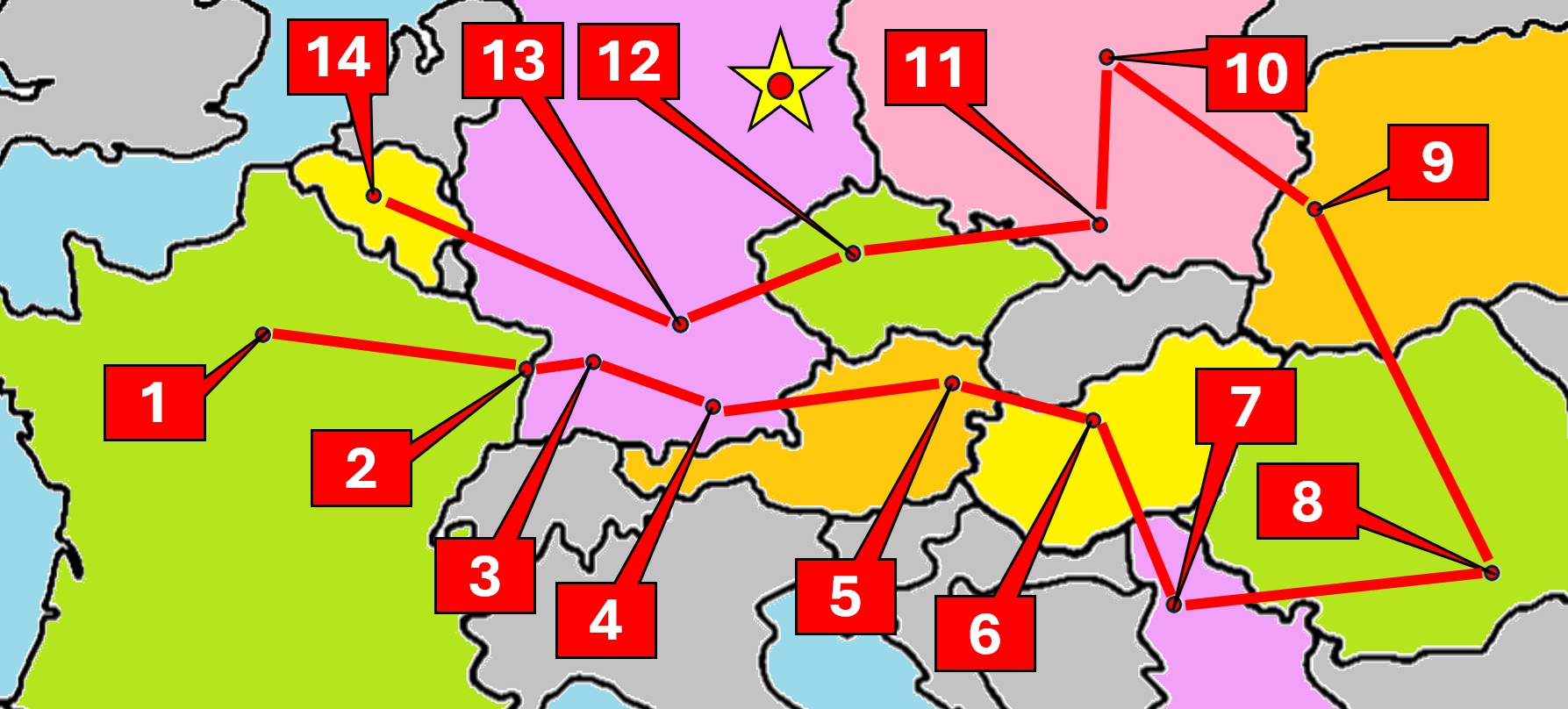
Krakow to Prague (Map 11-12)
According to Gazeta Polska, "On Sunday [September 2] , Miss Dorange left Krakow at 9 a.m., and was escorted a few kilometers away by officers of the O.K.V.P. corps. Miss Dorange stopped in Zator, after which she proceeded to the Czech border."
Zator is 58 kilometers west of Krakow and Cieszyn is 80 kilometers west of Zator, so presumably these were two overnight stops. Cieszyn and the Czech city of Český Těšín are on opposite sides of the Olza River which forms the Polish-Czech border at this point.
Rachel managed to cross the border without the Czech press noticing until she was almost to Prague. On September 10 Pragai Magyar Hirlap, quoting the newspaper Pondelni List reported that "the sporting public was not informed yesterday that the daring lady had arrived in Czechoslovakia, even though Miss d'Orange had crossed the border of the republic three days ago."
Three days earlier would have had Rachel crossing the border on September 7 or 8, but in fact she must have crossed it on either the 3rd or the 4th.
According to Pragai Magyar Hirlap "the first news that appeared in the Prague press about her stay here only reported that Miss d'Orange arrived in Plaňany at six o'clock on Sunday evening [September 9] and in the [same] evening she reached Böhmisch Brőd, where she spent the night in a hotel."
Böhmisch Brőd is now called Český Brod. The distance from Krakow to here is 471 kilometers, which Rachel covered in eight days, an average of 59 kilometers a day.
As usual, "Miss D'Orange first took care of her horse in Böhmisch Brőd. In the hotel stable, she washed the dust off him herself, fed him, and gave ihim water. She has been doing this work since she left Paris. She travels about sixty-five kilometers a day on the highway, but yesterday she made an exception and traveled eighty kilometers."
Rachel made her entry into Prague the next morning, September 10.
"She left Böhmisch Brod at seven in the morning and reached the border of Hrdlořezy near Prague at half past nine, where she was greeted by enthusiastic crowds.
"On behalf of the Czechoslovakian Equestrian Association, Dr. Eisner welcomed Miss d'Orange and presented her with a bouquet of flowers. Director Pick greeted her on behalf of the Prague Equestrian Club. The French embassy was also represented at the reception, and Captain Spáleny was present on behalf of the Czechoslovak army. Miss d'Orange then entered Prague accompanied by her many admirers and took up residence in a hotel. She will stay in Prague for two or three days, then return to Paris via Karlsbad and Nuremberg."
The welcome was a gratifying change after what she had experienced in Bucharest, Warsaw and Krakow.
"Her horse was stabled at the Poděbrady barracks on Republic Square. Miss d'Orange brought only one evening gown with her, in addition to her riding clothes."
There is some confusion in the reports of Rachel's departure from Prague. Le Matin quoted a report datelined September 15 that said she left "yesterday afternoon," i.e., September 14.
Pragai Magyar Hirlap of September 16 said that she left "yesterday," i.e., September 15, but said that she spent two days in Prague when actually she had arrived five days earlier. This report also said that Rachel's "admirers in Prague presented her with a gold powder box as a gift, presumably a compact.
Le Petit Journal agreed with Pragai Magyar Hirlap that Rachel left on September 15 and said that she was seen off by a large crowd as she rode Le Huppé out of the Poděbrady barracks.