




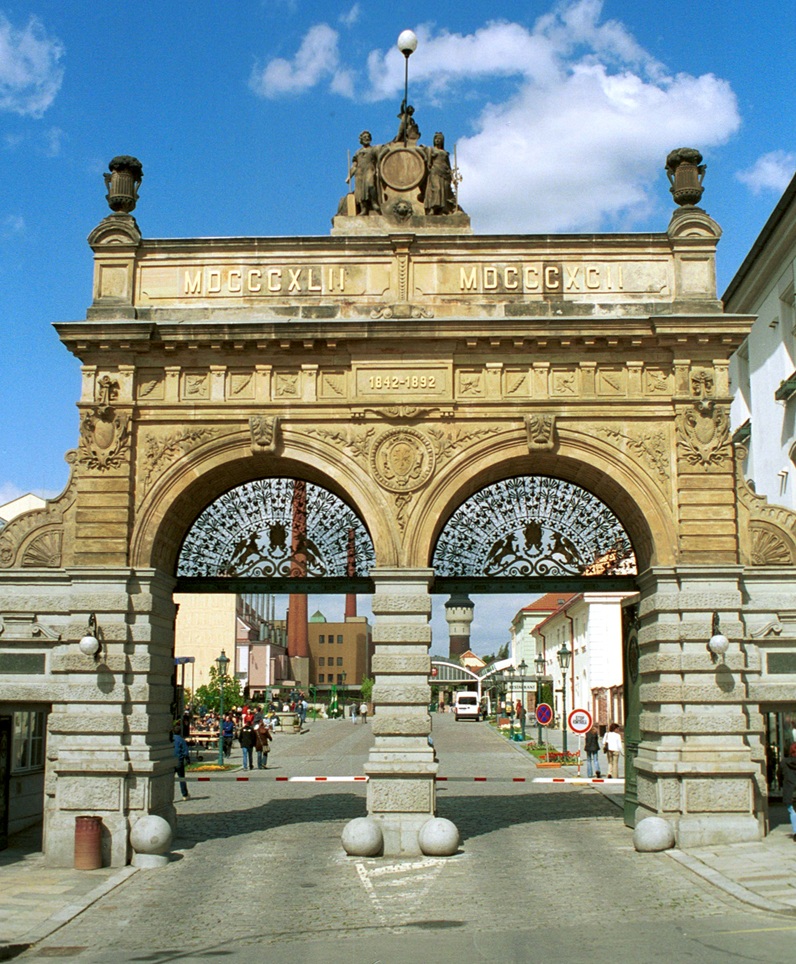
Above: The Jubilee gate (detail), constructed in 1892 to celebrate the 50th anniversary of Burghers' Brewery and Pilsner beer.
Pizeň / Pilsen, Czechia.
Source: "Pilsen Brewery Gate," published 4.5.2015 Prazdrog (brewery).

Above: Le Haras de Strasbourg (Strasbourg Stud Farm), photo circa 1965 when it was still in operation. Le Huppé was stabled at the farm on the night of September 24-25, 1928.
Source: "Le Haras de Strasbourg a deux cents ans" ("The Strasbourg Stud Farm is 200 years old"), Archives DNA (Dernières Nouvelles d'Alsace / Latest News From Alsace). One of four photos.
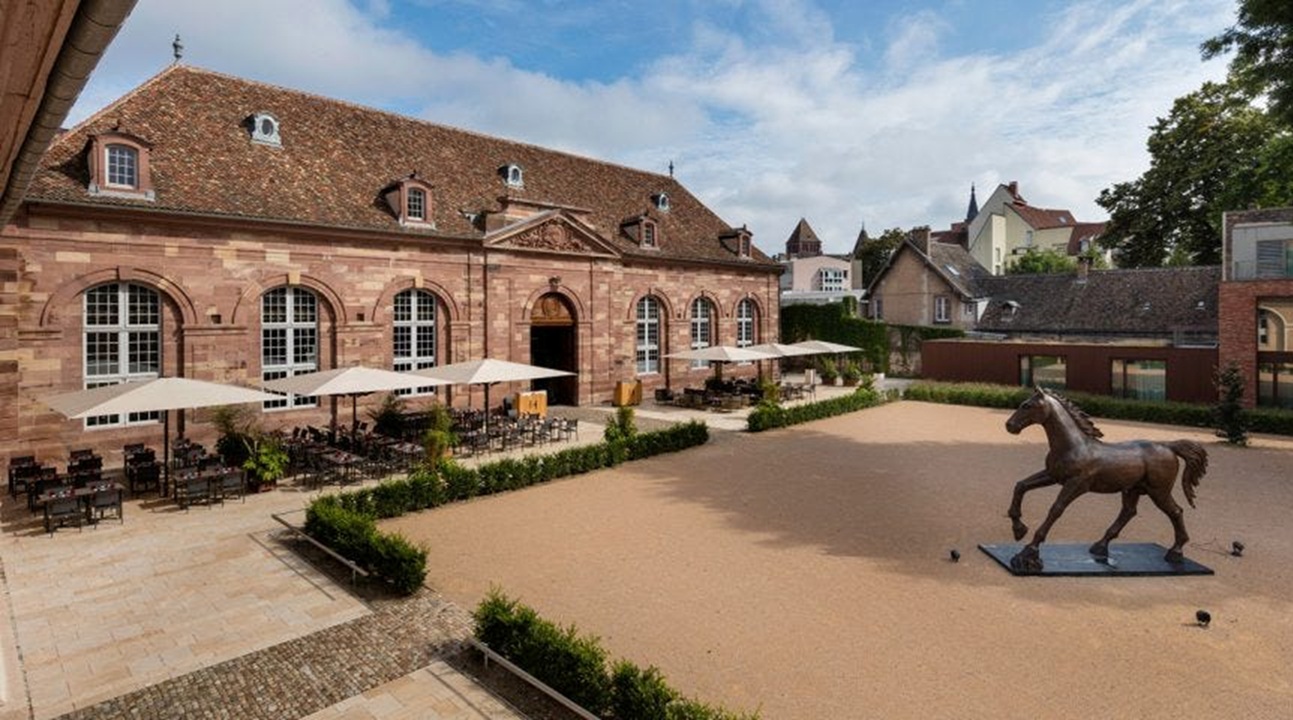
Above: Same building, now part of the Les Haras Hotel.
Source: Chris O'Brien, "Dreaming Of France: Les Haras Hotel: Luxury In Strasbourg" French Crossroads (blog).
9. Bucharest, 1928 (continued)
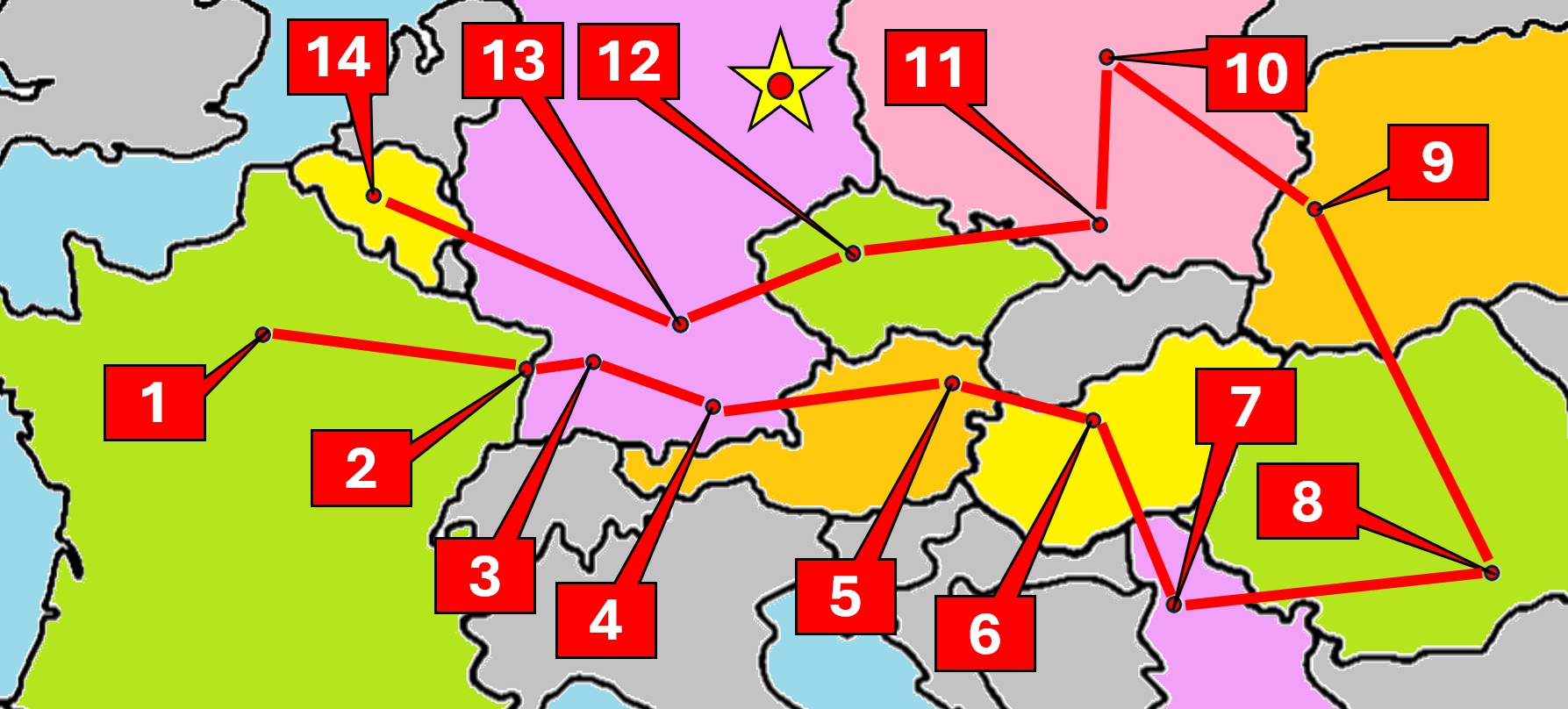
Prague to Brussels (Map 12-13-14)
After Prague, we run into another gap in news coverage until Rachel arrived in Strasbourg on the afternoon of September 24. If she left Prague on September 15, it took her ten days to cover the 602 kilometers at an average of 60 kilometers a day.
We do however have an itinerary. Le Petit Journal listed seven towns on her route, with one more provided by Journal de Guebwiller:
Rachel and Le Huppé crossed the Rhine River over the bridge from Kehl, Germany, the same bridge that they crossed in the opposite direction on April 22, almost exactly five months earlier (Page 15).
"Four charming female riders from Strasbourg were waiting for them on the Kehler Bridge: Madame Eyrand, Mademoiselles Juliane, Feuchter, and Lauffenburger.
"After Madame Eyrand presented them with a beautiful bouquet of flowers and the inevitable passport formalities had been completed, the five riders set off on a leisurely ride through the city, where they were greeted enthusiastically by the public.
"Accompanied by a large crowd of admirers, Mlle Dorange arrived at the Haras stables. Mr. de Laurens, Sous-directeur, warmly welcomed the rider and gave her faithful horse "Le Huppé" every conceivable care....
The Haras was created as a royal stud farm and riding academy and consisted of a complex of buildings constructed in the 18th century. In 2013 the restored complex, a listed monument since 1922, was opened as a luxury hotel.
"Throughout her journey, Mlle Dorange tells us, she was the object of general admiration and was received by the highest dignitaries, who organized splendid events in her honor.
"Le Huppé, her brave horse, performed wonderfully throughout the entire journey. Despite a painful wound, he covered more than 9,000 [sic] kilometers with his mistress on his back over the last two [sic] months. He completed the last 900 kilometers in an impressive time of 12 days.
"It is difficult to know what to admire most: the personal courage and entrepreneurial spirit of the horsewoman or the horse's remarkable endurance.
"Mlle Dorange will leave Strasbourg heading for Zabern at 1 p.m. this afternoon [September 25].
Zabern, now called Saverne in Alsace-Lorraine is 54 kilometers from Strasbourg.
It was in Strasbourg that Rachel gave the interview in which she offered her assessment of Colonel Păun and of men in general (Page 23). In the same interview she confessed that during the arduous journey she had often come close to quitting:
"But don't think," the courageous Frenchwoman continued, "that it has always been so wonderful. There were certainly disappointments. When you spend a hundred days in the saddle, the journey does eventually become monotonous. The days follow one another and are all too similar.
"Then there is the exhaustion, the wearisome fatigue, and the difficulty of finding ordinary food. I have often been on the verge of giving up the entire journey and returning to Paris. But I was ashamed not to accomplish what I had undertaken. My pride kept me going, and here I am!"
At the same time she glossed over the hostile treatment she had received in Bucharest, Warsaw and Krakow, choosing to remember only the good times with good people:
"Miss Dorange, according to our correspondent, is delighted with her journey and no less so with the friendly reception she has received, particularly in Romania and Poland.... [In] Warsaw and Prague, warm welcomes from the French colony and Polish and Czech friends.
"And what is the lesson of this journey, mademoiselle?"
"The lesson. Yes. What can I say; it's probably not a profound lesson, but I've simply proven that with energy and by taking good care of one's horse, one can make a six-month tour of Europe.
"That's no small feat. My gray bowler hat withstood the sun and wind; my riding boots withstood the dust and mud; my body and Huppé endured all the exertion. Call it a lesson in equestrian energy.."
"And what will you do when you're back in Paris again?"
"First, rest, and then… but please don't tell anyone. I'm really looking forward to wearing a dress again. Always having to wear those riding breeches is annoying, and I'd rather not even mention my riding boots.
"And then there's nothing better than a pleasant stroll along the boulevards, because even if you ride 9,000 kilometers in a year, the longing for Paris becomes too strong.."