




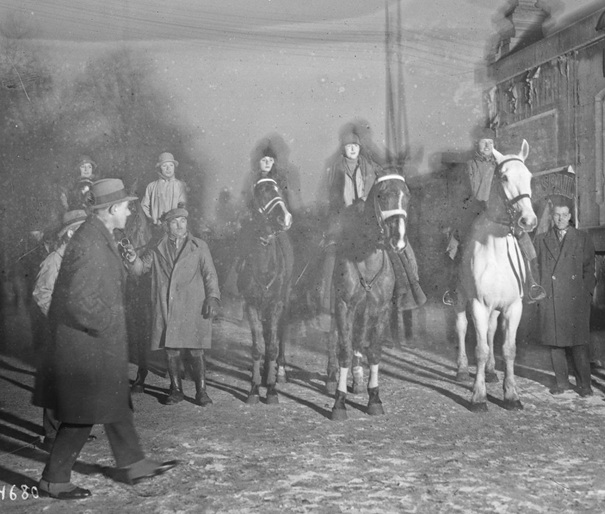
Above: January 5, 1929. Chilly amazons await the start of the Paris-Cannes race. In the early morning darkness the photographer has used a flash.
Source: Bibliothèque nationale de France (via Gallica). Photo credit: Agence Roi press photograph.
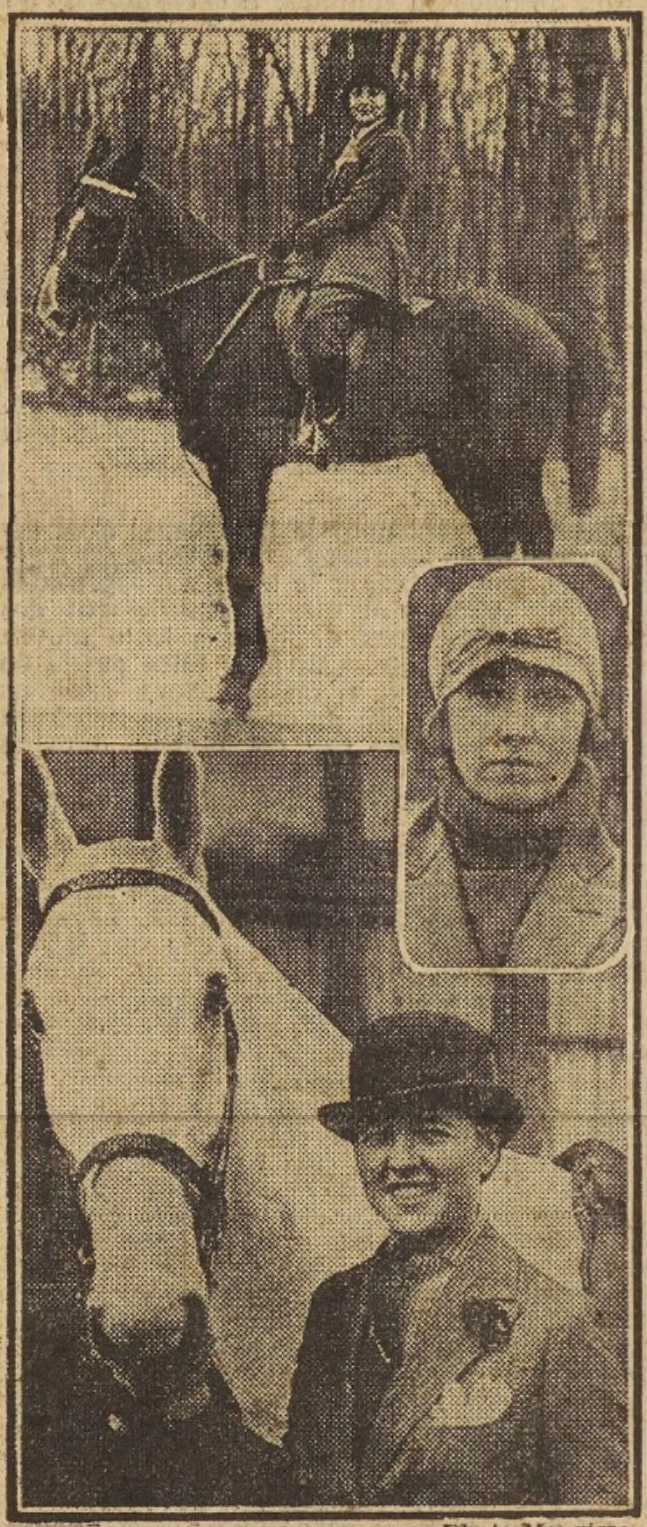
Above: Huguette Villers (top); Mademoiselle Lenoir (middle); Rachel Dorange and Dick (bottom).
Source: Le Progrès (Lyon), January 6, 1929, p. 1. Bibliothèque nationale de France (via Gallica). Photo credit: Meurisse.
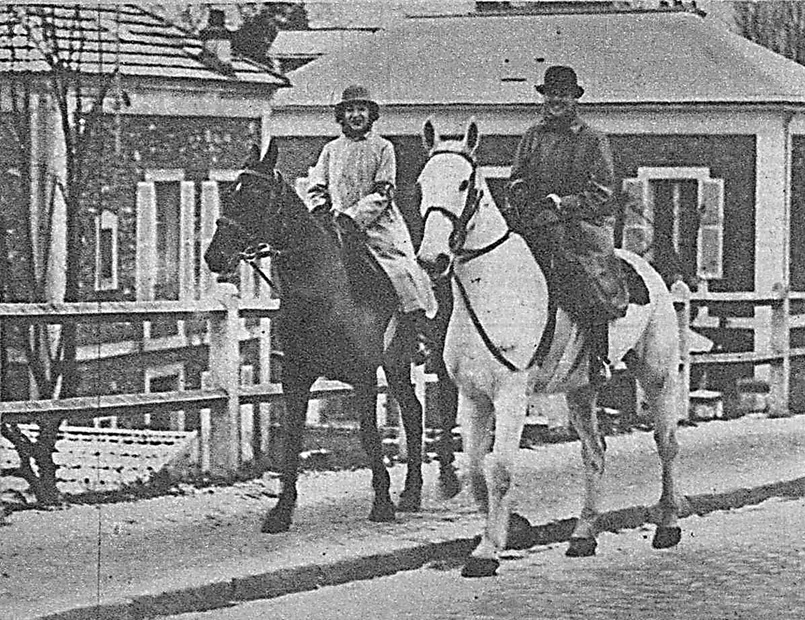
Above: Mlle Savin and Rachel passing through Villeneuve-Saint-Georges, 21 kilometers south of Paris (detail). In another 75 kilometers they will reach Villeneuve-la-Guyard where they will both pull out of the race.
Source: El Dia Grafico, January 11, 1929, p. 23 (via Biblioteca Virtual de Prensa Histórica). Photo credit: Vidal.
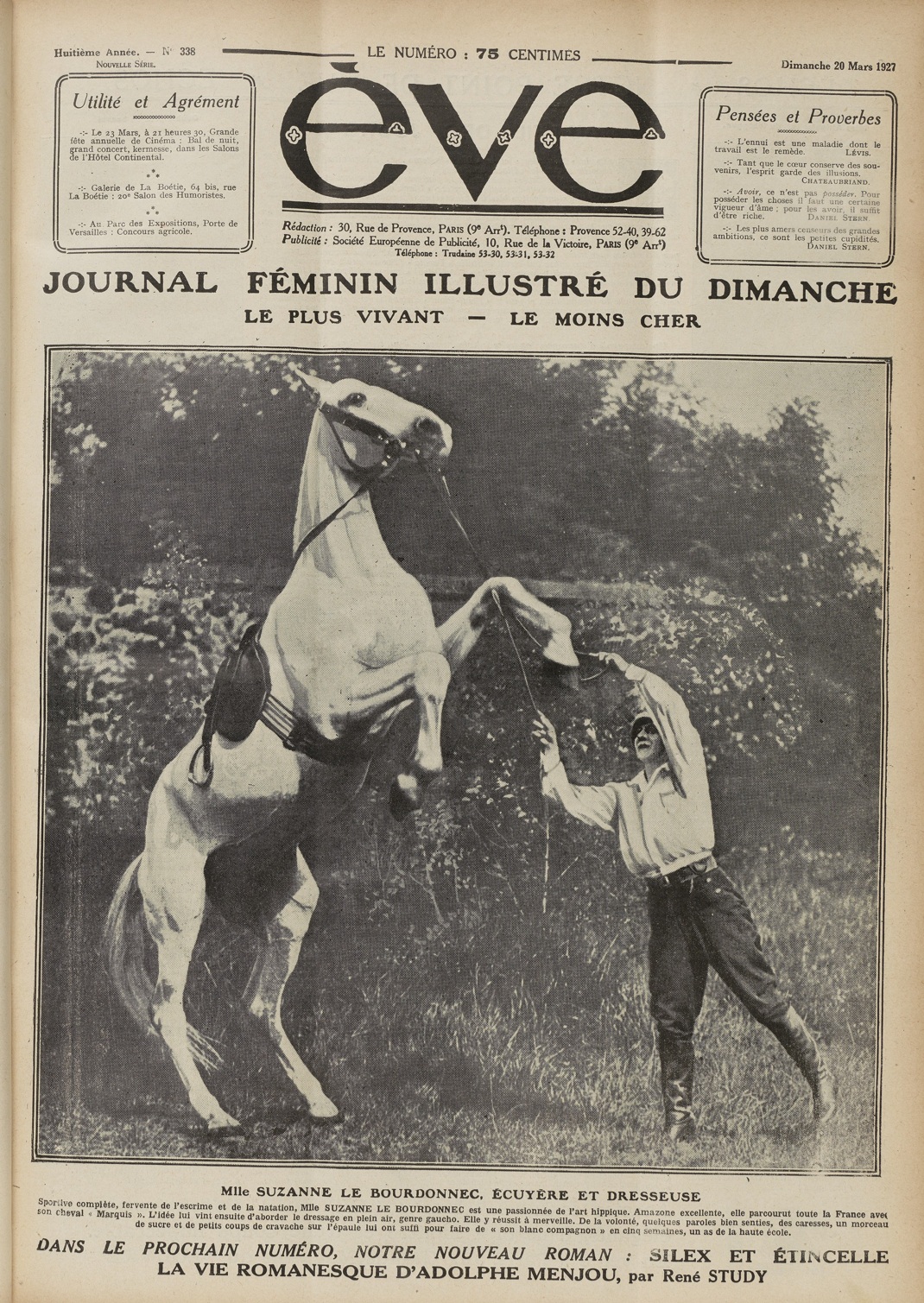
Above: Suzanne Le Bourdonnec and her horse Marquis on the cover of Eve. They toured France and performed "gaucho style" dressage routines in outdoor venues.
Source: Eve, March 20, 1927. Bibliothèque nationale de France (via Gallica).
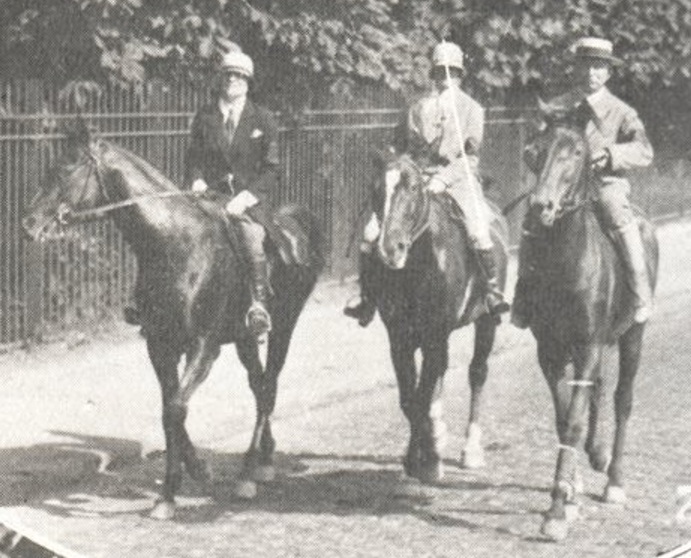
Above: Yvonne Leber (left) with two other participants in the Paris-Deauville "comme autrefois ("as in the old days") race (detail). One of a page of photos taken at the start of the race in Paris.
Source: Le Sport Universel Illustré, July 7, 1928, p. 492 (Bibliothèque nationale de France (via Gallica).
10. Paris-Cannes, 1929
Shortly after 7 o'clock on the freezing cold morning of Monday, January 5, 1929, whipped by blustery wind, eleven women on horseback waited for the starter's signal to set off on twelve-day, 900 kilometer endurance race from Paris to Cannes:
It was the second edition of the race Paris-Cannes race that was run the year before, in January, 1928 (page 10).
The women all seem to have been serious contenders and some were prominent equestrians. Mary Féraud had recently completed her Paris-Rome long-distance ride. She, Madame Lenoir and Rachel Grossi had all participated in the 1928 Paris-Cannes race. Yvonne Leber was the first horsewoman across the finish line (beating out Mary Féraud) in a 200-kilometer race from Paris to Deauville. Suzanne Lebourdonnec was a well-known dressage rider.
Huguette Villers, billed as a 17-year-old aspiring movie star, proved to be a determined competitor. She went on to complete at least one other ride, 400 kilometers from Aix-les-Bains to Juan-les-Pins, in 1930. By 1930 Fernande Hustinx had moved from horses to cars and made a name for herself as a rally driver for Peugeot.
Rachel Dorange had flatly refused to participate in the 1928 race. And yet here she was, lined up with ten other women, dressed in her boots, breeches and derby hat, smiling for the cameras and chatting with reporters. But why?
She had even less to gain from this race than she had in 1928. Her Paris-Bucharest-Paris ride had placed her head and shoulders above any rival amazon, including Marie Féraud. Winning the race would mean llittle or nothing to her, but losing would dim the lustre of her long distance achievements.
And then there was the weather. A correspondent of the German language newspaper Stunde described the scene at the starting point:
"It was freezing cold. The two city customs officers at the iron gate of the Porte Dorée had almost frozen to death overnight. An old tram puffs through the fog. The security guard is wrapped up like a mummy. His beard is frosted over. A merciless January wind whistles from the Bois de Vincennes. The huge construction site of the colonial exhibition lies deserted and frozen. Horses neigh and stamp their feet. A few cars rattle by. The few curious onlookers sit on the hoods of their cars to warm their legs."
Conditions were even worse when the race started.
As in 1928, the 1929 race was scheduled to fill the sports pages during the slow winter season when outdoor sports came to a halt. The effect on horses and riders, as a consideration, was a distant second. This was not lost on some observers:
"There was considerable skepticism about the outcome of the 1929 event. While the first race took place during favorable weather conditions, the second... was run in harsh and hostile weather: cold, snow, a biting wind, and black ice, to such an extent that no one believed the audacious and charming amazons... would ever reach the finish line on their courageous mounts....
"We know, from the details we provided day by day, that some, to ease the strain on their horses, walked long stretches of the route. And in what conditions! In the snow, on treacherous roads, and sometimes in slippers or with bandaged knees after their horses slipped."
So, with all this misery to look forward to, why was Rachel so cheerful at the start of the race? Probably because she had no intention of lasting more than a single day.
Rachel's mount in the race was a horse called Dick and in her interview with Die Stunde she clearly planted the idea of withdrawing from the race as well as setting Dick up for the blame:
"'I'll ride hard,' she says, 'but I don't know if I'll reach the finish line. If Dick plays a trick on me again like last year, I'm lost. But I hope I won't need to use the letter of recommendation that the director of the railroad company gave us for the careful return transport of our horses.'"
What trick could Dick have possibly played on Rachel last year? Neither one of them was involved in the 1928 Paris-Cannes race, and when that race began Rachel was almost a thousand kilometers away in Monte Carlo.
In any case Rachel stuck out the 1929 race until the first checkpoint at Villeneuve-la-Guyard, 95 kilometers from Paris and good enough to honour her commitment to participate. Besides, it would have been embarrassing to quit before she had completed the first stage.
The race ended on January 14, 1929 after twelve punishing days on the road, with Rachel Grossi and Mary Féraud well ahead of the remaining contestants.
Rachel crossed the finish line first but Mary was awarded a share of first place on points because, unlike most of the other riders she had cared for Stuart herself and did not rely on help from a companion or from grooms or stablehands along the way.
Mary and Rachel Grossi split the first and second place prizes, winning 4,000 francs each. Suzanne Le Bourdonnec won third prize.
Despite her abandonment of the 1929 race, Rachel Dorange's minimal participation had served its purpose. Her supposed rivalry with Mary Féraud raised public interest in the purported showdown between them, which Rachel's outright refusal to participate would have scuttled.
As the list of contenders attests, Rachel and Mary also drew in other riders. The two attracted a lot of attention to the race which rubbed off on the other contestants, and of course beating both Rachel and Mary would be a feather in the cap of whoever won the race.
An intriguing question remains. Was Rachel's quick exit from the 1929 Paris-Cannes race a put-up job between her and the organizers?
There is no solid evidence but we have grounds for suspicion in the reappearance of our old friends Armand Massard and Jean Hallaure, the masterminds behind the 1928 Paris-Cannes race and, along with Viscount Charles d'Alauzier, sponsors of the brief but spectacular riding career of Martha Gaiatry.