




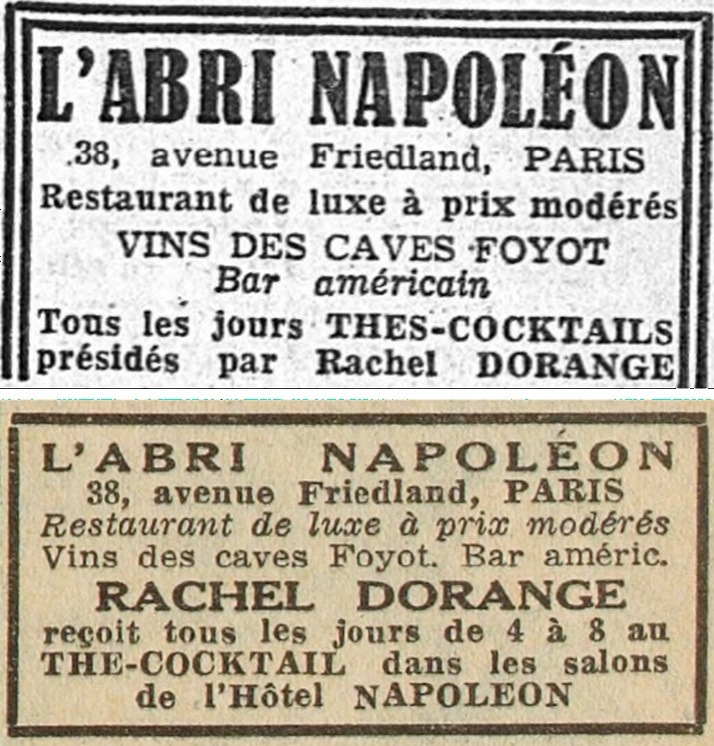
Above: Two ads announcing Rachel "hosting" (or "welcoming") guests for tea and cocktails at the Hôtel Napoléon.
Source: (Top) L'Intransigeant, March 29, 1940, p. 3. (Bottom) Excelsior, April 18, 1940, p. 3. National Library of France (via Gallica).
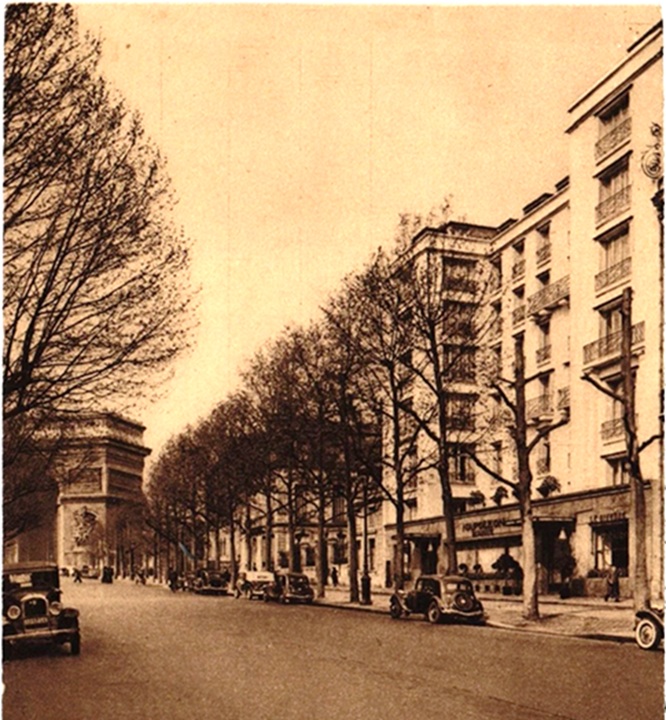
Above: The Hôtel Napoléon (right) with the Arc de Triomphe in the background, about 1930 (detail from postcard).
Source: Des Arts Photomecaniques - Strasbourg-Schiltigheim (via ebay). Vendor: cartepostalesale. The card was evidently used for advertising purposes by the hotel since the telephone number, street address and cable address are printed on the back.
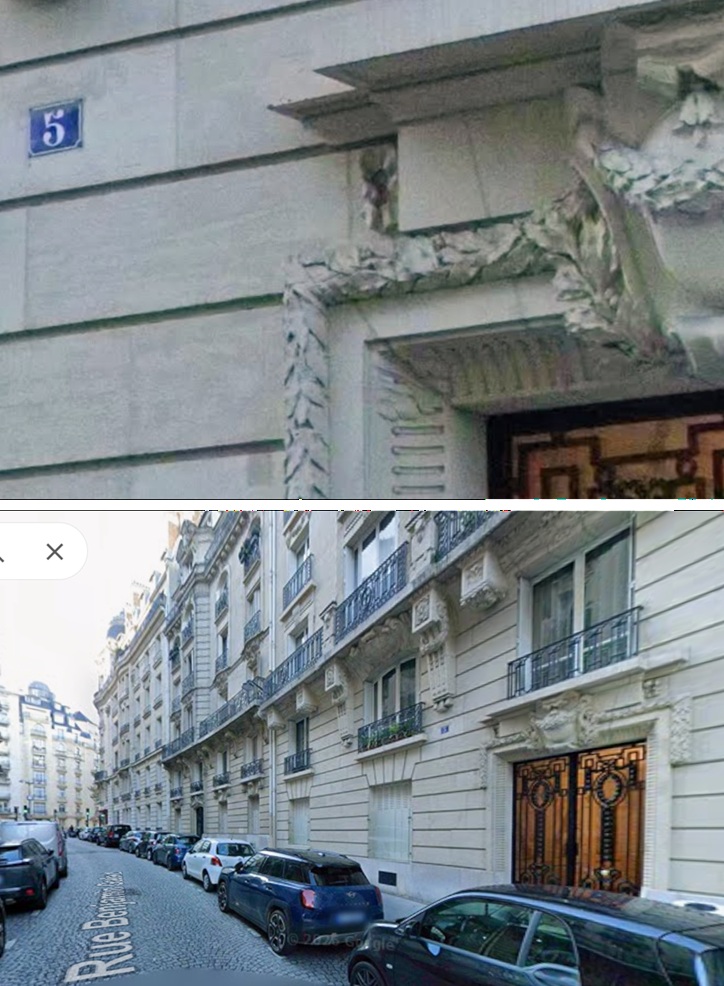
Above: Number 5 Rue Benjamin-Godard, where Rachel lived in a ground-floor apartment.
Source: Google Maps (Google image capture, October 2025).
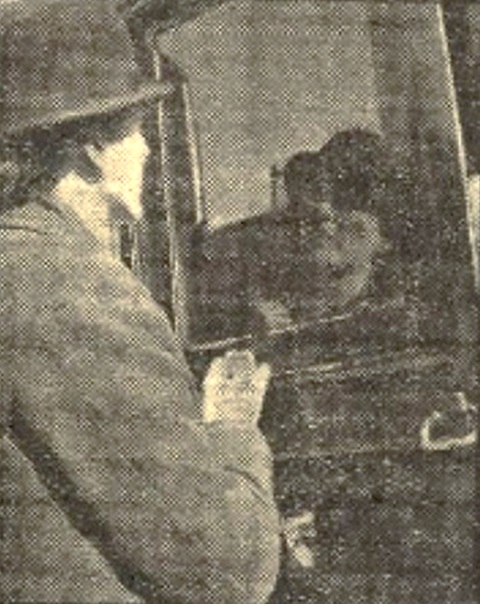
Above: "A bowler hat, a tie, and a hairnet: Rachel Dorange is ready." Rachel checks her reflection in her cab's window before setting off.
Source: 7 Jours, "Rachel Dorange... est devenue cocher de fiacre" ("Rachel Dorange... has become a cab driver"), March 23, 1941, p. 11. National Library of France (via Gallica).
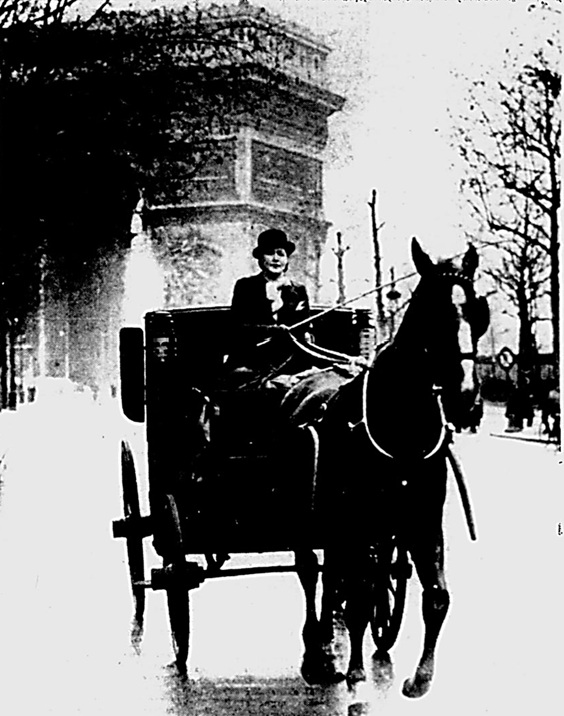
Above: Rachel driving on Avenue Foch with the Arc de Triomphe in the background, March 1941.
Source: Pittsburgh Post-Gazette, March 19, 1941, p. 25 (Google Newspapers).
18. War Years, 1939-45 (continued)
We do not know what Rachel did during 1939, but on March 29 and April 6, 1940 ads for a bar called L'Abri Napoléon (Napoleon's shelter) appeared in two newspapers announcing that tea and cocktails would be available daily "hosted by Rachel Dorange" (left).
On April 16 and 18, two more ads in two different papers appeared with subtle changes. Rachel's name was now more prominent and rather than "hosting" tea and cocktails in the bar she was "welcoming" guests for tea and cocktails in the lounges of the Hôtel Napoléon from 4 to 8 p.m. L'Abri Napoléon was located in the hotel.
When Le Huppé died in 1930 Rachel talked of opening a small bar (page 43), so maybe this was her way of testing the waters. The Hôtel Napoléon was and still is a luxury hotel so it and the bar were certainly up to Rachel's standards.
Whatever her motive, Rachel's role was probably limited to being a celebrity draw, greeting and chatting with customers. It's hard to imagine her serving tea or mixing cocktails. Judging by small number of ads the experiment did not last long.
But as usual, there's another version. In 1946 Rachel told France-Amérique that "I would have loved to go back to my bar at the 'Napoléon' to serve my famous aperitifs, but the 'Napoléon' had been requisitioned." And sure enough, the only published ads for 'L'Abri Napoléon' are the four that feature Rachel, suggesting that the bar was indeed shut down.
By January, 1941 Rachel was fully engaged in the career that she would pursue for the next 25 years. Paris Soir ran a front-page picture story on January 31 (previous page) and asked the obvious question: why become a cab driver?"
"To this question at least one woman has a prompt response.... The celebrated horsewoman has returned to her preferred occupation, that of managing horses, and at the same time she has found a job that day by day is increasingly lucrative."
Rachel told Paule Corday in 1945 that she initially purchased a horse (Coco) and a fiacre not for cab driving but to make a tour of France. Needless to say, in Nazi-controlled Europe travel was tightly restricted so long-distance travel, even within France, was out of the question. If Rachel wanted to manage a horse, cab driving was really the only option available.
In 1951 Rachel gave Qui? Detective magazine some details of how she got into the cab business, at the same time revealing her knowledge of and affection for vestiges of her city's urban history.
"It was at 28 Rue Bayard, just off the corner of Avenue Montaigne, a complex of shady courtyards and half-ruined buildings – delicate carved woodwork worn away by time, balustrades chiseled in the time of Louis XVI – where the famous English grooms Bartlett, who had settled there in 1855, had quickly, I was told, made a name for themselves among the high society of the time for the elegance of their carriages and the perfection of their thoroughbreds.
"In 1940, Mr. Trouvé, a horse dealer, having rented this coach house from the Bartlett descendants to park the horse-drawn carriages temporarily brought back into use due to the absence of taxis – I know something of this, having taken up "carriage driving" myself at that time, as one had to make a living – realized that business wasn't so bad: the last of the 'Drags' "Coco A 1948 New York Herald Tribune report pinpointed her address as number 5 Rue Benjamin-Godard. Yves Rameau visited her there in 1946. He described a "small apartment, decorated with exquisite taste". Nevertheless the apartment was large enough for Rachel to host parties with several invited guests (page 61) and even a horse:
"I once saw Coco in the drawing-room of Rachel Dorange's flat," wrote Paul White, the Daily Mail Paris correspondent. "She was giving a party, and thought it unfair to leave 'the most faithful of her friends' outside."
Michel Détroyat (1905-1956) was a celebrated French aviator and stunt pilot during the 1920s and 1930s. He was also the first entrepreneur to see the business potential of horse-drawn transportation in a gasoline-starved city and rounded up all the carriages he could find to start a hack business. It would not have taken long for others, like Rachel's Mr. Trouvé, to follow his example.
Rachel's purchase of Coco through Détroyat suggests that he acted as a broker for horse dealers. She may even have started out by driving a cab belonging to Détroyat, or some other owner, before she purchased one of her own.
A March, 1941 photo story in the newspaper 7 Jours shows her with a "an old horse [called] 'Bonhomme,' which she would never have chosen in the old days." This sounds like the typical experience of cab drivers throughout history: having to drive whatever vehicle an owner chose – or was able – to provide them with.
Even after she purchased Coco Rachel was still in danger of losing him. The German war machine still relied heavily on horses. A total of 2.75 million of them served the German army during World War II and about 80 percent of German logistics and transport relied on horses. It was only in 1943 that Coco was exempted from requisition, probably thanks in some measure to Rachel's fame.
But where did Rachel get the 26,000 francs to purchase Coco?
In 1946 Rachel told Yves Rameau that following her breakup with Maurice, or Dr. Jean, she was so exhausted "both physically and morally, that she was unable to accept any engagements of any kind. So, when the war broke out, she was in complete material distress. The only thing that remained to her, to release her from this impasse, was her faithful horse Coco....
"With money borrowed from a friend she bought a fiacre, obtained a cab driver's license, harnessed Coco and largely earned her living to the end of the war." This leaves us with two versions of history. In one, Rachel is unable to work and is in complete material distress at the outbreak of war, but though she has to borrow money to buy a cab she already owns a horse. In the other version Rachel is able to finance trips to Monte Carlo in 1933, to the Italian Border in 1935 and to Nice in 1938 as well to purchase Coco (on October 24, 1940 as she told Poule Corday) with no mention of having to borrow money.
In a 1946 interview with France-Amerique Rachel provided some insight into her cab driving life during the Occupation:
"Arthur Weill was my first client. I used to go pick him up every morning on Rue Bassano. Two thousand francs a month – what I make now in just two trips. He died."
There are only two mentions of an Arthur Weill in the Gallica newspaper archive, both referring to a 68-year-old man who was deported with his family to Auschwitz in March, 1944, and was killed there in April (see notes).
"After that I had the Schwartzes, the Zig-Zag cigarette people. They were deported. I had no luck. Neither did they, I must add." (The Schwartzes may have had a connection with Zig-Zag but they were not the owners.)
"So I took anyone, except the Krauts, of course. I'm a peasant at heart, just like Joan of Arc. And for me, the enemies of France are my enemies. I make common cause.
"But hauling around rude people who called me 'cochère' without knowing what I'd been – that hurt me. I thought of something else to earn Coco's and my own pocket money! I took poetry lessons so I could get into the Comédie-Française in an Amazon role.
"And while driving my clients, I'd recite them from my seat, extending the ride when I hadn't finished so as not to interrupt the monologue. So they'd bang on the window, not understanding a thing, those illiterates.
"One day, as I was reaching out my hand for dramatic effect, a German car thought I was turning and hit me head-on. There I was on the pavement with a broken leg and a skull that had been cut open for a trepanation – which, apparently, isn't great for your memory. I got off easy, but not in court.
"'Why are you dressed in a coachman's costume?" the German president "'It's my work outfit – and my formal attire,' I replied. And I added, 'It's good enough for the Prussians.' So he told me I was trying to play 'Mademoiselle Fi-fi,' whom I've never even met, I can tell you that much.
"'No,' I replied; 'I want to join the Comédie Française.' That must have impressed him, because he let me off the hook, the doctor having acknowledged that my fall had really knocked my head. In fact, for three months I couldn't get back into my seat.... And then, all of a sudden, it came back. I was able to get back on my seat with Coco – and my poetry lessons." It is certainly plausible that Rachel had Jewish clients who were arrested and deported to Nazi death camps. However, the lurid tale of her accident and court appearance does not ring true. An attention-grabbing story like this would surely have generated reports in French newspapers and there are none.
Moreover, although Rachel liked to perform on stage, the idea of her turning cab customers into a captive audience seems out of character, as does the idea of Rachel getting carried away with her poetry recital while driving.
The court president's remark about "Mademoiselle Fi-fi" is also odd. It comes from a story by Guy de Maupassant in which the title character is a brutal Prussian officer whose troops call him "Mademoiselle Fi-fi" because of his effeminacy – hardly the kind of literary reference that a Nazi official would make.
On the other hand the reference is the sort of thing that Rachel might drop into a tall tale in order to give it some colour. Especially since the heroine of de Maupassant's story is a Jewish woman named Rachel who kills Mademoiselle Fi-fi and gets away with it.
Rachel's new career as a horse cab driver was noted by several wartime newspapers in articles that were no different from peacetime reportage. French newspapers were under strict Nazi scrutiny but Nazi attention was focused on politics and war news. Coverage of other journalistic preoccupations, such as sports, human interest, entertainment, accidents and crime remained much the same as it had always been.
Rachel's fame as a horsewoman and her upper-crust fan base served her well in her new role. The Swiss newspaper Berner Tagwacht and the German newspaper Westfälische Zeitung reported that it was now considered "good form" and "fashionable" to ride in Rachel's cab.
A report in Candide contains a startling revelation. Asked how she felt about driving a cab, Rachel responded "Really great – it's the first time in my life I've made money!"
Her comment brings us back to the puzzle of how she made her living before cab driving. But there can be litte doubt that even if Rachel was not wholly dependent on cab fares they would certainly have helped her to make ends meet in the new black market economy.