




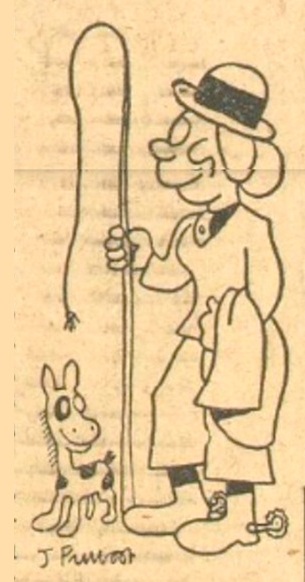
Above: Cartoon of Rachel illustrating the 1942 L'Oeuvre article about her lawsuit.
Source: L'Oeuvre, "Rachel Dorange, cocher de fiacre, a des ennuis avec sa couturière" ("Rachel Dorange, cab driver, is having trouble with her couturier") by Robert Danger, August 15, 1942, p. 1. National Library of France (via Gallica).
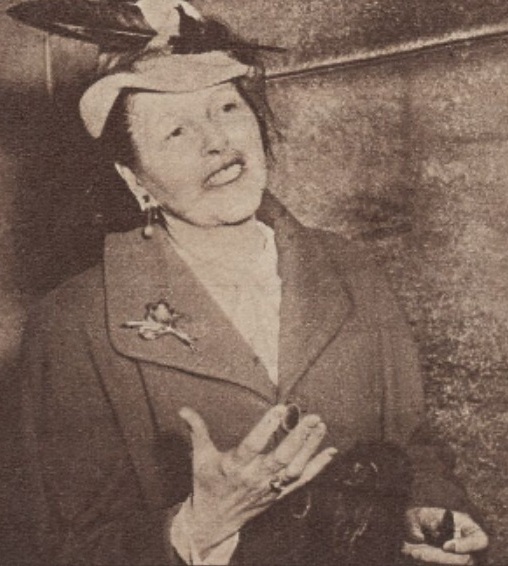
Above: Rachel in 1951, after her courtroom victory over Madame Nadal (detail).
Source: Qui? Detective, "Privée de cheval, Rachel Dorange réclame des Fauteuils" ("Deprived of her horse, Rachel Dorange reclaims her armchairs"), December 31, 1951, p. 17. National Library of France (via Gallica).
18. War Years, 1939-45 (continued)
Rachel claimed to have modeled clothes as a mannequin for a renowned fashion designer when she was sixteen (or possibly when she was twenty-four) and Dr. Hervé Ménager thought she might have worked for the well-known couturier Jean Patou (page 3).
We know for certain that Rachel had a friendship with a couturier named Madame Nadal, but things turned ugly and Rachel wound up taking her former friend to court in August, 1942. According to L'Oeuvre:
"Mlle Rachel Dorange had entrusted this person with four armchairs, Louis XV and Louis XVI medallions, and a chandelier, to enable her to luxuriously furnish the apartment where she practices her profession.
"However, the couturier finds the furniture so much to her liking that she no longer wishes to return it.
"She now claims that Mlle Rachel Dorange gave her the gilded armchairs, not as a deposit, but as a barter, in payment for the dazzling riding outfit she had designed for her.
"Mlle Rachel Dorange protested through the office of attorney Rémy Machetto and claims that this peculiar barter never existed except in the imagination of her couturier, whom she accuses of breach of trust.
"And Rachel Dorange adds, in her colorful language as a cab driver: 'If you told this story to a wooden horse, it would
kick you in the arse!'" The fact that Rachel possessed these antique items once again raises the question of how she financed her lifestyle. But to continue:
Rachel's lawsuit dragged on for nine years, until December, 1951. An article in Qui? Detective magazine provided some background:
"Madame Nadal, formerly a head model at a fashion house where Rachel worked as a mannequin, having set up her own dressmaking business, borrowed four antique armchairs and a chandelier from her; all valuable items.... This loan dates back to 1933. Since then, Rachel has been asking for the chairs back in vain...."
Nadal now claimed that she had provided Rachel with at least sixty gowns without ever receiving payment for them. "You won't convince anyone of that," retorted Rachel's lawyer, Maitre Grillon. "Mlle Dorange's generosity – not to say prodigality – is well known to all."
Unfortunately for Madame Nadal, previous scrapes with the law failed to impress the judge. He took into account a 1941 conviction that netted her three months in jail and a 600-franc fine, and a three-month suspended sentence from 1948.
The prosecuting attorney declined to make a closing argument because, he said, there was no point: the facts of the case were now so old and familiar that the judge could make his decision on them alone. The judge agreed: he ordered Nadal to return the chairs to Rachel and in addition, pay her 5,000 francs in damages and interest.
Was Madame Nadal the "fashionable couturier" who panicked at Rachel's Théâtre de l'Étoile performance in 1946 when it seemed that Rachel might commit suicide wearing an evening gown that was purchased on credit (page 45)? The lawsuit over the armchairs would certainly add a bizarre twist to an already bizarre theatrical experience.