




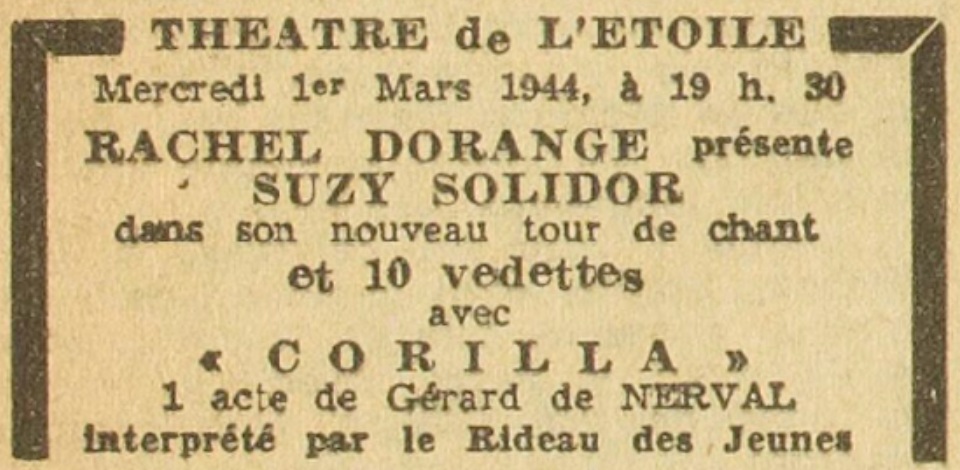
Above: Ad for Rachel's "gala" at Théâtre de l'Étoile on March 1, 1944.
Source: Paris-Midi February 29, 1944, p. 2. National Library of France (via Gallica).
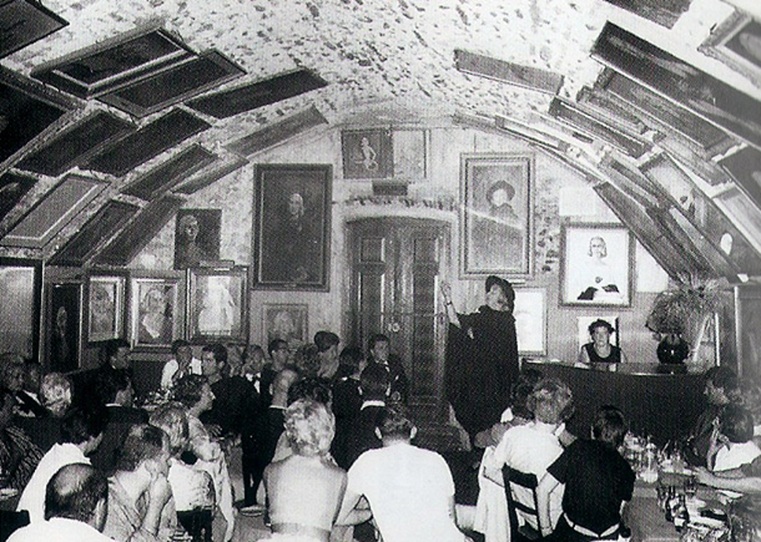
Above: Suzy Solidor singing in her second nightclub, Chez Suzy, opened in February, 1954. The interior, decorated with portraits of herself, probably resembled her original club, La Vie Parisienne.
Source: Louis L'Amour's Lost Treasures. Novelist and short-story writer Louis L'Amour consulted Suzy, apparently a distant relative, about the history of the L'Amour family.
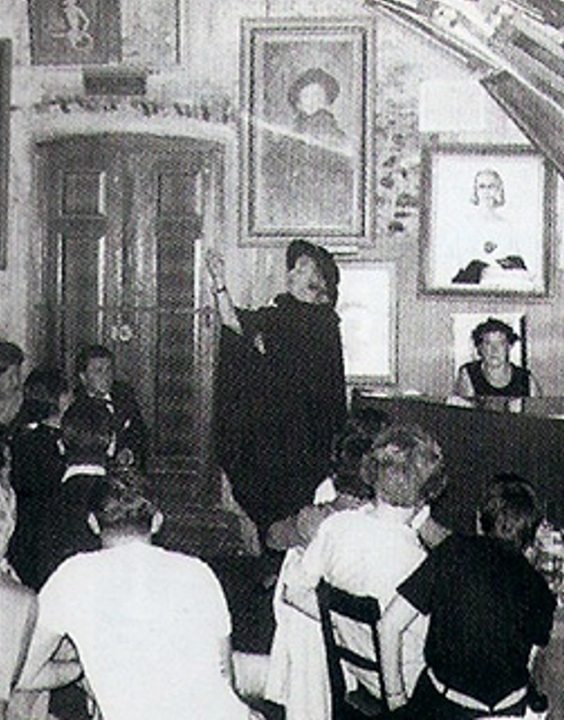
Above: Same photo (detail).
18. War Years, 1939-45 (continued)
A pair of ads in Paris-Soir and Paris-Midi announced an event to take place at Théâtre de l'Étoile on March 1, 1944, at 7:30 p.m.:
"Rachel Dorange presents Suzy Solidor in her new song recital, with 10 star performers and 'Corilla', a one-act play by Gérard de Nerval performed by the Rideau des Jeunes."
Suzy Solidor (1900-1983) was a movie actor and popular singer on French radio who owned a fashionable nightclub called La Vie Parisienne which she opened in 1932. The club was decorated with dozens of portraits of Solidor painted by famous artists of the time, including Pablo Picasso. The portraits were the product of a publicity stunt engineered by Solidor to make herself "the most painted woman in the world."
Although the ads named only Solidor, a short article in the Les Nouveaux Temps identified the other participants in Rachel's "gala" or variety show:
"Just because you're a female coachman doesn't mean you lack good taste. During her gala at l'Étoile tonight, Rachel Dorange will introduce Suzy Solidor in her new song recital, written by Jean Mariat and Jean Marion. Hélène Romanée, Alain Gerbier, Renée Dyane, Hélyett and Marc Dauphin will also perform new songs. Christian Foye, the young principal dancer of the Opéra-Comique, will perform Pygmalion for the first time in a music hall, alongside Olga Alexandrovicz, under the direction of the author Jacques Besse. Finally, Rachel Dorange, who will present her own poetry and dance recital, has secured a performance by 'Le Rideau des Jeunes' of an unpublished one-act play, 'Corilla' by Gérard de Nerval, in which Geneviève Pernet, the lead performer, will be dressed according to a design by the dancer Ione."
Probably all of these participants were then well known in Paris. Many of their names still pop up in web searches.
For example, Hélène Romanée was a singer and radio performer. Renée Dyane was a singer and music hall performer. Hélyett Dauphin was a noted composer and arranger. Christian Foye and Olga Alexandrovicz were well-known ballet dancers and dance partners. Geneviève Ione was a prominent French ballet and stage dancer. "Le Rideau des Jeunes" was a respected theatre troup.
The fact that Rachel was able to recruit so many established artists shows that she was well connected with the theatre world, and was evidently well regarded. Characteristically she included herself among the star performers.
Rachel's recruits may have regarded her as a bit eccentric but they likely appreciated her ability to organize a theatrical event that gave them some exposure and perhaps a bit of badly needed cash.
This is the last wartime report we have for Rachel. Three months after her gala, on June 6, the Allies landed in Normandy and on August 25 the German garrison in Paris surrendered. Liberated areas of France were immediately swept by a wave of reprisals (the "Wild Purge") against suspected collaborators and against members of the Milice, a paramilitary organization formed to combat the French Resistance. The reprisals included summary executions. It is estimated that between 10,000 and 15,000 such executions took place.
The "Wild Purge" ended once Charles De Gaulle's provisional government assumed power. It was replaced by a "legal purge" which lasted from 1945 to 1949. A total of 791 executions were carried out, including that of the Vichy prime minister, Pierre Laval. Other punishments for collaboration with the enemy were graded according to the seriousness of the offence. A total of 49,723 people were sentenced to "national degradation," which involved a loss of citizenship priveleges.
Because Suzy Solidor was a regular singer on Radio-Paris, a Nazi controlled radio station that also broadcast German propaganda, she was convicted of collaboration and sentenced to a five-year ban on public appearances.
Michel Détroyat, through whom Rachel bought her horse Coco (page 54), was also convicted of being a collaborator on a charge of having organized an air transport group for the Germans during the occupation. He was sentenced to exile from France for twenty years but was allowed to return in 1951.
The rumour that Rachel was a Jew, which originated during her 1928 journey to Bucharest (pages 26 and 29), seems not to have followed her home to Paris. In 1928 the rumour subjected her to ostracism in Romania and Poland but had it emerged in Paris during the Occupation it might have been her death warrant.