




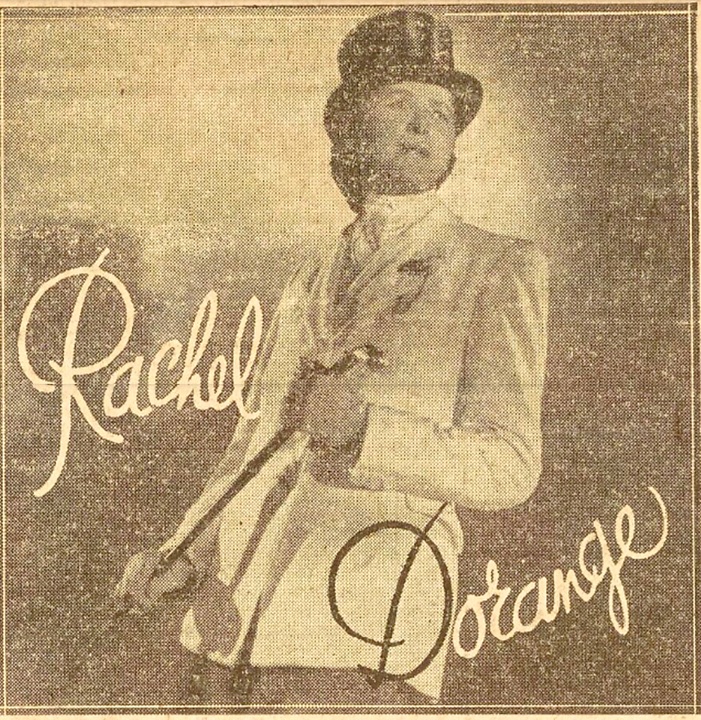
Above: Photo illustrating Paule Corday's interview with Rachel.
Source: "Rachel Dorange qui tenta de se suicider par désespoir d'amour nous parle de L'Histoire de Monte-Carlo" ("Rachel Dorange, who attempted suicide because of heartbreak, tells us about The Story of Monte Carlo") by Paule Corday, La Press November 13, 1945, p. 6. National Library of France (via Gallica).
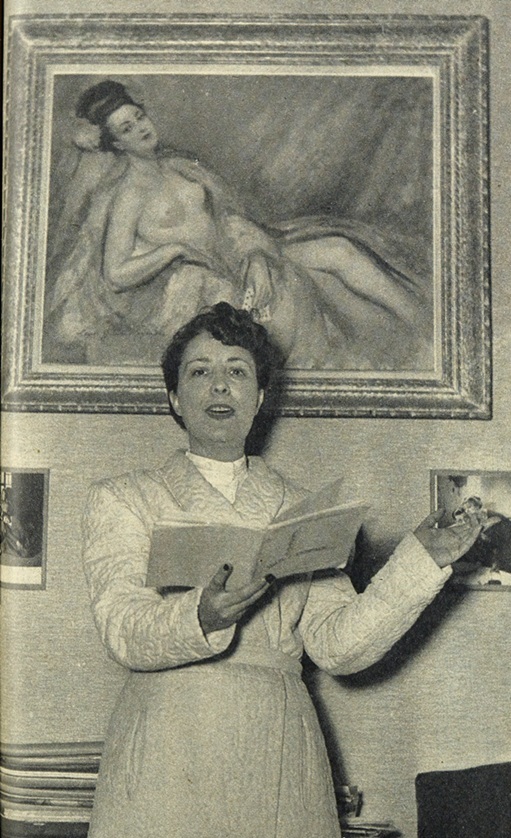
Above: Paule Corday in 1949 (detail).
Source:Point de Vue, "3.800.000 Fracaises se sont resigne a la solitude" ("3,800,000 French women have resigned themselves to loneliness") by Monica Senez, December 15, 1949, p. 5. National Library of France (via Gallica).
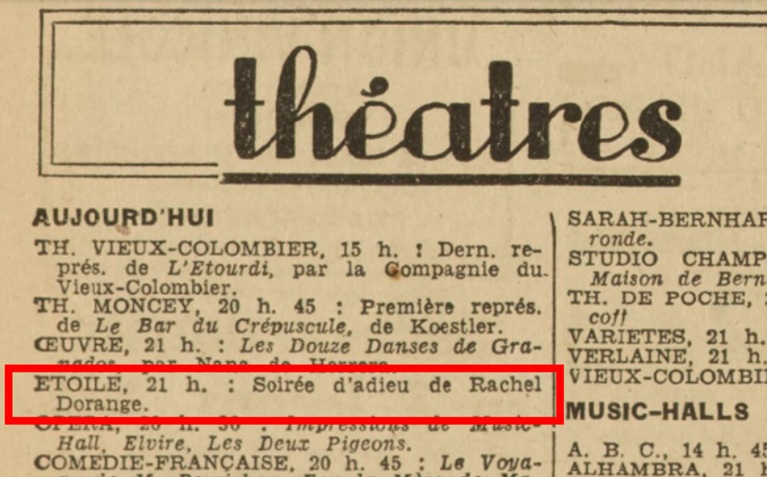
Above: Tiny notice in Le Figaro announcing Rachel's "farewell performance".
Source: Le Figaro, October 23, 1946, p. 4. National Library of France (via Gallica).
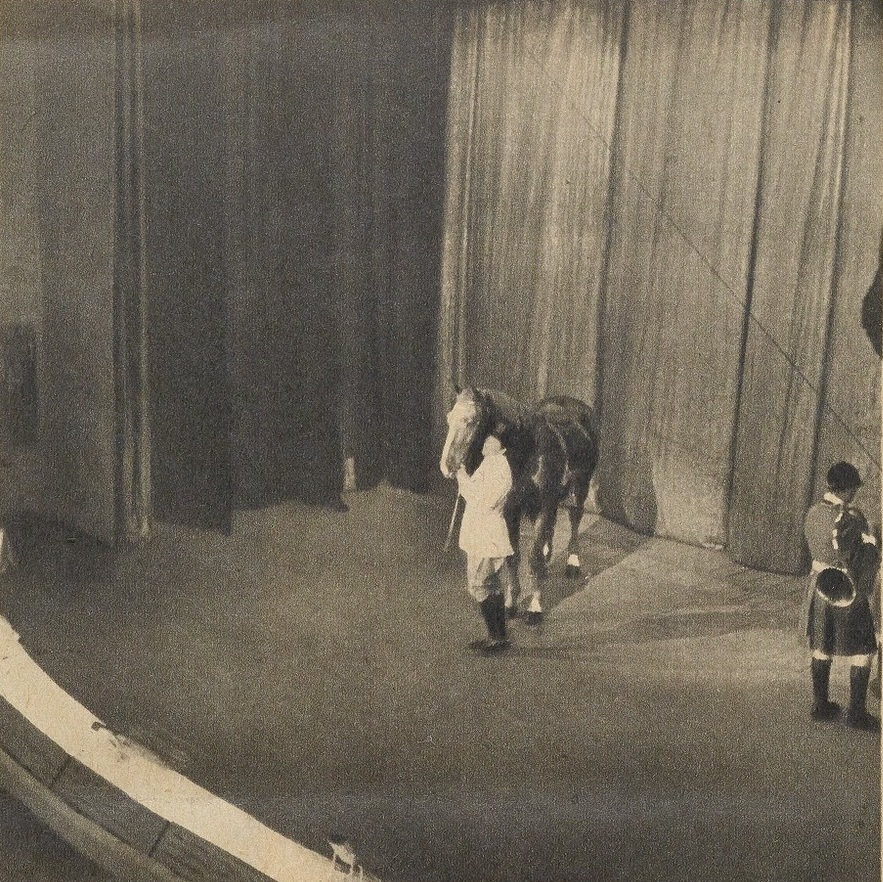
Above: Rachel on stage at Théâtre d'LÉtoile during her farewell performance, October 23, 1946..
Source: Point de Vue, November 5, 1946, p. 10. National Library of France (via Gallica).
13. Heartbreak, 1932 (continued)
The heartbreak that provoked Rachel's suicide attempt in 1932 became the central drama of her life, an obsession that haunted her for at least 20 years and even drove her to contemplate suicide yet again.
Nevertheless it did not stop her from pursuing her ambitions, nor did it affect her personal charm or the admiration and affection with which she was generally regarded. If the heartbreak was a cloud that hovered above her, it was a cloud that she could step out from under when she wanted to.
Like a cloud, the story of Rachel's heartbreak is hard to pin down. It changes shape and colour and dimensions with every telling.
The attempted suicide was a painful and unwelcome blemish on Rachel's celebrity and she did not publicly talk about it until thirteen years later, in November, 1945, when she was approached for an interview by La Presse reporter Paule Corday.
Paule Corday was a journalist, novelist and poet and an activist in the cause of women's rights. She later founded an association for the protection of single women against economic and other forms of exploitation.
"When I attempted suicide the man who was the cause of my distress said he didn't know me," Rachel told Corday.
"You lived together?"
"He forced me to abandon my work. He was a dentist, a boy who tortured us with his second thoughts. Nevertheless he was still not married. As they say: he had a short run. He left me with nothing. If you only want one woman why leave her in the street?" Rachel did not specify the work she had to abandon, but in other interviews she referred to her show business career at the Empire Music Hall (page 5).
It is clear that Rachel had spent a lot of time brooding about the emotional and other damage that she had suffered and she was determined to take revenge on the perpetrators.
"And now, what do you intend to do?"
"I intend a lawsuit for defamation. I've come from seeing my lawyer, Mr. Valensi." Théodore Valensi (1886-1959) was a prominent Paris lawyer. He pops up now and then over the years to take charge of Rachel's various lawsuits.
"You don't believe that silence would be more dignified?"
"No, because I have been ridiculed publicly. I want my former power, to go on stage without someone throwing 'the story of Monte Carlo' in my face."
"Rachel Dorange's face became purple: she spoke hastily. It was clear that she was suffering, and that soon enough her suffering would be misplaced to the point of doubting everything and everyone, hearing lies everywhere." Paule Corday's alarm was justified. Rachel's plan for a lawsuit must have fallen through because she opted instead for a bizarre strategy that reflected her desperate state of mind.
On October 23, 1946 Rachel rented the Théâtre de l'Étoile for a "farewell performance" during which she planned to publicly denounce a long list of persecutors before committing suicide.
"I wanted to reveal at the height of the performance all that I had in my heart, all the infamies of which I had been the victim, and proof in hand, to denounce all those complicit, in the police, in the justice system of which certain men, belonging to the so-called best French society had attempted to destroy me.
Liberté Soir reporter Yves Rameau, an invited guest, described the scene at the theatre:
"On October 23 last, [1946] I entered the Théâtre de l'Étoile. The most select society of Paris adorned the small venue to the last folding seat. Outside several hundred people waited hoping to participate in this soiree which according to rumours of the Parisian crowd promised to be the highlight of the season...."
Rachel's performance began with an exhibition of dressage with Coco, her cab horse during the occupation.
"When Rachel Dorange appeared mounted on Coco... a vague unease gripped everyone's spirits.... I realized that two words on the invitation card, 'Soirée d'Adieu', hid a tragic secret.... Even before the first act began our unease turned to anxiety.... In the lobby, everyone spoke in hushed tones, as if a sense of mourning hung over the house.
"The wildest rumors were circulating, and suddenly we heard the shrill cry of the most fashionable couturier, who was wailing:
"'To do this to me, who had so much trust in her, wanting to commit suicide wearing my evening dress!' Apparently word had gotten out about Rachel's intended suicide, so the packed house likely included idlers drawn by morbid curiosity. But there were also friends who sought to intervene:
"Then three very dignified gentlemen, following a woman of a certain age wearing magnificent jewels quickly disappeared through the door leading to the performers dressing rooms. The intermission took almost an hour, but not a seat was empty. The curtain was late in rising. We heard Rachel Dorange crying:
"'Say what you will, you will not prevent me from revealing the truth. I will not let anyone slander me.'
"After several minutes the curtain finally rose and Rachel Dorange, a bit weakly at first, quickly gathered herself, to the surprise of everyone, and exercised her great talent as a comedienne, in her magnificent evening dress bought on credit. At the end of the evening she received seven curtain calls and a veritable tempest of ovations.
"Nevertheless the mystery remained. Did she really wish to commit suicide? And why, in this case, did she choose as a setting this charming Parisian theatre? Rameau was able pose these questions to Rachel in an interview a few weeks later.