





Above: "Will Rachel Dorange have to sell her 'Coco' at auction?" Here Rachel's cab is an open carriage.
Source: L'Émancipateur, January 5, 1950, p. 3. National Library of France (via Gallica).

Above: "For Saint-Yves, Xanrof sang 'Le Fiacre'." Rachel delivering guests to the St. Yves nightclub.
Source: La Dépèche de Constantine, June 3, 1950, p. 3. National Library of France (via Gallica).
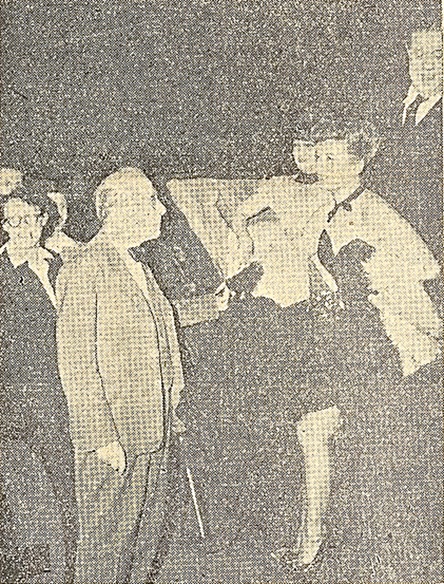
Above: "A Parisian Cabaret Celebrates Saint-Yves Day." Léon Xanrof greets guests arriving at the St. Yves nightclub in Rachel's cab.
Source: Same source.
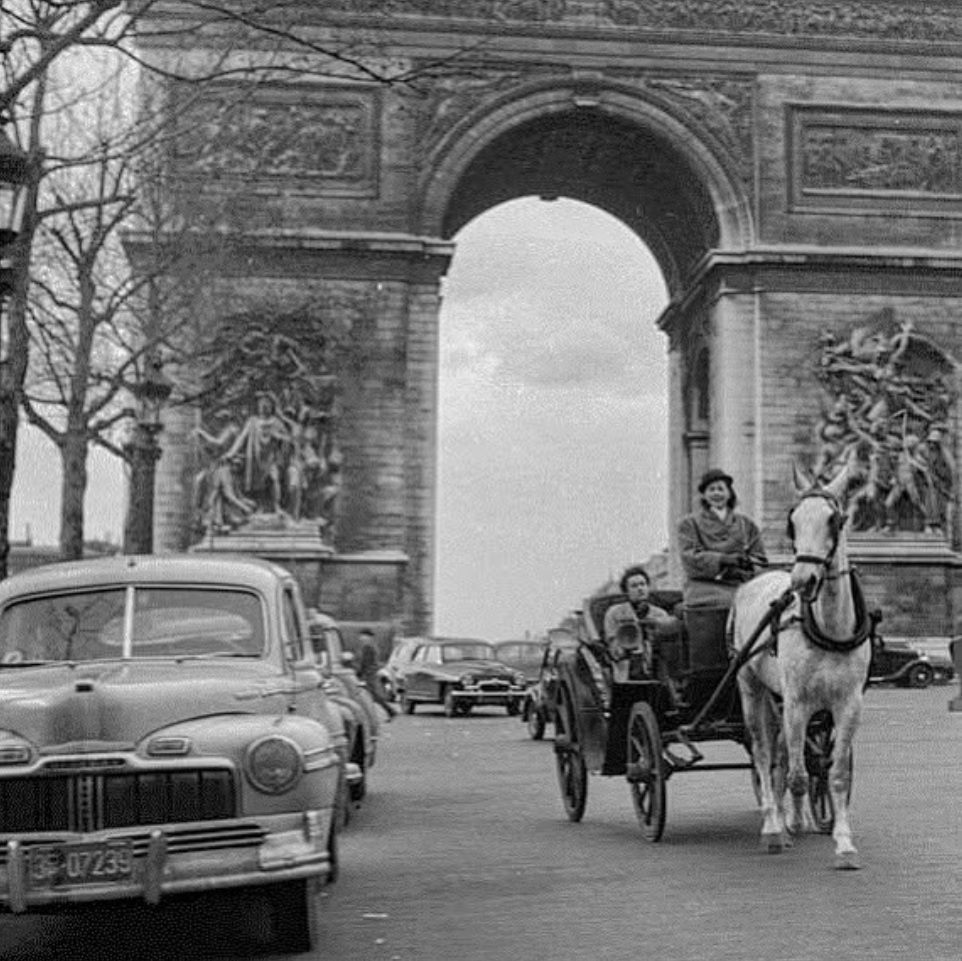
Above: Rachel Dorange at the Arc de Triomphe in 1950.
Source: Christina's Hansen's Facebook page. Christina Hansen is a New York City Central Park carriage driver and advocate. Her Facebook account contains a huge and appealing gallery of photos related to the NYC industry (e.g., horses, carriages, drivers, customers).

Above: Same photo (detail).
21. Scrapbook: 1949-1956
Scrapbook: 1949 In October, 1949, Paul Munier, in his L'Entente column entitled "My Grain of Salt," reported a sight that triggered a wave of nostalgia for the city's horse-drawn past:
"The other night, I was surprised to see three horse-drawn fiacres neatly lined up in the middle of the boulevard, right at the intersection of Place de l'Opéra, waiting for a customer. That's what I said: three fiacres, each with a gentle old horse at the reins.
"I couldn't believe my eyes. I'm not Parisian enough anymore, for heaven's sake! But there, of all places – at a crossroads where cars flow like a river – it made for a strange sight.
"Strange? No! Melancholic, rather. These horse-drawn fiacres, fragments of the past, lost, motionless, indifferent, silent, in a feverish, hallucinatory, noisy, frenetic present!" "Speaking of horses, a sad event has just taken place. Oh, not a catastrophe, no – it was only worth three lines in some newspapers.
"So here's the thing: Rachel Dorange is going to sell Coco. Rachel Dorange, Coco – those names don't ring a bell for you. You're too young, for heaven's sake! Yet they bring to mind a truly curious adventure that, alas, has come to an end today. I was going to say, 'It's come to a screeching halt!'
"Time passes, the wheel turns – even the wheels of a horse-drawn carriage! Rachel Dorange, whose temples must now be gray, is giving it up. She's going to make her final trip as a cabbie: Paris to Brussels and back. After that, she'll retire for good, and – at least I hope – Coco will live out his old age in front of a manger that's still well stocked." The prospect of Rachel and Coco disaooearing from the streets of Paris was noted by several newspapers, usually with regretful comments. L'Émancipateur reported the cost of maintaining Coco and envisaged a much grimmer fate awaiting him:
"From April 1 to October 18 of this year [1949], 'Coco' – who is happily approaching his thirteenth birthday – cost Rachel Dorange 124,777 francs net. Add to that taxes, insurance, and stall fees, and it's no wonder that the only female horse-drawn carriage driver in Paris is now thinking of selling her team.... Will Rachel Dorange now see her faithful 'Coco' go off to end up on the counter of some horse-meat butcher's shop? One cannot imagine it without a touch of bitterness."
124,777 francs over 201 days averages 621 francs per day. France-Soir rounded Coco's cost up to 650 francs per day. The critical problem for Rachel was that inflation had drastically devalued the franc from 119 per U.S. dollar in 1947 to 332 per U.S. dollar in 1949.
The cost per day of maintaining Coco was only $1.95 U.S., but any savings that Rachel had would have been correspondingly devalued. Also, with increased competition from taxis her cab income was probably reduced, and if her other income – wherever it came from – was fixed, it is not surprising that she had to consider giving up her horse.
However, media reports of Rachel's dilemma may have drummed up enough business to give her and Coco a reprieve. According to the German newspaper Badische Abend-Zeitung:
"But 'public opinion' in Paris has begun to shift. The radio recently issued an appeal on behalf of the last 'Madame Fiacre,' and even the weekly newsreel has included Rachel – along with her carriage and horse – in its series of images. Perhaps the last female Parisian cab driver can still be helped. It would be a shame if she were to disappear from the colorful Parisian street scene."
In any case, Rachel did not let her financial difficulties deter her from carrying out her plan to visit Brussels. From Le Berry Républicain:
"Maubeuge, October 21 – Rachel Dorange, who left Paris last Tuesday [October 18] in her horse-drawn carriage, arrived this evening in Bettignies, where Belgian and French customs officials kindly facilitated her passage. Rachel Dorange plans to arrive in Brussels on Sunday at noon."
Bettignies, on the Belgian border, is 271 kilometers northeast of Paris and 85 kilometers southwest of Brussels.
In due course she arrived. From the Belgian newspaper Pourquoi Pas?:
"A pretty woman'wearing a top hat and a red coat, riding breeches, and riding boots – driving a horse-drawn carriage on a weekday in the middle of Brussels' main square – is certainly an unusual sight. And it certainly attracted the amused curiosity of passersby, flower vendors, taxi drivers, and police officers....
"A professional horsewoman, she gives riding lessons and works as a cab driver in Paris. But times are tough; a horse is expensive to maintain: She'll have to sell Coco, with whom she has shared her life – and sometimes a stable – for nine years.
"Of course, it's not without a heavy heart that Mademoiselle Dorange will part with her faithful friend, but, courageous and optimistic, she declared: 'Oh well! We're now part of Paris's historic landmarks!'" Scrapbook: 1950
In May, 1950, the proprietors of the St. Yves cabaret nightclub at number 4 rue Université hit on an ingenious publicity stunt. They decided to hold a cocktail party on St. Yves day, May 19, and invited a flock of stage and screen stars to attend. Since the nightclub had a turn-of-the-century decor, the guests were asked to dress up in appropriately old-fashioned garb.
The stunt's most brilliant stroke was having Léon Xanrof preside over the cocktail party. Xanrof, the beloved composer of several songs that had become classics, was now 83 years old and a personification of the late 19th-century music hall life of Paris.
Xanrof's most popular song was "Le fiacre" and, fittingly, some of the celebrity guests arrived at the nightclub in Rachel's cab (left) with Xanroff there to greet them. He even took a short ride in the cab himself. Rachel had referenced and perhaps performed "Le fiacre" at her 1946 gala (page 59).
A year after Rachel had alerted a shocked world that she was going to retire from cab driving and sell Coco, she and Coco were still in business. Once again they set off on what was becoming Rachel's routine winter journey to the south of France. They left Paris on Friday, November 24 and passed through Melun, 59 kilometers to the south the same day:
"An Amazon in Melun. Mlle Rachel Dorange, who is on a trek from Paris to Monte Carlo with her famous horse 'CoCo,' rode through Melun on Friday as the crowd looked on with amusement or admiration. Wearing a red jacket, a coachman's hat, riding boots, and a whip in hand, she looked truly impressive. This isn't the first time she's made the trip from Paris to the French Riviera, but the last time she was on foot." (La République de Seine-et-Marne) `
It was apparently a fairly leisurely journey. It took Rachel a full month to cover the 784 kilometers to Marseille at an average of 26 kilometers a day. The Marseille newspaper Artistica announced their imminent arrival:
"The Horesewoman Rachel d'Orange will soon be visiting our city. We surely remember the exploits of Rachel Dorange, which so often made headlines – her trips to the Balkans riding bareback, the Paris-Nice race with a dog, and so on.
"This time, setting out from Paris and heading to Monte Carlo, Rachel Dorange is traveling by fiacre behind her faithful horse, Coco. We will soon have the pleasure of welcoming her here."
On the same day as the announcement in Artistica, Saturday, December 23, Le Patriote de Nice et du Sud-Est was predicting her arrival in Nice on Sunday – a neat trick, since Nice is 205 kilometers from Marseille (presumably there is an error in the timeline):
"'L'Éperon de Nice,' the oldest equestrian club on the French Riviera, will welcome tomorrow, Sunday, at its headquarters (the Baylon riding arena), the French star of international endurance riding: Rachel Dorange, who is visiting Nice on the occasion of her latest equestrian feat, the 'Paris-Menton' ride. Club members are invited to a reception in her honor at 11:30 a.m."
Rachel was in Nice (or possibly Monte Carlo) on January 4, 1951 because she left by train for Paris on January 5. The train ride was disastrous and life-changing.