




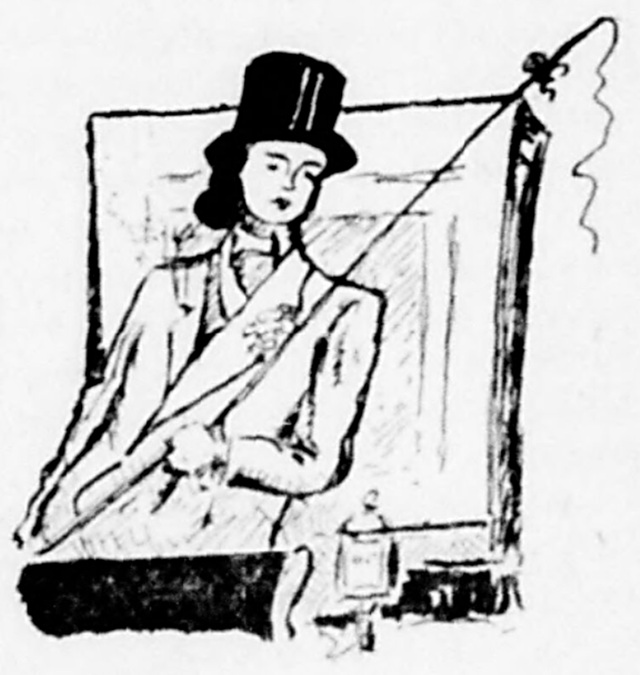
Above: "Une femme cocher."
Source: France-Amérique, "Nouvelles Parisiennes" ("Paris News") by Michel Georges-Michel, March 17, 1946, p. 8. National Library of France (via Gallica).
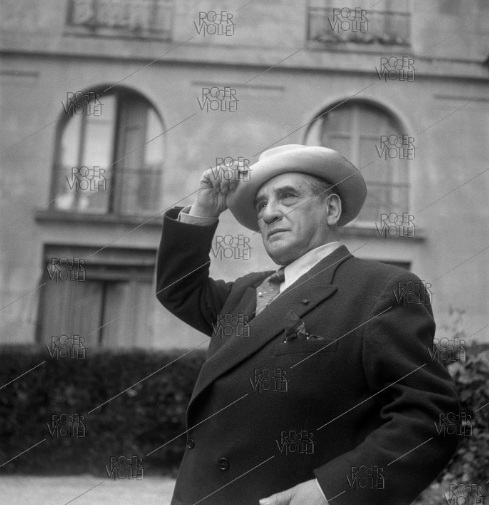
Above: "Michel Georges-Michel, Cannes (France) 1931."
Source: Roger Viollet Galerie
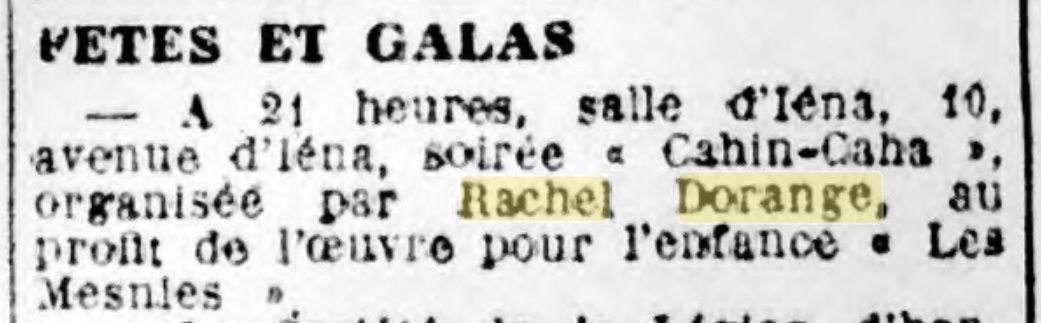
Above: Ad for Rachel's soirée, "Cahin-Caha."
Source: L'Époque, March 24, 1946, p. 2 National Library of France (via Gallica).
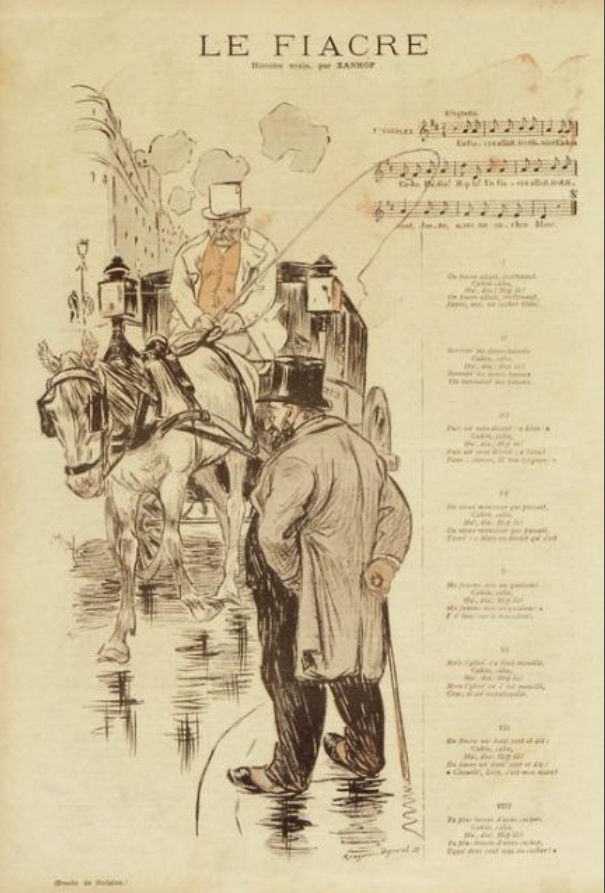
Above: Music and words for "Le Fiacre" by Léon Xanrof. Illustration by Théophile Steinlen (1859-1923) published in Gil Blas magazine, September 20, 1891.
Source: Steinlen.net.
19. Scrapbook: 1945-1947 (continued)
Scrapbook: 1946 In March, 1946 Michel Georges-Michel is walking down the street when he hears somebody whistling at him. Georges-Michel (1883-1985) was a painter, journalist and novelist and a major figure in the French art and film world.
"'Pssttt! Pssttt!' The call is so close, right behind me, that I turn around. It's a 'cochère' calling out to me. Quite strange, actually: she's wearing an impeccable top hat, has an orchid in her buttonhole, and her carriage is a dilapidated coupé.
"I give her a regretful wave; I have no need of her services. But there she is, shouting my name. I stop.
"'Well, don't you recognize me? Yes, that's what the war has done to me: instead of sitting in my carriage, I've climbed onto the seat where my coachman used to sit. And I'm soliciting customers.'
"I approach: 'But it's Dorange!'" The encounter triggers a flood of memories.
"Yes, Rachel Dorange, Paris-Berlin-Bucharest on horseback and return, former rider at the Nouveau-Cirque, First Prize in the 'Jockey' category at the Concours Hippique in the 'hunter' class, riding instructor, then society lady....
"If only I could remember! And the Cirque Molier, where, in the 'Jeu de la Rose,' she had substituted the 'removable costume' act and caused a scandal by undressing on horseback, all at once, as if in a fairy tale, and had appeared to the select audience that evening like a beautiful Diana on a mount whose very harness had fallen off.
"And her famous 'leather' stories, so terrifying that people accused her of making them up just to scare us." As is often the case with portrayals of Rachel – her own as well as those generated by the media – it is hard to distinguish legend from reality.
Rachel participated in the Concours Hippique in 1935 (page 51), but she was not a medal winner. Of course, Georges-Michel may have been remembering a Concours Hippique from another year.
He definitely seems to have remembered a much spicier version of Rachel's famous performance at the Cirque Molier in 1931 (page 5).
What Rachel's "leather stories" were is anyone's guess. Whatever they were we can only hope that they will surface some day.
Georges-Michel's memories include one that is not documented elsewhere: that of Rachel in a casino sitting at the baccarat table and "casually tossing a few ten-thousand-franc chips onto the felt."
He accepts Rachel's invitation for a ride:
"'Where are you going? Get in; we'll talk through the front window – I'll open it: you won't be any colder than I am.
"'Don't worry about the price. Usually I charge twelve to fifteen hundred for a ride – damn it, I have to feed Coco, my horse, and he costs me more than I do. But you once drove me back from Deauville or Cannes in your Citroën, so we'll work something out.'" In 1946 the exchange rate was 119 French francs per U.S. dollar, so Rachel was charging the 1946 equivalent of $10 to $12.60 U.S. A 1946 article in Le Pique Boeuf complaining about exorbitant taxi fares in Marseille noted that the official taxi tarif in Paris was eight francs a kilometer. So, for the same trip that would cost 500 francs in Marseille, a Paris cab customer would pay 20 francs for the flag drop, 60 francs for mileage and 20 francs for a tip, totalling 100 francs (equivalent to 84 cents U.S.).
It would seem that Rachel was asking stiff price for the privilege of riding with a celebrity, though on the next page we'll see her charging someone a mere 500 francs. But getting back to Michel Georges-Michel:
"She opens the door. Here I am in her little cage. A light crack of the whip at Coco, and...."
Along the way Rachel tells him about Arthur Weill, the Schwartzes, her accident and her appearance in court (page 54). Then she announces her future plans:
"'And next month, I'm making my debut at the Salle d'Iéna in a revue by Raymond Souplex, a great guy: 'Cahin… ca-ha… Hue dia, hop là!' After that, with Coco, I'll make the Tour de France, with the actors in my cab, to give performances in every city.
"'So here you are. But no, I don't want anything, just to tell you. Just buy me an aperitif at the bar. Then I'll recite a poem for you. And you can judge the effect on the customers.'" An ad in L'Époque on March 24, 1946 (left) announced a "soirée" entitled "Cahin-Caha" organized by Rachel Dorange, to be held at the Salle d'Iéna the same evening at 9 p.m. Proceeds were in aid of Les Mesnies, a children's charity.
Raymond Souplex (1901-1972) was an actor, singer and screenwriter and evidently one of Rachel's many artistic friends. The revue he devised must have had a cab driving theme – the phrase "Cahin-caha, Hue, dia, hop là" is a refrain from "le Fiacre" ("the Cab"), a racy and therefore popular song by Léon Xanrof (1867-1953). It was made famous by the music hall singer Yvette Guilbert, a friend of Henri de Toulouse-Lautrec.
"In this song a cuckolded old man walking in a Parisian street hears kisses, moans, and his wife's voice coming from inside a suspiciously rolling and pitching cab. He rushes forward, trips on the slippery wooden-paved road and is squashed to death by the cab. The lady then opens the door and rejoices, telling her lover that they do not need to be hiding any more. She then urges her lover to pay the princely tip of one hundred sous (five gold francs) to the cab driver." (Wikipedia)
"Cahin Caha" is a term describing unpredictable, irregular progress, equivalent to "hit and miss" or "off and on." "Hue," "dia" and "hop-là" are commands to a horse to turn right, turn left, and giddyup!
In 1950 Xanrof, then 83 years old, presided over a "cocktail party" in his honour with celebrity guests arriving in Rachel's cab (page 64).