• Driver Profiles
Jim Morris Edmonton, Alberta / September 20, 1985 Jim Morris, 39, grew up in Alix, Alberta, about 160 kilometres (100 miles) south of Edmonton. His brother Oliver described him as "a lifelong bachelor and sports fanatic." At six foot two and 200 pounds he had excelled at baseball, football and hockey in high school and, according to Oliver, "never lost an arm wrestle in his life."
"He was very, very strong but equally mild. I never saw him in a fight."
Mr. Morris studied physical education at the University of Alberta and the Univesity of Calgary but ultimately abandoned his studies. He preferred to work with his hands and took on a variety of jobs until he settled on taxi driving. He liked this work because it gave him time to do the things he liked best such as curling for about four months every winter.
It became a family tradition for Mr. Morris to join his father and brother and a family friend each winter to compete in curling bonspiels in and around Lacombe, Alberta.
"We would play, I guess, a total of of 10 bonspiels," Oliver Morris recalled. Jim Morris was also an excellent golfer.
On Friday, Sept. 20, 1985, a 15-year-old juvenile and an 18-year-old man met in a shopping mall and discussed ways of making some "quick money". The 18-year-old was carrying a duffle bag containing a disassembled .22/20 gauge over-and-under rifle and shotgun and some .22 ammunition.
The two called a taxi and when Mr. Morris picked them up he was directed to an isolated dump north of Edmonton. The 18-year-old assembled the rifle en route and when they arrived he pointed it at Mr. Morris and ordered him to get out of the car and leave his money and keys on the ground.
The killer then fired a shot that grazed Mr. Morris's head and caused him to fall. He ordered Mr. Morris to get up and walk to a grassy area near the roadway. Here the killer shot him in the back of the head and then fired a third shot to make sure Mr. Morris was dead.
The killer and his accomplice split the $115 they found in Mr. Morris's wallet and then covered his body with grass.
Mr. Morris's cab was spotted by another driver at about 4:30 p.m. on the following Sunday. The windows were open and there was $8 on the meter. A police tracking dog located Mr. Morris's body.
The 15-year-old accomplice was sentenced to three years in prison. The 18-year-old killer was convicted of murder and sentenced to life in prison with no chance of parole for 15 years.
In September, 2000 the killer was released on full parole.
At about three a.m. on December 9, 2001, a 50-year-old Co-Op cab driver was flagged down at Alexander Plaza by a man who said he had a gun. When the driver attempted to flee, he was shot in the back of the shoulder.
Later that month Mr. Morris's killer failed to report to his parole officer. Police, suspecting his involvement in the recent shooting and in other attacks on cab drivers, issued a warrant for his arrest and described him as armed and dangerous.
The killer was eventually arrested and in March, 2002 he was charged with attempted murder and various weapons-related charges stemming from the December attack.
However, at a hearing in November, 2002, the most serious of these charges were withdrawn for lack of sufficient evidence. The killer was found guilty of some of the weapons offences and sentenced to three years in jail. He was also prohibited from possessing firearms for the rest of his life.
Mr. Morris was the fifth Edmonton taxi driver to be murdered in a little over four years, the others being Robert Seward, Frederick Horyn, Gerdina Kruidbos and Charmayne Manke.
During these years the he debate about safety devices and measures for cab drivers had been ongoing and intense but no action had resulted.
The murders of Mr. Seward, Mr. Horyn and Ms. Kruidbos in 1981 had forced the Edmonton Taxi Commission to create a subcommittee on taxi driver safety. The Subcommittee's report recommended that protective shields "be permitted" and that electronic warning devices be installed, but these recommendations fell on deaf ears.
Charmayne Manke's death prompted the Alberta government to establish a provincial "Task Force" on cab driver safety. The Task Torce report, Taxi Driver Safety in Alberta, simply accepted and repeated the industry's conventional wisdom on safety measures especially with regard to the "ineffectiveness" of shields. The report recommended electronic alarms, driver training, cash drops and compulsory health insurance for drivers (for more about the Task Force report, see Manjit Singh Dhaliwal).
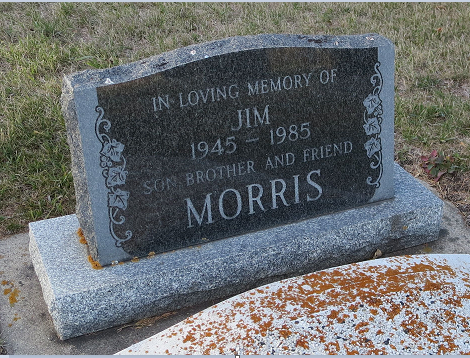
[Next column] Jim Morris is buried in Alix Cemetery, Alberta, in the Morris family plot with his mother and father. Photo by Aaron C. Shaw (detail). (Source: Find a Grave.)
When the task force report was issued in February, 1985, Bill Diachuk, the provincial minister responsible for workplace health and safety, was at pains to assure the taxi industry the compliance with the report's recommmendations would be purely voluntary.
However, when Jim Morris was murdered seven months later, even Mr. Diachuk had to admit that little had been done to improve driver safety. He now threatened to legislate mandatory safety requirement if the industry could not come to an agreement by the end of October.
Nevertheless Mr. Diachuk saw hope that Mr. Morris's death would "break the deadlock stalling better protection for cabbies."
"When I heard of the death yesterday, I felt it would bring both the drivers and the brokers (cab companies) to realize [that] the task force recommendations were valid," he said.
Mr. Diachuk could claim personal experience with the hazards of taxi driving. As a young man just out of high school he briefly drove a cab in Edmonton, but quit when one of his passengers pulled a knife on him.
By 2001, when Mr. Morris's killer was arrested for shooting the Co-Op driver, four more Edmonton taxi drivers had been murdered: Manjit Singh Dhaliwal in 1988, Gerald Fischer in 1991, Ivan Soproniuk in 1994, and Trevor O'Dell in 1995. Other drivers had survived serious injuries during attacks.
The debate over safety measures was still going on, with industry representatives arguing that everything that could be done was already being done.
Phil Strong, a spokesman for Laidlaw Transportation (which owned several Edmonton cab companies, including Yellow, Prestige Barrel and Checker) said that short of "driving around in an armoured tank, there's not much taxi drivers can do to protect themselves from people who want to rob them."
Dave Werlin, chairman of the Edmonton Taxi Cab Commission, said "I don't know how you protect yourself completely. We've talked about having shields in the cab, but they'd shoot right through the back of the seat if they wanted to."
Christopher Atkinson, spokesman for Co-Op Taxi, estimated that 90 per cent of Co-Op drivers would resist using the shields.
Once again, street smarts and training were touted as the best defence against attacks.
"Co-Op has a training system to help drivers minimize the risks," said Mr. Werlin. "They talk about relationships with your passengers, so if he's got a chip on his shoulder, he doesn't take it out on you."
Drivers are encouraged to err on the side of caution when picking up someone, said Mr. Werlin. "If in doubt, forget the $10 fare and save your life."
Jim Morris was buried in Alix Cemetery in the family plot. His father died in 1994.