




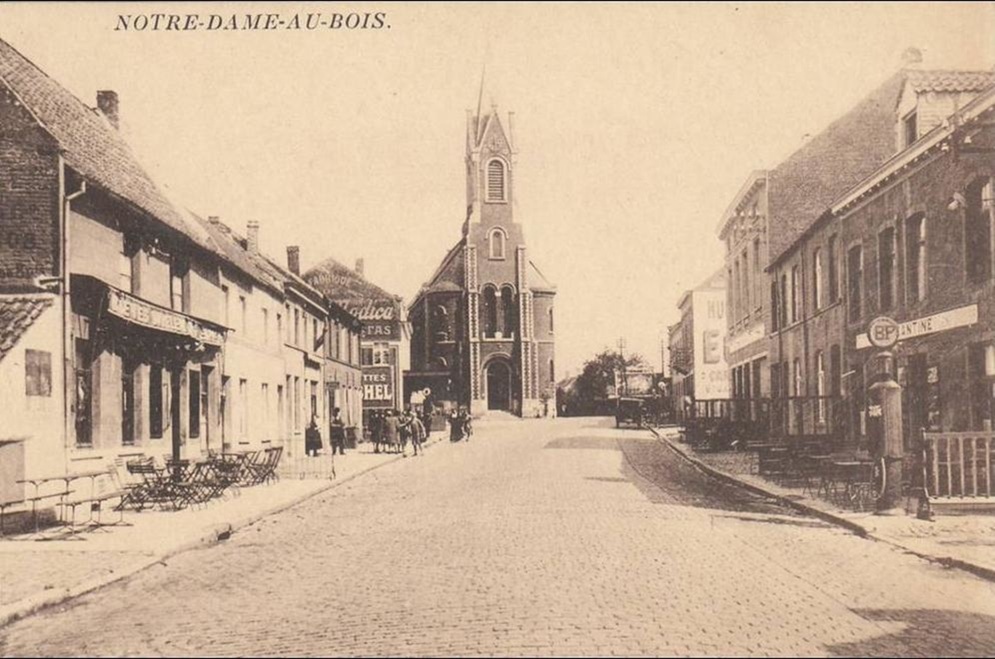
Above: Notre Dame au Bois (postcard, circa 1920). The cornerstone of the church was laid in 1650. It was heavily damaged during World War II and underwent a major restoration completed in 1973.
Source: Geneat (genealogy web site). Also, "Notre Dame au Bois," (Wikipedia).
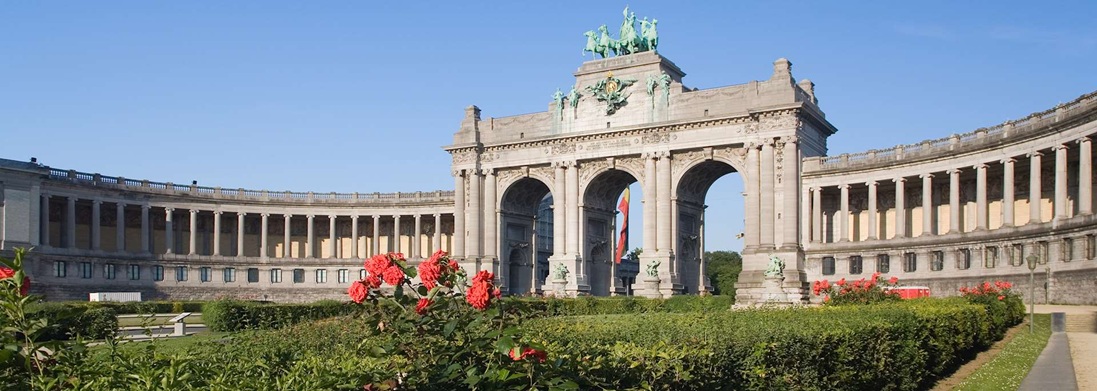
Above:. Arcades du Cinquantenaire, at the top of the Tervueren Hill where dignitaries and photographers waited to welcome Rachel. Intended to celebrate 50 years of Belgian independance in 1880, the Arcades were not completed until 1905. This photo shows the front (west side) of the Arcades.
Source: Gaudley Travel
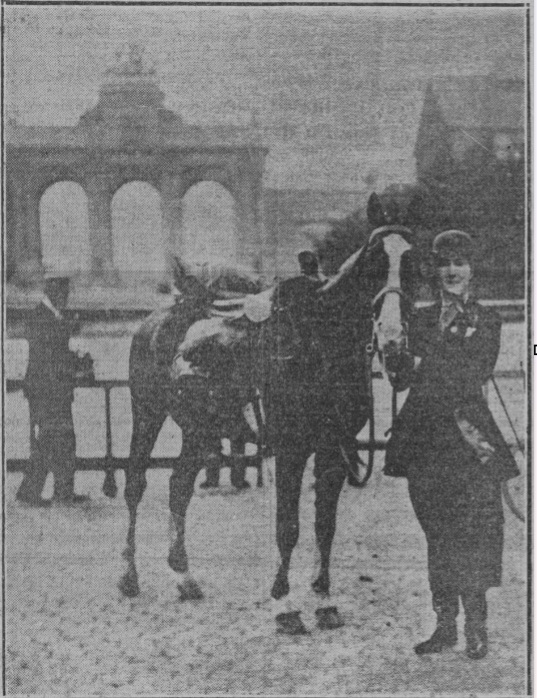
Above:. Rachel and Le Huppé at the Arcades du Cinquantenaire. Entering Brussels from the east, they would have approached the Arcades from behind. The eastern stretch of Avenue Tervueren is now a popular hill climbing challenge for cyclists.
Source: La Voz de Aragon. "La Raquel: amazona de pelo largo... ni baila el charlstón" ("La Raquel: a horsewoman with long hair who... doesn't dance the Charleston"), September 8, 1929, p. 3 (via Biblioteca Virtual de Prensa Histórica).
9. Bucharest, 1928 (continued)
Prague to Brussels (Map 12-13-14) and back to Paris
Rachel left Strasbourg at 1 p.m. on Tuesday, September 25. She arrived in Luxembourg on the afternoon of Sunday, September 30 and and was rerceived at the French legation. She left for Brussels on Monday, October 1.
Three days later, on Thursday, October 4, she reached the village of Notre Dame au Bois, about 19 kilometers from Brussels, where she was met by a group of riders who escorted her into the city and along Avenue de Tervueren, the showpiece route for ceremonial processions.
Notre Dame au Bois, also known as "Jezus-Eik" (Jesus-Oak) owed its fame to an oak tree near which, in the 1600s, an apparition of the Virgin Mary had appeared several times.
"Count Edouard du Val de Beaulieu was waiting for her on the Tervueren Hill, along with Captain Agn and the guides, surrounded by newspaper reporters and photographers."
"The guides," under the command of Count Edouard and Captain Agn, were the 1st Regiment of Guides, an elite regiment of the Belgian cavalry.
Rachel was also received by the French ambassador to Luxembourg, Maurice Herbette. After visiting some personal friends she left Brussels at 4 o'clock on Friday afternoon, October 5. She planned to spend that night at Halle, 31 kilometers south of Brussels, and expected to arrive in Paris on Wednesday, October 10.
In fact, though, Rachel reached Paris on October 9, having spent the previous night in Senlis, 56 kilometers away. It rained all the way from Senlis and she rode hunched over against the downpour.
As with her journey to Berlin and back in 1927, the first people to greet her were at Le Bourget airfield but this time a big crowd of photographers, journalists and well wishers had gathered there. Rachel arrived a little before 3 p.m.
When she dismounted to talk to reporters, aviators from the 34th regiment seized Le Huppé's bridle and led him inside a cafe. They offered Rachel a glass of champagne, but she declined. Apart from the fact that she didn't drink, she was in too much of a hurry to be on her way.
She was followed by a parade of cars all the way into Paris. Her first stop was at the offices of Le Petit Journal where she was greeted by the editor and staff.
The next day Le Petit Journal published Rachel's own account of the journey ("My Wonderful Trip"). But her report, about 600 words long, may have been a disappointment.
It amounted to bare facts (lists of the countries and cities she passed through) combined with generalities about long distances covered, the weather, the beautiful countrysides, the welcoming crowds, the magnificent official receptions. But where were the lively anecdotes and observations that she had favoured interviewers with at various stops along the way?
"Adventures? No, just minor incidents on the road, but above all, impressions, exquisite emotions! The singular joy of travelling mile after mile on roads that seen to have no end, to breath the air of foreign lands...."
Back in April the last thing she shouted as she and Le Huppé trotted out of Paris was "All my thanks to Le Petit Journal! I'll write you often with all my news!" But although she sent off plenty of letters and postcards ("a hundred" when she left Warsaw said a reporter though this may have been an exaggeration), she sent only three terse bulletins to the newspaper (pages 14, 15 and 24).
Apart from the three bulletins Le Petit Journal received only one not very long article. The proprietors may have been left wondering about the return on their investment, especially after Rachel gave an interview to Paris Match.
Rachel told Match that before leaving Paris in April she paid the quarterly rent on her apartment for July but not for October, telling her landlord that she was confident that she would be back home in time to pay the October rent in person. And she was.
She also showed off her autograph book and an inscription penned by a Romanian general: "You, Mademoiselle, have brought to France's little sister [that is, Romania] the smile of her beloved big sister. Thank you."
The sentiment would ring hollow in 1940 when France was defeated and occupied by Germany and Romania had signed on as Germany's ally.