




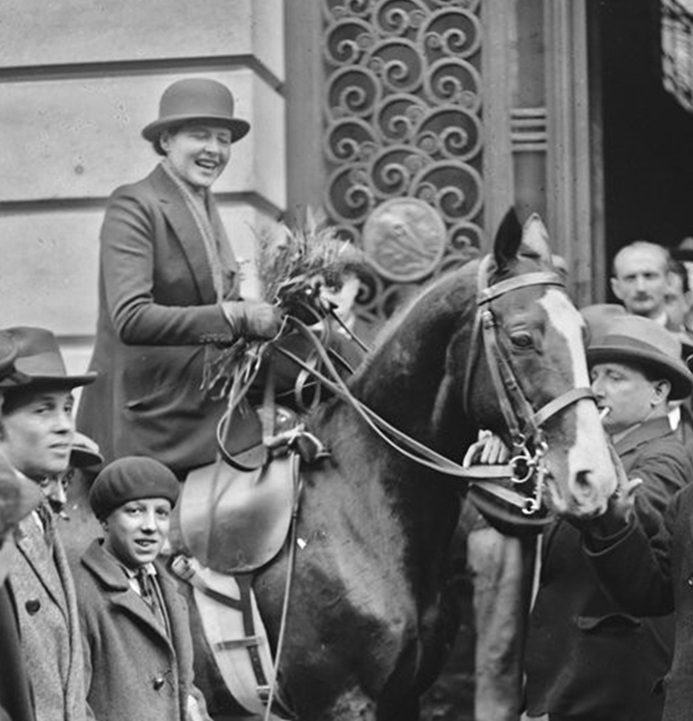
Above: Rachel and Le Huppé in happier days. Returning from Berlin (detail).
Source: Agence Roi press photo, November 21, 1927. National Library of France (via Gallica).
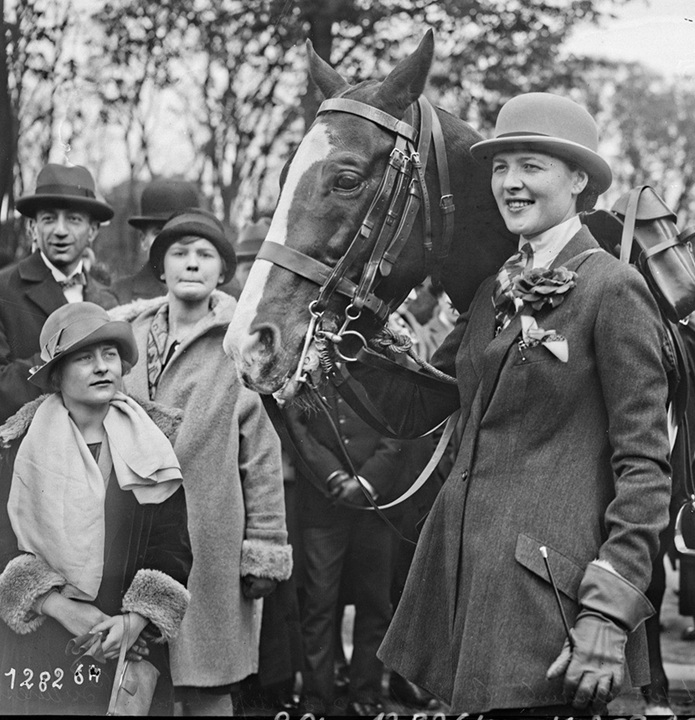
Above: Departing for Bucharest (detail).
Source: Agence Roi press photo, April 11, 1928. National Library of France (via Gallica).
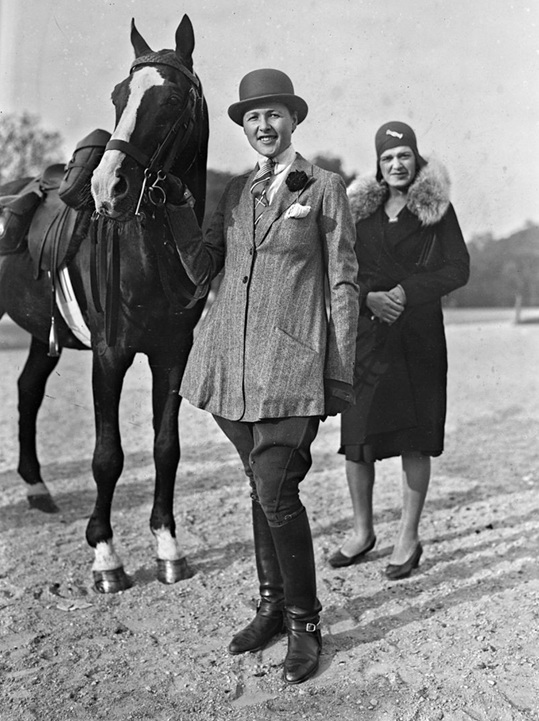
Above: Departing for Barcelona (detail).
Source: Agence Roi press photo, September 2, 1929. National Library of France (via Gallica).
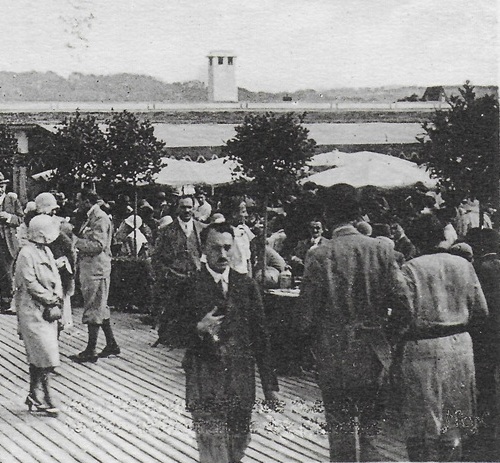
Above: Deauville: Les Planches (boardwalk) and, under the umbrellas and behind them, the Bar du Soleil (Bar of the Sun). Postcard circa 1930 (detail).
Source: "Deauville, la Plage Fleurie, Les Planches, Le Bar de Soleil," Éditions du Cigogne no. 68 via Geneat.

Above: Place de l'Étoile in 1921.
Source: U.S. Army Air Service, Aerial view of Paris, France, centered on the Arc de Triomphe. Collier's New Encyclopedia, 1921, v. 4, frontispiece (via Wikimedia Commons).

12. Death of Le Huppé, 1930
In August, 1930 Rachel was in Deauville, the glamorous seaside resort 200 kilometers northwest of Paris on the English Channel. It was here, on August 23, that she revealed that Le Huppé was dead. He had been put down, presumably because of the pain that caused him to limp. The neurotomy had only provided temporary relief.
Rachel also told Le Charivari that she was giving up competitive horseback riding. "But Le Charivari, always well-informed, can announce to its readers that a small bar decorated with oranges and horseshoes will soon open in the Étoile neighborhood under the management of Rachel Dorange, who hopes to welcome all her equestrian friends among her clientele." (La Liberté)
The Étoile neighbourhood was named after Place de l'Étoile (left), now Place Charles de Gaulle, a circular, star-shaped intersection from which twelve major thoroughfares radiate to all parts of Paris. The Arc de Triomphe occupies the center of the traffic circle. The neighbourhood then as now was very upscale, so establishing a bar there was, from a real estate perspective, quite ambitious.
Rachel was questioned about her future plans in Paris Midi:
"People were beginning to get used to this athletic 'tandem' – Rachel Dorange and Le Huppé – when, last year, the horse, a valiant companion through hours of struggle, had to be put down!
"His owner was deeply grieved by this sudden loss, and she has not competed since.
"Just the other day, at the Bar du Soleil in Deauville, a few friends who were waiting for her at dry martini time were discussing her absence.
"'Rachel doesn't seem eager to start competing again anytime soon,' said a young man who had just arrived, a racket under his arm.
"'Yes, that's the impression she gives me,' replied a pretty young woman whose red swimsuit set off her blonde hair.
"And the conversation continued like this until Rachel Dorange herself appeared. No boots, no whip, no spurs – just a simple, elegant summer outfit.
"'Hi! How are you?'
"'Terrible!' replied the young tennis player dramatically.
"'What's the matter?'
"'The thing is, we don't know whether or not you'll be riding again."
"'Yes, for my own pleasure, but never officially again, if I may say so!'
"'So, no more competitions, no more races, no more vaudeville? No more applause? No more....'
"'No, all that is over; I'm changing course; I'm going to do something else.'
"Everyone's curiosity was piqued, and questions flew back and forth, but Rachel Dorange, that day, wouldn't say any more.
"However, a few leaks have allowed us to learn what Mlle Dorange was secretly preparing during the quiet of her vacation....
"So, in a few weeks, the Étoile neighborhood will be home to a new bar – elegant and... tiny – which will be run by... our horsewoman.
"Decorated with horseshoes and... oranges, it will be a very Parisian spot, where, between two shakers, you'll see the photograph of a great friend we'll often talk about: Le Huppé!" The problem with these reports, as with Rachel herself, is how far to believe them. There is a distinct odor of fabrication about them, of reporters inventing conversations to give suppositious facts an air of authenticity.
Another conversation from Le Tout Lyon:
"We have received astonishing news: the young rider is giving up riding because her favorite horse, to whom she owed all her successes, was recently put down. Poor Le Huppé!
"Human decency forbids us from openly mourning an animal; but we can carry that grief in our hearts. That is what Rachel Dorange is doing, stoically. Only her closest friends know of her sorrow.
"'It will pass,' they tell her, 'you'll come to terms with it.'
"Someone added one day, 'You'll remarry....' The thoughtless person was sharply rebuked for his careless remark.
"And yet, this cruel separation of Rachel Dorange from her favorite mount is indeed a kind of widowhood. She remains faithful to the memory of Le Huppé and has no intention of replacing him.
"We ourselves would have been unaware of this little drama in the life of the beautiful horsewoman had we not come into contact, the other day, with a group of riders who were discussing it.
"'Well, it's worse than I thought. Rachel Dorange has thrown away her boots, her riding crop, and her spurs. She doesn't want anything to remind her of a sport she once loved but can no longer practice on a mere nag.'
"'But then, what is the young lady going to do?' asked a gentleman. Another, who was well-informed, replied:
"'She plans to open an elegant bar in the Étoile district. The establishment will be decorated with horseshoes and oranges. Above the counter, a photo of Le Huppé will preside over the libations.'
"'Are you sure it's a bar?' asked the first.
"'What else would you have it be? A funeral monument, for heaven's sake!'" At least two authors were a bit careless with their "facts." Le Tout Lyon opened its report by stating "We remember the charming Rachel Dorange, who won the Paris-Cannes horse race," while Paris Midi told its readers "We remember the famous Paris-Cannes women's horse race, which simultaneously made famous a charming rider, Mlle Dorange, and a magnificent horse: Le Huppé."
Rachel was given credit for winning a race that she dropped out of after the first day. Mary Féraud would be justified if her nose got out of joint.
On Tuesday, August 26, three days after announcing Le Huppé's death, Rachel was more than 800 kilometers south of Deauville in Biarritz. There she attended a "high society" gala at the Hôtel du Palais.
The gala celebrated the unveiling of a monument honouring Empress Eugénie, the consort of Napoleon III. The Empress is credited with causing the transformation of Biarritz from a humble fishing village to a luxurioius resort town by establishing her summer residence there. The former Villa Eugénie, her summer palace built in 1854, is now the Hôtel du Palais (picture page 40).
From L'Indépendant des Basses-Pyrénées:
"A Grand Gala at the Hôtel du Palais.
"The management of the Hôtel du Palais could not, of course, let the inauguration of the monument erected by Biarritz in memory of Empress Eugénie pass without participating in a very special way in this tribute.
"Thus, on Tuesday evening, the magnificent salons of this luxurious establishment served as the setting for a sumptuous gala of a kind rarely seen. Among the most select guests, we noted... Mlle Rachel Dorange..." From Comoedia:
"A high-society party at the Hôtel du Palais.
"We have reported on this splendid high-society party, which brought together hundreds of guests in the grand and superbly decorated dining room of the Hôtel du Palais.
"The ball that followed – the highlight of the evening – was particularly lively. Transparent balloons and white orbs floated and fluttered above the countless couples. Everyone joined in the general merriment with equal enthusiasm. This second Monday was, once again, unanimously appreciated. We recognized, among the tables: ... Rachel Dorange."