





Above: The Detective magazine article about Rachel's suicide attempt.
Source: "Chagrin d'Amazone" ("An Amazon's Sorrow"), Detective, vol. 5, no. 203, September 15, 1932, p. 6 (via Bilipo (Bibliothèque des Littératures Policières). "Crime Fiction Library".
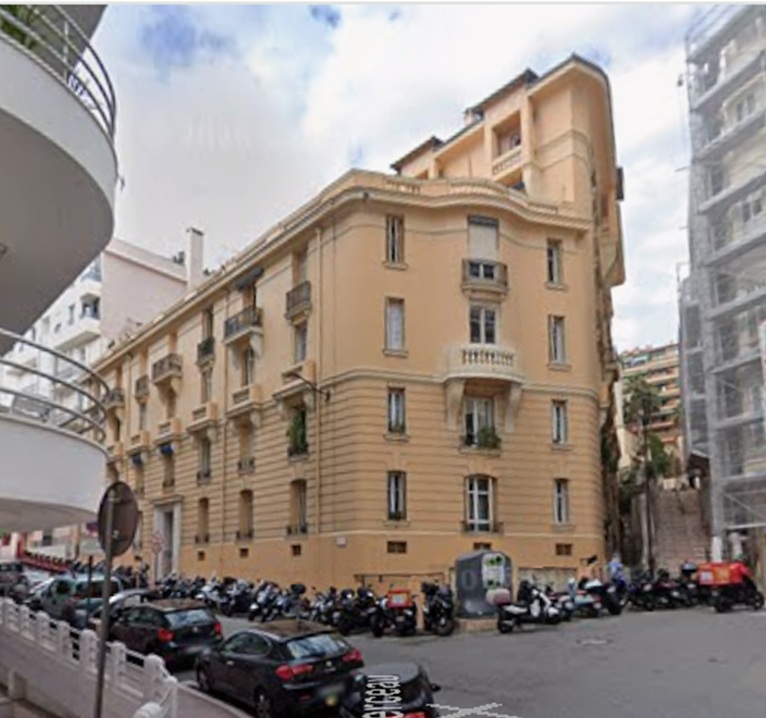
Above: Bellevue-Palais, 1 Rue Bellevue, where Rachel lived in Monte Carlo.
Source: Google Maps image capture, October 2024.
13. Heartbreak, 1932
In July of 1931 Rachel performed in the 50th Anniversary celebration of the Cirque Molier, performing in a horseback drama involving a swordfight and a kidnapping (page 5). But then she disappeared from the news for more than a year. Where was she?
On September 9, 1932, Rachel made headlines of another sort: newspapers around the world reported her attempted suicide in Monte Carlo. The most detailed account was published a week later in the popular true-crime magazine Detective:
"For the past year, Rachel Dorange had been living in Monte Carlo, where she occupied a comfortable apartment at the Bellevue-Palace, furnished with paintings, art trinkets, and gifts received during her travels across Europe.
"... during the night of Wednesday the 7th to Thursday the 8th, a taxi coming from Cannes pulled up at the Bellevue-Palace. It was 1:30 in the morning, and the man who got out told the hotel concierge that he was bringing back Miss Dorange.
"He explained that he was the owner of the Hôtel Terminus in Cannes and that Miss Dorange had suddenly fallen ill. The young woman was put to bed and left to sleep.
"When Rachel Dorange's room was entered the next morning, she was found gasping for breath, her face contorted. Dr. Boyer, who had been called, diagnosed poisoning by either veronal or cocaine. Rachel Dorange was taken to the hospital in Monaco." The poison proved to be Veronal, a barbiturate introduced in 1903 to treat insomnia and anxiety. It was withdrawn in the mid-1950's because it led to severe addiction and frequent fatal overdoses.
"On the nightstand in the apartment, the police commissioner found a box containing a dozen letters. One was addressed to Mr. Bernard Dorange, residing in Paris; the other, unsealed and undated, bore the simple inscription: "For Mom."
"This letter was a kind of emotional testament. In it, Rachel Dorange confessed to her heartbreak and her intention to take her own life: 'If I fail the first time,' she wrote, 'I'll keep trying until I succeed.'
"And all night long, her roommates in the hospital heard her repeating a name she uttered sometimes gently, sometimes angrily.
"Love, the kind that pushes one to the edge of the abyss, takes the form this time of a young, blond, elegant man, much like the many young men one encounters in Monte Carlo or Nice – blond, elegant, nonchalant – who speak of women's hearts as if they were mere trifles." On September 9, the day after her suicide attempt, Rachel's condition had "improved significantly." From Paris-Midi:
"According to the latest reports, it appears that the distraught woman will survive the poisoning from the Veronal tablets she ingested. A doctor is providing her with constant and devoted care. Her condition is stable, with signs of improvement, the physician stated this morning."
Naturally, speculation swirled around the question of why she wanted to take her own life:
"The details of the personal sorrows that drove Rachel Dorange to contemplate suicide are still largely unknown. One of her close friends, however, could not hide the whole truth and confided that the famous horsewoman, who had overcome so many obstacles in her sport, could not bear the abandonment by a 'flirt.'
"In Monte Carlo, where she lived, she dismayed all her friends with the melancholy that seemed to consume her. Discreet, the young woman did not readily confide the nature of her worries; but one could easily guess that a painful romantic affair was turning her life upside down. So Rachel Dorange's desperate act did not come as a great surprise to her friends." By September 12 Rachel was judged to be out of danger physically but her mental health was still in question. From L'Est Républicain:
"Amazon Rachel Dorange is out of danger. The health of Miss Rachel Dorange, who attempted suicide in Nice by ingesting a large dose of Veronal, is no longer a cause for concern. Constant supervision is being maintained at the patient's bedside, as she continues to express the intention to take her own life.
"The mysterious friend, the unwitting hero of this tragic affair, has come forward. He went to the hospital and asked for permission to visit the distraught woman. But given her current state of agitation, his request could not be granted." On September 25, Paris-Midi reported that Rachel was up and about and back in Paris:
"The other evening, Rachel Dorange made her first public appearance in Paris since her dramatic suicide attempt. It was backstage at a circus near Place de la République, and the pretty acrobat's friends, seeing how pale she looked, were worried about her health.
"She told them of the painful trials that had driven her to the act that nearly took her life, and she still seemed deeply shaken by her unrequited love.
"'But come on,' someone said to her, 'I suppose you won't try that madness again!'
"'Who knows?' she replied... 'I might not be able to pull myself together!'" However, the same paper, on the same day, also published this little note:
"Rachel Dorange, whose recent suicide attempt has not been forgotten, is set to resume training to perform her horseback act once again."
We do not know how long Rachel was in hospital nor when she returned to Paris. The vague Paris-Midi statement that she was seen at the circus "the other day" suggests that she was already in Paris for a while. Presumably she spent some time recuperating at home before venturing out.
It is therefore safe to say that she was in hospital for a maximum of two weeks and could have been there for as little as a week or less. All we know for certain is that she would have been released some time after September 12.