





Above: Water chute at Luna Park, Paris (postcard; detail). "Boat ride on the Lake after a drop of 25 meters."
Source: "Luna Park. – Water Chute. Promenade en barque sur le Lac après la chute de 25m de haut" (via Les Musées de la Ville de Paris).
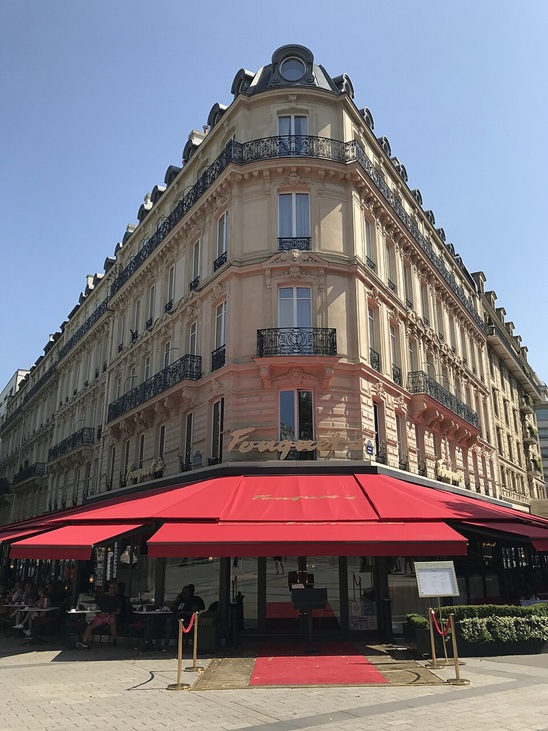
Above: Le Fouquet's in 2019. Opened in 1898, this luxurious restaurant occupies a triangular lot at 99 Champs-Élysées.
Source: "Fouquet's Paris - brasserie et hotel de luxe sur les Champs-Élysées" (Wikimedia Commons). Photo credit: Sophiecharra1, July 24, 2019.

19. Scrapbook: 1945-1947
With the end of the war, France began the arduous process of recovery from the devastation inflicted by the occupation and by military action as the Allies fought their way toward Germany. The recovery was hampered by France's effort to reassert control over her former colonies which drew her into two long, bloody wars – in Viet Nam from 1946 to 1954 and in Algeria from 1954 to 1960.
Rachel's immediate postwar years were dominated by the emotional crisis that had consumed her since her suicide attempt in 1932. Paule Corday observed Rachel's fierce determination to take revenge on people she saw as her persecutors, an obsession that brought her to the brink of suicide a second time (page 45). The obsession persisted as Rachel sought to expose their villainy in two stage performances and ultimately in a volume of "explosive" memoirs (page 48),
But apart from these outbursts of emotional drama, Rachel's public career rolled on much as it always had. Whether on horseback or driving a cab – or even on stage – Rachel remained a national and even an international celebrity, always willing to talk to reporters and always good for entertaining newspaper copy.
We can therefore follow her public career simply by compiling a scrapbook of newspaper and magazine clippings.
Scrapbook: 1945 At war's end Rachel had serious qualms about being able to continue her cab driving career. The German occupation had starved motor transport of gasoline, making the obsolete horse-cab viable once again. But now things had changed. Despite continued shortages taxicabs and private cars began to reappear on the streets of Paris. This did not bode well for the horse cab.
As she told Paule Corday, "Fiacres will soon disappear. I'm putting mine in the stable so that I can realize my wishes.... I want my former power, to go on stage without someone throwing 'the story of Monte Carlo' in my face."
However, Rachel's ideas of employment options were a bit fanciful.
"I have asked for permission to start a cabaret. I have also thought of taking over Luna Park in order to create a circle...."
Luna Park (left) was an large amusement park that operated in Paris from 1909 to 1931. It boasted a "scenic railway" roller coaster, a "water chute" and a dance hall among other attractions. Although the park closed in 1931 some of the rides may have continued operating into the 1940s. The site is now occupied by the Hyatt Regency Paris Étoile Hotel and a convention centre complex.
What Rachel thought of as a "circle" was probably an ongoing series of shows like her "gala" of 1944. And Rachel had another dream:
"If I had a lot of money I would create a rolling bar in a caravan. I would need permission to park at seaside towns.... When I was small my father would say every day 'soon, we'll sell the house and buy a caravan.' I never could do what he really wanted. Because a vagabond life is in the blood."
Paule Corday was skeptical about Rachel's plans:
"If you begin working seriously again, that would do you a lot of good.... But be reasonable, working in order to earn a living."
Rachel remained dubious about how long the horse cab business would last, but with no practical alternatives at hand she decided to continue with it for the time being.
In fact, Rachel was parked in front of a fashionable restaurant (left) with a customer waiting when Paule Corday approached her for an interview:
"On the Champs Elysees, in front of Le Fouquet's, a fiacre is parked. The driver's seat is empty.
"An old lady bedecked with cock feathers, bejeweled with diamonds, loaded down, looks about her in agitation, shouting to the right, questioning to the left.
"'Driver? Driver, where are you? Where is the driver?'
"She is on the point of hailing a velo-taxi and leaving me alone beside the horse when the driver appears.
"It's not a man but a tall beautiful woman who wears fine leather boots and velour trousers: Rachel Dorange." Meanwhile, with the lifting of wartime travel restrictions Rachel was able to resume her winter trips to the south of France. The difference was that she now travelled in her cab instead of on horseback or on foot.
Rachel told Paule Corday that "When I feel a fit of depression arising in me I harness the horse to the fiacre and... hit the road. Actually, I've come back from Nice."
There seems to be no press coverage of this 1945 trip. The most detailed account comes from her 1951 Qui? Detective magazine interview which refers to "that heroic-picaresque Paris-Cannes journey of 1945, by horse-drawn carriage, to sell postcards for the benefit of the social welfare projects of the 2nd Armoured Division (proceeds for the cause: 24,000 francs; for the coachwoman: a week of complications and trouble with the police and the Security Services in Marseille)."
The French 2nd Armoured Division (Deuxième Division Blindée, nicknamed 2e DB) was the Allied unit that liberated Paris in 1944. In September, 1945 a 2e DB Association was created for the purpose of providing assistance to veterans of the Division and their families.
However, once again the evidence for Rachel's trip to Nice and/or Cannes, for her postcard sales and for her hassles with the authorities in Marseille rests on her own testimony.