




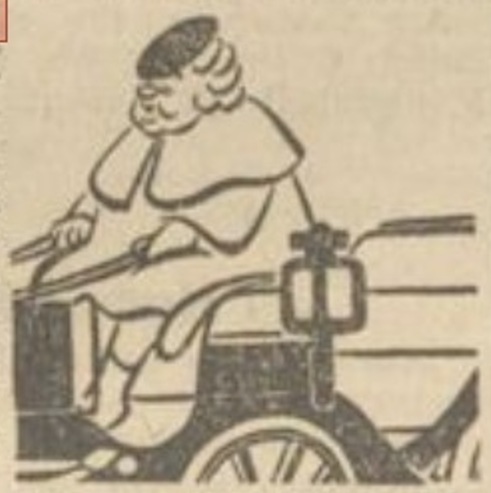
Above: Cartoon illustrating article. "She is not beautiful and is already over fifty...."
Source: Die Weltpresse, "Mademoiselle Rachel Dorange. eine Pariser Spezialität, will 'umsatteln'" ("Mademoiselle Rachel Dorange, a Parisian specialty, wants to 'change tack'"), August 17, 1946, p. 4. Austrian National Library (via ANNO).
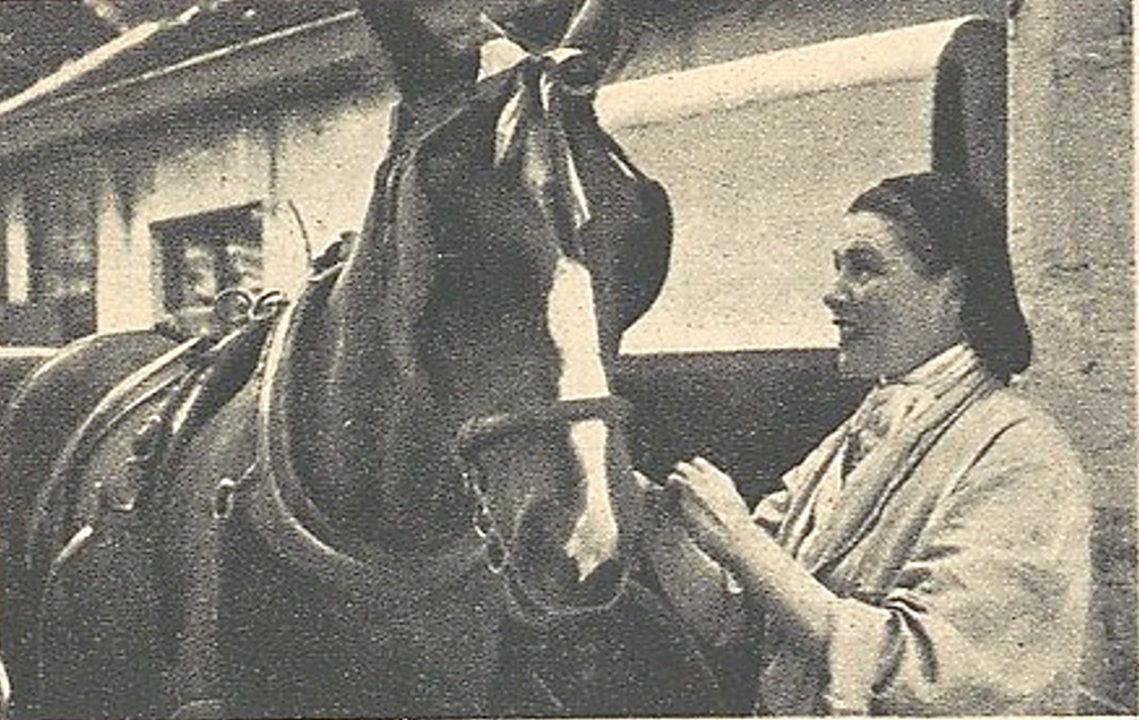
Above: "Rachel Dorange is a cab driver of rare gentleness."
Source: V, "Femme du monde la nuit, cochère le jour" ("Socialite by night, cochère by day"), August 4, 1946, p. 4. National Library of Frence (via Gallica).
19. Scrapbook: 1945-1947 (continued)
Scrapbook: 1946, continued In August, 1946 the Vienna newspaper Die Weltpresse published a less than complimentary item announcing Rachel's supposed intention of giving up cab driving and illustrated it with a cartoon of a frumpy-looking cochère (left).
"She is not beautiful and is already over fifty, but she is original and part of the Parisian cityscape: Mademoiselle Rachel Dorange drives her old-fashioned, elegant horse-drawn carriage through the streets of Paris, transporting her passengers. During the war, business was booming because cars were almost completely unavailable in those years, but now competition from gasoline-powered vehicles is reappearing, so Rachel Dorange has decided to open a café. Or to go on stage and disappear from the cityscape.
"It's a shame, really, because she is a delightful figure in her tattered riding breeches and little felt hat on her flaming red hair, which once turned the heads of many a man, as evidenced by yellowed love letters rumored to be from certain diplomats who did not shy away from 'diplomatic advances.'" This little article demonstrates a tendency for reporters not only to be careless with facts but also to invent versions of Rachel that accorded with personal misconceptions or even editorial policy.
In Primo de Rivera's Spain she was presented as a devout Catholic who "disdains modern customs.... and proclaims her Catholic ideals with great fervor" (page 42). In Eastern Europe, in several newspaper accounts, she was a Ukrainian Jew masquerading as a Frenchwoman (pages 26 and 29).
In this case there is plenty of photographic evidence to refute the frump image and especially the idea that Rachel would ever be caught wearing "tattered riding breeches." Rachel was scrupulously careful about how she appeared in photographs, to the point of pulling a gun on a photographer who wanted to take a picture of her walking Le Huppé (page 19).
A very different portrayal of Rachel also appeared in August, 1946, in the magazine V. The article opens with a description of Rachel dropping a customer off at Le Fouquet's, the restaurant in the picture on page 58:
"A horse-drawn carriage pulls up in front of Fouquet's on the Champs-Élysées. An elegant woman steps out. A few onlookers stop to watch as she rummages through her purse. 'See you tonight,' she says, paying the 500 francs for the ride. 'Right, my dear,' replies the coachwoman as she pockets the bills. 'Thank you, and see you tonight.'
"No one looks at the woman entering the restaurant. All eyes are turned toward the seat of the carriage occupied by a woman. A very beautiful woman. A pearl-gray bowler hat, a yellow scarf, a well-fitted black jacket, beige riding breeches, and boots.
"'Rachel Dorange," a passerby says to his neighbor.'
"It's definitely her. The most beautiful and famous horsewoman of the pre-war era. Her equestrian exploits are not forgotten. There she is, a coachwoman. All because of an unfortunate love story. This afternoon, like every day, she harnessed her horse Coco to a 45-year-old carriage and set off 'on the prowl.'
"But tonight, she's invited to the same high-society party as her client from Fouquet's. Because at night, Rachel undergoes a transformation. She no longer drives a cab. She has someone drive her. Her dresses come from the top fashion houses. She drinks champagne. She frequents trendy nightclubs in elegant company. A Cinderella existence. But without Prince Charming. Or rather, because of a Prince Charming... who was a dentist." This article, published almost three months before Rachel's suicidal breakdown on stage at the Théâtre de l'Étoile, contains yet another version of her ill-starred love affair. This version takes place not in 1932 but at the outbreak of World War II, and her career as a music hall star is replaced by another vocation:
"At that time, she was not only the undisputed queen of the horsewomen but also the owner of the most chic riding academy in Paris. She gave it all up for her dentist. He repaid her by leaving her."
Rachel also confided her fear that the day of the horse cab was coming to an end. What would she do then?
"'I'll probably open a cabaret. I've applied for a license. And if I succeed, I'll have a bar trailer built. I'll hitch Coco to it, and we'll hit the road again.'"