




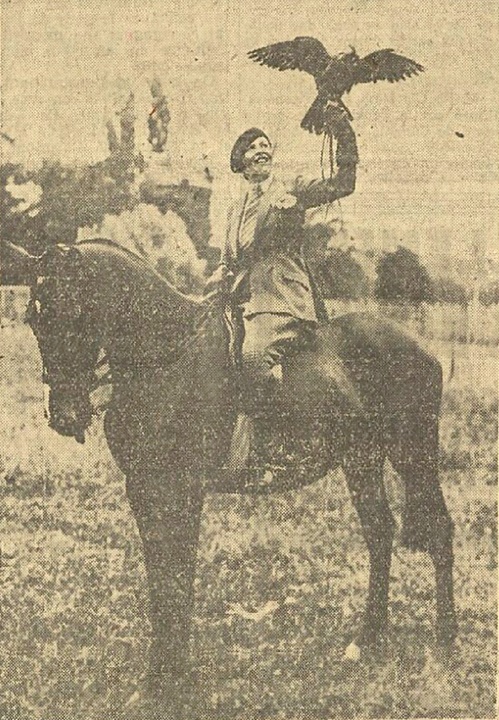
Above: Rachel with a falcon. Photo illustrating her interview with Yves Rameau.
Source: "Le Destin Bouleversant de Rachel Dorange" ("The Tumultuous Destiny of Rachel Dorange"), Liberté Soir November 19, 1946, p. 1. National Library of France (via Gallica).
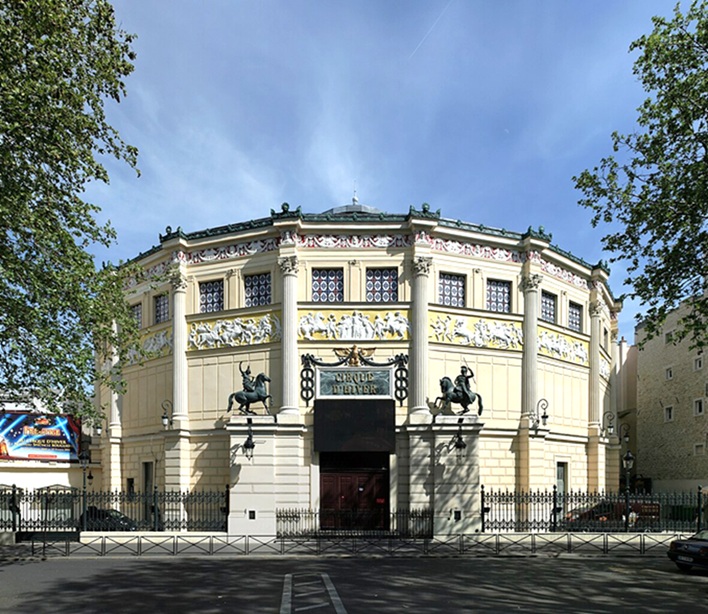
Above: The Cirque d'Hiver (Winter Circus) in 2011 (detail). This is the oldest existing circus building in the world, and the Cirque d'Hiver (established in 1852) is the oldest circus still in operation. See Circopedia.
Source: Wikimedia Commons. Photo credit: Coyau (own work).

13. Heartbreak, 1932 (continued)
Rachel's tale of love, betrayal and heartbreak blossomed dramatically between her interview with Paule Corday in October, 1945 and her interview with Yves Rameau in November, 1946. Among other details the faithless dentist evolved into a faithless medical student.
In the Rameau version the fatal romance began in 1925 during her stage career at the Empire Music Hall (page 5).
"All of Paris came to applaud her and at the end of her number the stage was transformed into a veritable flower garden.
"And among the heaps of enormous and costly bouquets that she was offered she noticed daily an anonymous little bouquet of violets. Over six months she found in her dressing room this humble and touching tribute and despite all her efforts she could not discover the origin of such a delicate and impressive gesture.
"One day, nevertheless, a young medical student appeared at her dressing room. He held in his hand a bouquet of violets.
"This was the beginning of a passionate love affair and the tragedy that would upset her life.
"Son of one of the richest families in France, he lived in Monaco. We will hide his true identity and call him Maurice. He persuaded Rachel to abandon her triumphal career and follow him to Monte Carlo.
"But alas! The idyll was only of short duration. Forced by his family to leave his mistress to marry and immensely wealthy young woman belonging to the same class as he. Maurice gave in but frankly disclosed his parents' plans to Rachel and asked her not to leave him after his marriage which for him was no more than a mere formality....
"Rachel refused to play this unworthy game and in her immense sadness had only one idea – to forget by travelling the road with her horse. It was thus that she began her audacious journeys on horseback, across the whole of Europe, which made her famous throughout the entire world." There followed Rachel's three celebrated long-distance rides to Berlin in 1927, Bucharest in 1928 and Barcelona in 1929, but these achievements failed to cure her of Maurice.
"On the point of signing a contract for a music hall and circus tour across Europe, she received a letter from Maurice begging her to rejoin him immediately in Monte Carlo.
"In spite of the objections of her friends from whom she sought advice and who told her she had no right to abandon an extremely brilliant career to rejoin a man who was married with two children and who had treated her shamefully two years earlier, she passed over the objections following her heart instead of reason. Then started a terrible ordeal which still tortures her today.
"Once she arrived in Monte Carlo, Maurice left his home, lived several months with her and in order to avoid scandal abandoned her again while asking her to remain in Monte Carlo.
"Once again heartbroken by what she considered cowardice she accepted the first engagement offered by the Cirque d'Hiver. Then having no desire exept to leave Europe and put an ocean between her and an impossible love, she resolved to move to the Argentine where she hoped to undertake raising polo horses.
"Everything was ready, but once again Maurice intervened, promising her everything if she finally gave up her equestrian and circus exploits. He promised to buy her a big family apartment where she could live sufficiently and independently in Monte Carlo.
"She accepted. Several months later Maurice changed his mind after which Rachel began drinking and gambling like a madwoman at the Casino losing her last sous and last jewellery." Oddly, considering that Rachel was a constant focus of interest for journalists, no hint of this scandalous public behaviour reached the newspapers.
"One morning her neighbours heard groans coming from her apartment; they alerted the concierge who, hearing no response to repeated ringing of the doorbell, opened the door by means of a locksmith in the presence of a police officer.
"All the newspapers reported her attempted suicide, but at the hospital, thanks to the influence of Maurice's family, she was kept in complete isolation and could not even receive visits from her most intimate friends who worried about her state of health.
"When she was better, she was told that Maurice's wife had arrived in company with a nun. 'You should be happy that Maurice's wife has come to see a woman like you.' A terrible relapse followed this brutal and pitiless intervention.
"When, finally she left the hospital, terribly aged and extremely feeble, she learned that in the meantime someone had sold her furniture and everything she possessed to pay her creditors." From Rachel's telling, it sounds like she was incarcerated in the hospital for months and emerged a physical and emotional wreck. No doubt that is what it felt like, but in fact, according to press reports, she was in hospital for at most two weeks and possibly as little as a week or less. Moreover, she bounced back quickly and soon after returning to Paris she was preparing to resume her circus performances.
"Desperately, she applied to the Casino administration who handed her a paper in which it was stipulated that, in lieu of paying 20,000 francs (about 800 U.S. dollars at the time), she agreed never to return to Monte Carlo. Seeing no immediate alternative, she agreed and left Monte Carlo the same evening.
"The four years that followed passed like a bad dream.... It was not until 1937 that she renewed her equestrian activities at the Cirque d'Hiver.... " Far from not renewing her equestrian activities until 1937, Rachel was back in the saddle at the Cirque d'Hiver in January, 1933. Then, despite having lost (as she claimed) all of her money, jewellery and furniture she acquired another horse and undertook a ride to Monte Carlo in February, 1933, even though she was supposedly banned from there.
The trip had to be cut short at Charmoy, 157 kilometers from Paris, when her horse fell ill but she continued on to Monte Carlo by train (page 49).
Again, in August of 1935 she set off on a horseback ride to Rome with two horses, but had to give up after almost 1,000 kilometers when she was forbidden entry into Italy unless she paid a 5,000 franc fee (page 50). On this trip she avoided passing through Monaco "from which she was expelled following her suicide attempt two years ago, as Monegasque laws are very strict on this point."
"She then demonstrated that she was equally capable of accomplishing long journeys on foot. In 1938, indeed, she travelled the route from Paris to Nice via Marseille, nearly 1,200 kilometers while selling cards in aid of unemployed intellectuals (page 52).
"She could not resist returning to Monte Carlo, perhaps influenced by the secret wish to see Maurice, even from a distance. A few days after her arrival a police officer woke her up at daybreak, brought her to a police station on orders from the Monacan chief of police on a charge of extortion brought by Maurice.
"After two hours of intense interrogation, during which she did not cease to proclaim her innocence she was released and escorted to the border of the miniature principality." During Rachel's walk from Paris to Nice in February-March, 1938, she was actually arrested for vagrancy at Ponthierry, about 50 kilometers south of Paris, and jailed overnight. She was released the next morning with apologies, but not before she lodged a formal complaint against the police, followed by a lawsuit and a public airing of her grievance in front of a theatre audience.
Rachel's progress on the walk was reported in several newspapers and she was greeted by local citizens at each of the 30 overnight stops she made en route. With so much attention it would have been hard for her to sneak unnoticed over to Monte Carlo, 21 kilometers away from Nice.
Moreover, if she had been arrested and interrogated by the Monacan police surely this outrage would have made the news. Considering Rachel's reaction to the Ponthierry police it is hard to imagine her remaining silent about it. Once again we are left with nothing but Rachel's own testimony for evidence.
"But the file of slanderous accusations followed her everywhere and wherever she went she faced more interrogations by the French police at the request of the Monacan authorities. It became a veritable obsession to prove her innocence and expose the existance of an active conspiracy. She was on the point of insanity when the Monacan chief of police committed suicide for mysterious reasons. As though touched by a magic wand, from that moment on she was freed of worry."
Even so, she was still not free of Maurice.
"Meanwhile, a few months ago, I saw Maurice again in the street by accident. He hardly recognized me, who he had insulted. I was so thunderstruck that it was only at that moment, for the first time, that I recognized the folly of my love. Disgusted with myself, my life made no sense. I decided to end it.
"But I did not wish that he who had pushed me to this deed by cowardice would continue to play the gentleman while I left the world, regarded as an adventuress or even a blackmailer.
"For that reason I wanted to expose all the evidence at the Théâtre d'Etoile."